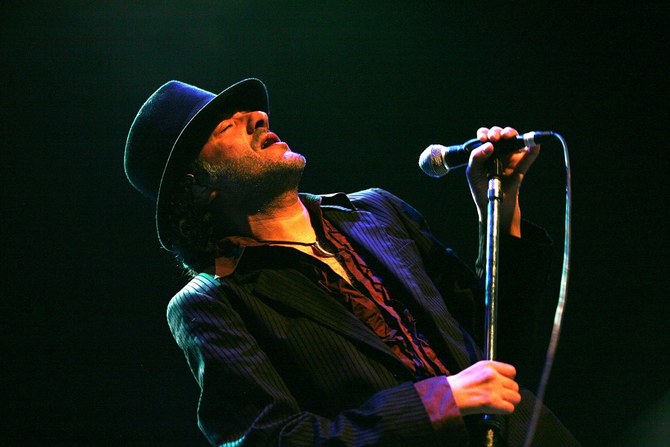

MARBELLA: The legendary Algerian singer Rachid Taha — aka ‘The King of Rock & Rai’ and ‘The Rebel Voice of a Generation’ — died five years ago this week. Known for both his effortlessly cool look — black curls, fedora, cigarettes — and his raspy vocals, Taha hit the peak of his popularity in the 1990s, thanks to versions of timeless Arabic hits “Ya Rayah” and “Abdel Kader” (the latter with fellow Algerian singers — and fellow rai masters — Cheb Khaled and Faudel).
One of Taha’s longtime collaborators was English guitarist and producer Steve Hillage, who first met Taha back in 1982. At the time, Taha — who emigrated with his family to France in the late 1960s — was frontman of the Arab-Franco rock band Carte de Séjour (‘residence permit’), and Hillage received a call, asking if he would produce their debut album.

Taha's friend and collaborator Steve Hillage. (Getty Images)
Hillage headed to the band’s base in Lyon. “I was taken to a small show they were doing and I walked into the dressing room, and there was Rachid,” Hillage tells Arab News. “He was playing some really interesting chaabi music on a cassette, and he said, ‘Bonjour Steve! Listen to this (music), it’s pure blues.’ That was the first thing we discussed. We became good friends from that moment.”
One of the band’s most popular tracks was an ironic remake of the 1943 patriotic anthem “Douce France,” which they released at a time when anti-Arab sentiments were on the rise in 1980s France.
“It was a great metaphor to have this rough-looking Algerian guy singing, ‘Douce France. Cher pays de mon enfance’ (Sweet France. Dear land of my childhood). That was quite a political statement,” Hillage notes. “In fact, some French politicians were helping to promote it. They were giving copies of it out in the French parliament.”
Carte de Séjour disbanded in 1990, but Taha went on to enjoy a hugely successful solo career. His music was a fascinating mélange of rock, punk, funk, blues, and chaabi music.
“I think he ultimately wanted to say that all our cultures are linked — no barriers,” says Hillage. “He was very much an independent thinker. He didn’t have one political line. He quite liked being controversial. He had a lot of problems in the Arab world. People would say: ‘He can’t really sing. How dare he do a reprise of (iconic Syrian-Egyptian singer) Farid Al-Atrash? It’s an insult.’

Taha (center) with his band Carte du Sejour in 1987. (Getty Images)
“But Bob Dylan had the same problem. People said that he couldn’t sing, but he had something really engaging and powerful in the way he delivered his vocals, and Rachid was the same,” Hillage continues. “He wasn’t necessarily recognized as one of France’s great rock singers by the French, but I’m telling you he was one of France’s great rock singers, if not the greatest. In a way, he was too rock for the Arabs and too Arab for the French.” That has changed over time; Taha’s talent is now celebrated in the Arab world and in Europe. In October, a tribute show featuring Taha’s music will take place in France’s Alsace region.
Often described as an activist, Taha didn’t shy away from writing provocative lyrics on political oppression. One powerful example is his 2000 song “Barra Barra” (Out Out), on which Hillage played guitar, and in which Taha sings of “ruin and war,” and blood flowing while “people remain silent.”
But the Nineties were truly Taha’s golden years. His signature track “Ya Rayah” (O Traveller) — based on an immigrant song by late Algerian singer Dahmane El-Harrachi — was released in 1993 with a fresher sound, impacting Arab communities everywhere. According to Hillage, it surprisingly almost didn’t make the cut.
“The record company didn’t like it. They thought it was too Maghrebi and not pop music enough,” he says. But the song was being played in restaurants, clubs and was widely talked about. It was re-released in 1997.
Another milestone for Taha was his live concert (later released as an album), “1, 2, 3 Soleils” in 1998 with Cheb Khaled and Faudel at one of Paris’ largest venues, the Bercy Arena. It was a huge success and is a significant event in French music history. Hillage, the concert’s musical director, says it was “the most amazing two hours of my life.”
The last time Hillage saw Taha was just 10 days prior to his death, aged 59, on Sept. 12, 2018. The two of them were enthusiastically discussing putting on a live show in Lyon.
“He was just snatched away all of a sudden. When he died, I lost a very good friend,” says Hillage. “I still miss him.”