

Main Pakistan-Afghan border crossing closed for second day after clashes

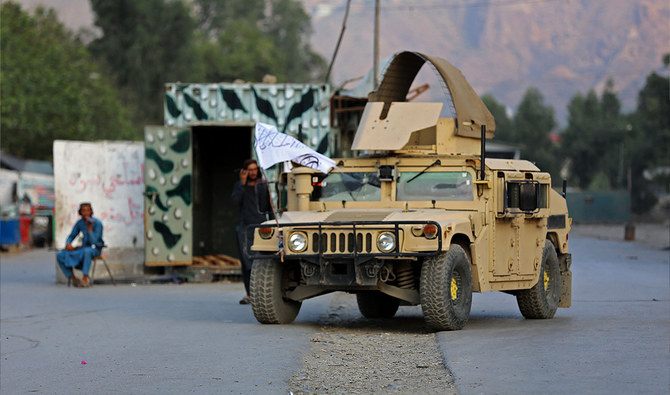
A humvee (HMMWV) vehicle is seen near the closed gates of Torkham border crossing between Afghanistan and Pakistan in Afghanistan's eastern Nangarhar province on September 6, 2023. (AFP)
Short Url
Updated 07 September 2023
Follow

Main Pakistan-Afghan border crossing closed for second day after clashes

  • Torkham border is the main point of transit for travelers and goods between Pakistan and landlocked Afghanistan
  • Business community says hundreds of trucks laden with fruit, vegetables and other goods are stuck due to the closure

PESHAWAR: Pakistan’s main border crossing with Afghanistan was closed for a second day on Thursday, leading to a build-up of trucks laden with goods, after clashes between security forces from the two countries.

The busy border crossing had closed on Wednesday after Pakistani and Afghan Taliban forces started firing at each other, according to local officials.

Abdul Basir Zabuli, a spokesman for the Taliban-led police in Afghanistan’s eastern Nangarhar province, where the crossing lies, said that authorities from both countries were trying to determine the reason for the clash.

The Torkham border point is the main point of transit for travelers and goods between Pakistan and landlocked Afghanistan.

Ziaul Haq Sarhadi, director of the Pakistan-Afghanistan Joint Chamber of Commerce and Industry, said hundreds of trucks laden with fruit, vegetables and other goods were stuck due to the closure.

“The traders are suffering heavy losses after the border in Torkham was closed on Wednesday following a firing incident there,” he told Reuters.

The entire flow of trade had been affected and loading of goods in the southern port of Karachi had been disrupted.

Disputes linked to the 2,600 km (1,615 mile) border have been a bone of contention between the neighbors for decades.

In a separate incident, Pakistan’s military said four soldiers had been killed in clashes in Chitral district, near the Afghan border, on Wednesday and that 12 militants had died.

The Pakistani Taliban, or Tehreek-e-Taliban Pakistan (TTP), said in a statement its fighters had fought against security forces in the area for the past two days.

The Pakistani military echoed its demands of Afghan Taliban authorities to stop the use of its territory for militant attacks after the clashes in Chitral, a mountainous area near the Afghan border popular with Pakistani and foreign tourists.

The Afghan Taliban have denied their territory is being used by militants, saying security concerns within its neighbor are an internal issue for Pakistani authorities.

Attacks claimed by the TTP have grown in Pakistan in recent years. The group has pledged allegiance to the Afghan Taliban but is not directly a part of it.


Pakistan military says 12 soldiers killed in border fighting as Kabul calls for dialogue

Updated 7 sec ago
Follow

Pakistan military says 12 soldiers killed in border fighting as Kabul calls for dialogue

  • Military says 274 Afghan fighters killed, over 400 injured in ongoing operation
  • Afghan authorities earlier said 55 Pakistani soldiers killed in retaliatory strikes

ISLAMABAD: Pakistan’s military said on Friday 12 soldiers had been killed in cross-border fighting with Afghan forces, as it detailed the scale of an ongoing border operation and accused the Kabul government of coordinating with militant groups targeting Pakistan.

The announcement followed days of escalating hostilities triggered by Pakistani airstrikes earlier this week on what Islamabad said were Tehreek-e-Taliban Pakistan (TTP) and Daesh militant camps inside Afghanistan. Since then, both governments have reported retaliatory operations and issued conflicting casualty figures, marking the most serious deterioration in relations between the neighbors in recent months.

The 2,600-kilometer (1,600-mile) shared frontier between the two nations, a key trade and transit corridor, has remained closed to trade and movement since October 2025 amid recurring tensions.

Lt. Gen. Ahmed Sharif Chaudhry, director general of Inter-Services Public Relations (ISPR), told a news conference in Rawalpindi that Pakistani forces had repelled coordinated attacks at 53 locations along the border and responded under what he described as Operation Ghazab lil-Haq.

“While safeguarding Pakistan’s honor and territorial integrity, 12 brave soldiers have embraced martyrdom in the operation so far, while 27 have been injured and one soldier is missing in action,” he said.

Chaudhry said Pakistan had destroyed 274 Taliban posts and positions and more than 400 fighters were injured, describing those figures as conservative estimates. He added that 73 posts were completely destroyed along the border and 18 had been captured.

He said Afghan Taliban forces had launched physical raids “in collusion and in support of an internationally declared terrorist organization” and accused the Taliban administration of acting in coordination with militant groups.

“The Afghan Taliban regime is the master proxy of these terrorist proxies which are operating from Afghanistan,” he said.

Kabul has repeatedly said it does not allow militants to operate in its territory. 

Chaudhry said Pakistan had targeted 22 locations across the border, including in Kabul, Kandahar, Paktia, Nangarhar, Khost and Paktika.

“All targets were selected with great care based on intelligence. They were military objectives, and utmost care was taken to avoid any civilian collateral damage,” he said.

He said the Taliban authorities faced a choice.

“Either they choose terrorists and terrorism or side with Pakistan,” he said.

KABUL CALLS FOR DIALOGUE 

Separately on Friday afternoon, Afghan Taliban spokesperson Zabihullah Mujahid called for talks to resolve the crisis.

“We have always emphasized peaceful resolution, and now too we want the issue to be resolved through dialogue,” he said.

In a detailed statement earlier in the day, Afghanistan’s Ministry of National Defense said it had carried out airstrikes inside Pakistan in response to what it described as Pakistani “aerial incursions” into Kabul, Kandahar and Paktia.

Afghan officials said 55 Pakistani soldiers were killed and that several posts were captured, claims denied by Islamabad.

None of the casualty figures or battlefield claims from either side could be independently verified.

Pakistan’s Information Minister Attaullah Tarar earlier said militants had attempted to launch drones inside Pakistani territory.

“Fitna al khawarij terrorists have attempted to launch small drones in Abbotabad, Swabi and Nowshera. Anti Drone Systems have brought down all the drones. No damage to life,” Tarar said.

“The incidents have again exposed direct linkages between Afghan Taliban Regime and Terrorism in Pakistan.”

Separately, Prime Minister Shehbaz Sharif on Friday visited General Headquarters (GHQ) in Rawalpindi, where he was briefed by the military leadership on the evolving situation. 

According to a statement from the Prime Minister’s Office, Sharif said there would be “zero tolerance” toward what he described as collusion between the Afghan Taliban regime and militant elements.

“Pakistan knows very well how to defend itself against any aggression,” the statement quoted him as saying, adding that the armed forces were ready to safeguard the country.
Regional concern

Cross-border violence has intensified in recent weeks, with Pakistan blaming a surge in suicide bombings and militant attacks on insurgents it says are based in Afghanistan. Kabul denies providing safe havens and says Pakistan’s security challenges are an internal matter.

The latest clashes mark the third major escalation between the neighbors in less than a year. Similar strikes last year triggered weeklong fighting before Qatar, Türkiye and other regional actors mediated a ceasefire in October.

Several countries, including China, Russia, Saudi Arabia and Iran, have expressed concern and urged restraint.

Operations on both sides were ongoing as of Friday evening.