French president wants Russian flag banned at Paris Olympics, citing Moscow’s ‘war crimes’

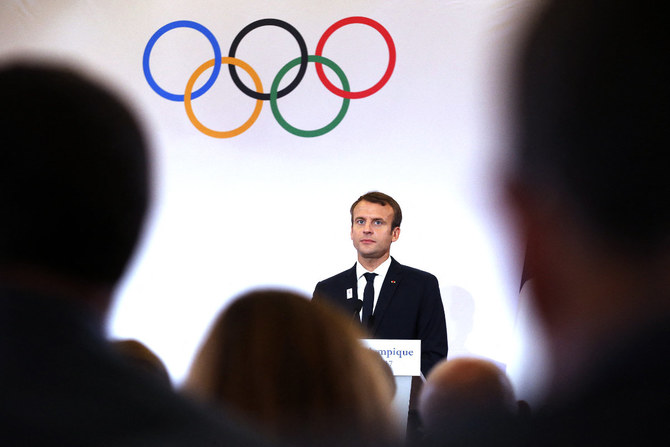
French President Emmanuel Macron says he has no objection to Russian athletes taking part in the 2024 Paris Olympics so long as they have not actively supported Russia's war against Ukraine. (AFP/File photo)
Short Url
Updated 07 September 2023
Follow

French president wants Russian flag banned at Paris Olympics, citing Moscow’s ‘war crimes’

  • “There is no place for Russia as a country at a time when it has committed war crimes, when it has deported children,” says Macron
  • But he said the IOC has to "differentiate between Russian athletes who are accomplices and those who are victims of the regime"

PARIS: French president Emmanuel Macron insisted Wednesday that “the Russian flag cannot be at the Paris Olympic Games... at a time when Russia is committing war crimes.”

Quizzed on the possible presence of Russian athletes in Paris competing as neutrals, Macron added: “I hope that this is a decision of conscience in the Olympic world. It is not the host state which must decide what the International Olympic Committee (IOC) should do.”
He added to sports daily L’Equipe: “I have total confidence in Thomas Bach (the IOC president).”
Athletes from Russia and Belarus have faced sanctions from a multitude of sports since Russia invaded Ukraine in February of 2022.
Despite the ongoing war, the IOC has recommended allowing athletes from Russia and Moscow ally Belarus to compete as individual neutrals in international competitions.
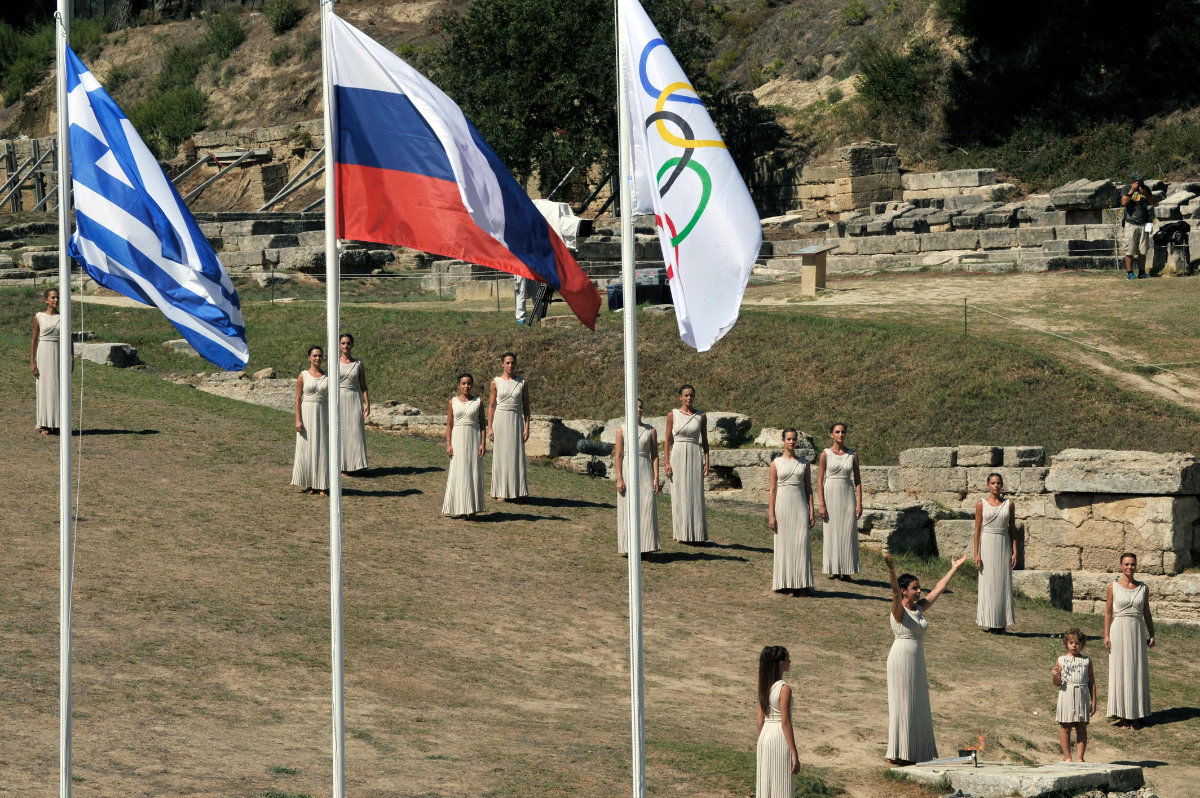


The Russian flag (center) flutters along with the Greek (left) and Olympic flags on September 29, 2013 during the lighting ceremony in ancient Olympia, the sanctuary where the Olympic Games were born in 776 BC. (AFP/File Photo)

Those allowed to reintegrate into world sport must satisfy certain conditions.
These include competing under a neutral flag and proving that they have not actively supported the war in Ukraine.
“Obviously, there cannot be the Russian flag at the Paris Games, I think there is consensus,” Macron added in his interview with L’Equipe.
“There is no place for Russia as a country at a time when it has committed war crimes, when it has deported children.”
“The real question that the Olympic world will have to decide is what place to give to these Russian athletes who sometimes have prepared for a lifetime, and can also be the victims of this regime.”
However, Macron pondered how to differentiate between those Russian athletes who are accomplices and those who are victims of the regime.
“This is the real question,” he added.
The IOC must, he said, make a decision that is fair and understood by Ukrainians.
“This is the balancing act that we will have to carry out.”


India, Arab League target $500bn in trade by 2030

Updated 6 sec ago
Follow

India, Arab League target $500bn in trade by 2030

  • It was the first such gathering of India–Arab FMs since the forum’s inauguration in 2016
  • India and Arab states agree to link their startup ecosystems, cooperate in the space sector

NEW DELHI: India and the Arab League have committed to doubling bilateral trade to $500 billion by 2030, as their top diplomats met in New Delhi for the India–Arab Foreign Ministers’ Meeting. 

The foreign ministers’ forum is the highest mechanism guiding India’s partnership with the Arab world. It was established in March 2002, with an agreement to institutionalize dialogue between India and the League of Arab States, a regional bloc of 22 Arab countries from the Middle East and North Africa.

The New Delhi meeting on Saturday was the first gathering in a decade, following the inaugural forum in Bahrain in 2016.

India’s Foreign Minister S. Jaishankar said in his opening remarks that the forum was taking place amid a transformation in the global order.

“Nowhere is this more apparent than in West Asia or the Middle East, where the landscape itself has undergone a dramatic change in the last year,” he said. “This obviously impacts all of us, and India as a proximate region. To a considerable degree, its implications are relevant for India’s relationship with Arab nations as well.”

Jaishankar and his UAE counterpart co-chaired the talks, which aimed at producing a cooperation agenda for 2026-28.

“It currently covers energy, environment, agriculture, tourism, human resource development, culture and education, amongst others,” Jaishankar said.

“India looks forward to more contemporary dimensions of cooperation being included, such as digital, space, start-ups, innovation, etc.”

According to the “executive program” released by India’s Ministry of External Affairs, the roadmap agreed by India and the League outlined their planned collaboration, which included the target “to double trade between India and LAS to US$500 billion by 2030, from the current trade of US$240 billion.”

Under the roadmap, they also agreed to link their startup ecosystems by facilitating market access, joint projects, and investment opportunities — especially health tech, fintech, agritech, and green technologies — and strengthen cooperation in space with the establishment of an India–Arab Space Cooperation Working Group, of which the first meeting is scheduled for next year.

Over the past few years, there has been a growing momentum in Indo-Arab relations focused on economic, business, trade and investment ties between the regions that have some of the world’s youngest demographics, resulting in a “commonality of circumstances, visions and goals,” according to Muddassir Quamar, associate professor at the School of International Studies, Jawaharlal Nehru University.

“The focus of the summit meeting was on capitalizing on the economic opportunities … including in the field of energy security, sustainability, renewables, food and water security, environmental security, trade, investments, entrepreneurship, start-ups, technological innovations, educational cooperation, cultural cooperation, youth engagement, etc.,” Quamar told Arab News.

“A number of critical decisions have been taken for furthering future cooperation in this regard. In terms of opportunities, there is immense potential.”