

Saudi culture, heritage showcased at Abu Dhabi hunting exhibition

1 / 3
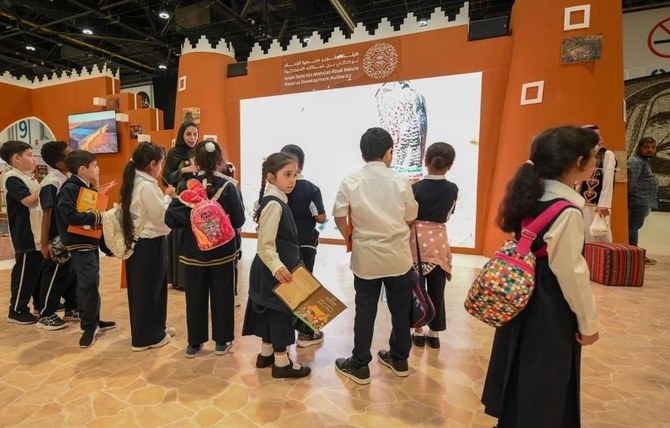
The Imam Turki bin Abdullah Royal Reserve pavilion at the Abu Dhabi Hunting and Equestrian Exhibition is proving popular with young visitors. (SPA)
2 / 3
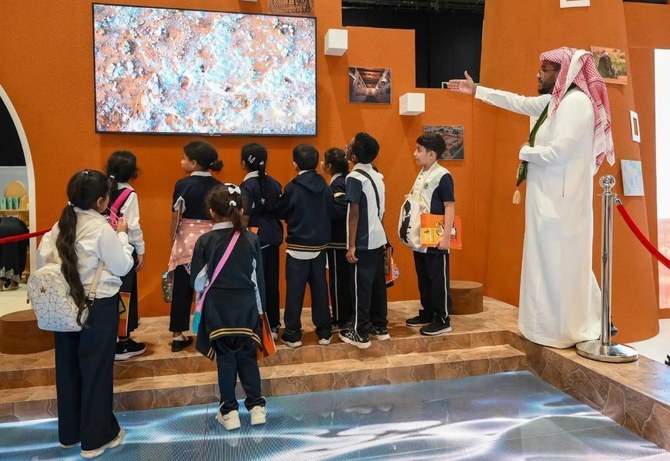
The pavilion is showcasing the reserve’s rich heritage, distinctive environmental features, attractive landscape and abundant wildlife. (SPA)
3 / 3
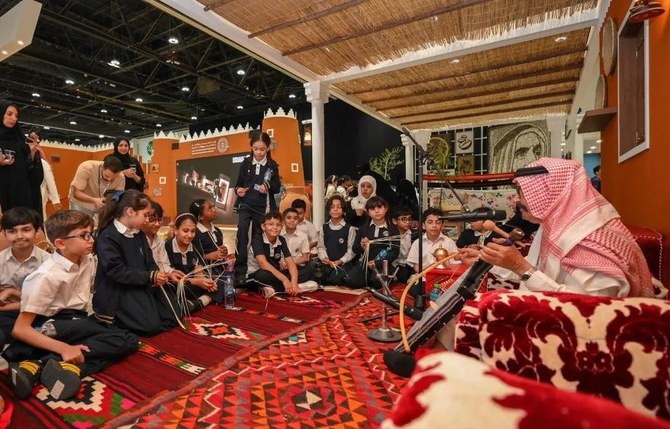
The Imam Turki bin Abdullah Royal Reserve pavilion is showcasing traditional Saudi crafts. (SPA)
Short Url
Updated 06 September 2023
Follow

Saudi culture, heritage showcased at Abu Dhabi hunting exhibition

  • Imam Turki bin Abdullah Royal Reserve Development Authority is representing the Kingdom at the Abu Dhabi International Hunting and Equestrian Exhibition
  • Visitors, particularly children, have been flocking to the reserve’s pavilion to find out more about the nature reserve and Saudi culture

RIYADH: Saudi heritage and traditional handicrafts are being showcased at a major expo taking place in the UAE.

The Imam Turki bin Abdullah Royal Reserve Development Authority is representing the Kingdom at the Abu Dhabi International Hunting and Equestrian Exhibition.

Organized by the Emirates Falconers’ Club under the title “Sustainability and Heritage — A Reborn Aspiration,” the event will run at the Abu Dhabi National Exhibition Center until Sept. 8.

Visitors, particularly children, have been flocking to the reserve’s pavilion to find out more about the nature reserve and Saudi culture.

With a focus on the past, present, and future, pavilion staff have been highlighting the economic and community activities associated with the region’s arts and crafts.

Details about the wildlife and landscapes of the reserve are also on offer along with information on historic landmarks, tourism attractions, and crafts such as sewing, knitting, embroidery, spinning, drawing, and sculpture.

Modern visual aids and traditional majlis provide an immersive experience and the exhibition features honey produced within the reserve.

The authority aims to support environmental, cultural, and heritage values, while promoting traditional sports and sustainable hunting.

Visitors can explore Al-Ashar Pool, located 50 km north of Truba city. The historic site is an important point along the Zubaida Trail, an ancient route used by Hajj pilgrims traveling through the Qassim region on their journey from Kufa in Iraq to Makkah. A 3-D model of the pool and its architectural landmarks is on display in the booth.

The reserve plays a key role in promoting sustainable hunting practices by sharing insights from the North Reserve, which spans 2,000 sq. km within the broader Imam Turki bin Abdullah Royal Reserve Development Authority.

It is the Kingdom’s first sustainable hunting reserve, established to regulate hunting activities and preserve the environment. The authority promotes responsible hunting practices, protects wildlife and habitats, and works to help revive traditional hunting methods.

Saudi Arabia's heritage treasures
The five historic sites inscribed on UNESCO’s World Heritage List tell a story of universal importance

Enter


keywords

Sale of Saudi artist Safeya Binzagr’s work sets record at Sotheby’s auction in Riyadh

Updated 01 February 2026
Follow

Sale of Saudi artist Safeya Binzagr’s work sets record at Sotheby’s auction in Riyadh

RIYADH: A painting by Saudi artist Safeya Binzagr sold for $2.1 million at Sotheby’s “Origins II” auction in Riyadh on Saturday, emerging as the top lot of the evening and setting a new auction record for a Saudi artist.

The work, “Coffee Shop in Madina Road” (1968), sold for $1.65 million before the buyer’s premium, the additional fee paid by the purchaser to the auction house on top of the hammer price.

The result nearly doubled the previous auction record for a Saudi artist and became the most valuable artwork ever sold at auction in the Kingdom. It also ranks as the third-highest price achieved for an Arab artist at auction.

It was presented as part of “Origins II,” Sotheby’s second auction staged in Saudi Arabia, comprising 62 modern and contemporary lots and bringing together Saudi artists alongside regional and international names.

Collectors from more than 40 countries participated in the auction, with around one-third of the lots sold to buyers within Saudi Arabia.

The sale totaled $19.6 million, exceeding its pre-sale estimate and bringing the combined value of works offered across “Origins” and “Origins II” to over $32 million.

Saudi artists were central to the evening’s results. All nine Saudi works offered found buyers, achieving a combined total of $4.3 million, well above pre‑sale expectations.

Ashkan Baghestani, Sotheby’s head of contemporary art for the Middle East, told Arab News at the auction that “Safeya made more than any other artist tonight, which is incredible.”

He said the results demonstrated Sotheby’s broader objective in the Kingdom.

“The results tonight show exactly what we’re trying to do here. Bring international collectors to Saudi Arabia and give them exposure to Saudi artists, especially the pioneers.”

All nine works by Saudi artists offered in the sale found buyers, generating a combined $4.3 million. Additional auction records were set for Egyptian artist Ahmed Morsi and Sudanese artist Abdel Badie Abdel Hay.

An untitled work from 1989 by Mohammed Al-Saleem sold for a triple estimate of $756,000, while a second work by the artist, “Flow” from 1987, achieved $630,000.

The sale opened with the auction debut of Mohamed Siam, whose “Untitled (Camel Race)” sold for $94,500. Also making his first auction appearance, Dia Aziz Dia’s prize-winning “La Palma (The Palma)” achieved $226,800.

The sale coincided with the opening week of the Contemporary Art Biennale in Riyadh, reinforcing the city’s growing role as a focal point for both cultural institutions and the art market.

Baghestani added that Saudi modern artists are now receiving long‑overdue recognition in the market.

“There’s so much interest and so much demand, and the price is where it should be,” he said.

International highlights included works by Pablo Picasso, Roy Lichtenstein, Andy Warhol and Anish Kapoor, underscoring Saudi Arabia’s growing role as a destination for major global art events and collectors.

Picasso’s “Paysage,” painted during the final decade of the artist’s life, sold for $1,600,000, becoming the second most valuable artwork sold at auction in Saudi Arabia.

Seven works by Lichtenstein from the personal collection of the artist and his wife, including collages, prints, works on paper and sculptures, all found buyers. Warhol was represented in the sale with two works: “Disquieting Muses (After de Chirico),” which sold for $1,033,200, and a complete set of four screenprints of “Muhammad Ali,” which achieved $352,000.

Baghestani said the strength of the results was closely tied to the material’s freshness. “These were not works from the trade. Some of them had not been seen since the 1970s,” he said.