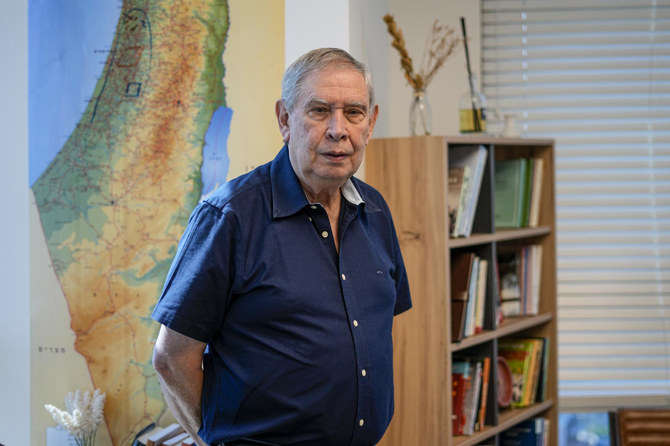
HERZLIYA, Israel: A former head of Israel’s Mossad intelligence agency told The Associated Press on Wednesday that Israel is enforcing an apartheid system in the West Bank, joining a tiny but growing list of retired officials to endorse an idea that remains largely on the fringes of Israeli discourse and international diplomacy.
Tamir Pardo becomes the latest former senior official to have concluded that Israel’s treatment of Palestinians in the West Bank amounts to apartheid, a reference to the system of racial separation in South Africa that ended in 1994.
Leading rights groups in Israel and abroad and Palestinians have accused Israel and its 56-year occupation of the West Bank of morphing into an apartheid system that they say gives Palestinians second-class status and is designed to maintain Jewish hegemony from the Jordan River to the Mediterranean Sea.
A handful of former Israeli leaders, diplomats and security men have warned that Israel risks becoming an apartheid state, but Pardo’s language was even more blunt.
“There is an apartheid state here,” Tamir Pardo said in an interview. “In a territory where two people are judged under two legal systems, that is an apartheid state.”
Given Pardo’s background, the comments carry special weight in security-obsessed Israel.
Pardo, who served as head of Israel’s clandestine spy agency from 2011-2016, wouldn’t say if he held the same beliefs while heading the Mossad. But he said that he believed among the country’s most pressing issues was the Palestinians — above Iran’s nuclear program, seen by Prime Minister Benjamin Netanyahu as an existential threat.
Pardo said that as Mossad chief, he repeatedly warned Netanyahu that he needed to decide what Israel’s borders were, or risk the destruction of a state for the Jews.
In the past year, Pardo has become an outspoken critic against Netanyahu and his government’s push to reshape the judicial system, slamming his old boss for steps he said would lead Israel to become a dictatorship. His candid evaluation Wednesday of Israel’s military occupation is rare among leaders of the grassroots protest movement against the judicial overhaul, which has largely avoided talk of the occupation out of concern that it might scare away more nationalist supporters.
Pardo’s remarks, and the overhaul, come as Israel’s far-right government, which is made up of ultranationalist parties who support annexing the West Bank, is working to entrench Israel’s hold on the territory. Some ministers have pledged to double the number of settlers currently living in the West Bank, which stands at a half-million.
In apartheid South Africa, a system based on white supremacy and racial segregation was in place from 1948 until 1994. The rights groups have based their conclusions on Israel on international conventions like the Rome Statute of the International Criminal Court. It defines apartheid as “an institutionalized regime of systematic oppression and domination by one racial group over any other racial group.”
Pardo said Israeli citizens can get into a car and drive wherever they want, excluding the blockaded Gaza Strip, but that Palestinians can’t drive everywhere. He said that his views on the system in the West Bank were “not extreme. It’s a fact.”
Israelis are barred from entering Palestinian areas of the West Bank, but can drive across Israel and throughout the 60 percent of the West Bank that Israel controls. Palestinians need permission from Israel to enter the country and often must pass through military checkpoints to move within the West Bank.
Rights groups point to discriminatory policies within Israel and in annexed east Jerusalem, Israel’s blockade of the Gaza Strip, which has been ruled by the Hamas militant group since 2007, and its occupation of the West Bank. Israel exerts overall control of the territory, maintains a two-tier legal system and is building and expanding Jewish settlements that most of the international community considers illegal.
Israel rejects any allegation of apartheid and says its own Arab citizens enjoy equal rights. Israel granted limited autonomy to the internationally recognized Palestinian Authority, which is based in the West Bank, at the height of the peace process in the 1990s and withdrew its soldiers and settlers from Gaza in 2005. It says the West Bank is disputed territory and that its fate should be determined in negotiations.
Pardo warned that if Israel doesn’t set borders between it and the Palestinians, Israel’s existence as a Jewish state will be in danger.
Experts predict Arabs will outnumber Jews in Israel plus the areas it captured in 1967 — the West Bank, Gaza Strip and east Jerusalem. Continued occupation could force Israel into a hard choice: Formalize Jewish minority rule over disenfranchised Palestinians — or give them the right to vote and potentially end the Zionist dream of a Jewish homeland in historic Palestine.
“Israel needs to decide what it wants. A country that has no border has no boundaries,” Pardo said.


Former Mossad chief says Israel is enforcing apartheid system in West Bank
https://arab.news/bwcj6
Former Mossad chief says Israel is enforcing apartheid system in West Bank

- Tamir Pardo becomes latest former senior official to conclude that Israel’s treatment of Palestinians in the West Bank amounts to apartheid


Iran FM tells UN all military bases of ‘hostile forces’ legitimate targets
- UN chief condemns escalation, calls for immediate return to negotiating table
- Emergency session of Security Council set to convene on Saturday in New York
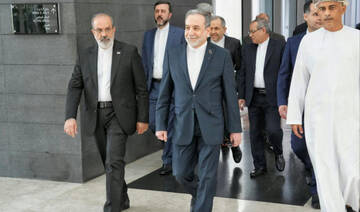
NEW YORK: Iran will use “all necessary defensive capabilities and means” to confront attacks by the US and Israel, and will treat “all bases, facilities, and assets of the hostile forces in the region” as legitimate military targets under its right to self-defense, Foreign Minister Abbas Araghchi said on Saturday.
In a letter to UN Secretary-General Antonio Guterres and the president of the Security Council, Araghchi said US and Israeli airstrikes are “a clear violation” of the UN Charter and amount to “an open armed aggression” against Iran.
Tehran is exercising its “inherent and lawful right of self-defense” under the UN Charter, he added.
The letter, seen by Arab News, accused the US and Israel of launching coordinated, large-scale attacks on Iranian territory, targeting defensive facilities and civilian sites in several cities.
Araghchi said Iran will continue to act “decisively and without hesitation until the aggression ceases fully and unequivocally,” adding that the US and Israel “shall bear full and direct responsibility for all ensuing consequences, including any escalation arising from their unlawful actions.”
He called on the 15-member Security Council to convene an emergency meeting to address a “breach of peace which is a real and serious threat to international peace and security,” and urged UN member states to “unequivocally condemn this act of aggression.”
An emergency session of the council is set to convene in New York on Saturday, requested by France, Bahrain, Colombia, China and Russia.
The Russian mission at the UN said in a statement that during the meeting, Moscow will demand that the US and Israel “immediately cease their illegal and escalatory actions and embark on a path toward a political and diplomatic settlement.” It added that “Russia is willing to provide all necessary assistance in this process.”
Meanwhile, Guterres condemned the military escalation, saying “the use of force by the United States and Israel against Iran, and the subsequent retaliation by Iran across the region, undermine international peace and security.”
The UN Charter clearly prohibits “the threat of the use of force against the territorial integrity or political independence of any state, or in any other manner inconsistent with the Purposes of the United Nations,” Guterres said in a statement.
He called for an immediate cessation of hostilities and de-escalation, and an immediate return to the negotiating table, adding that “failing to do so risks a wider regional conflict with grave consequences for civilians and regional stability.”
UN human rights chief Volker Turk also deplored the escalation and warned that civilians are the ones who end up paying “the ultimate price.”
He said: “Bombs and missiles are not the way to resolve differences but only result in death, destruction and human misery.”
Turk called for restraint and implored the parties “to see reason, to de-escalate, and (return) to the ‘negotiating table’ where they had been actively seeking a solution only hours earlier.”