Pakistan’s top court reserves verdict on petition against changes to accountability laws

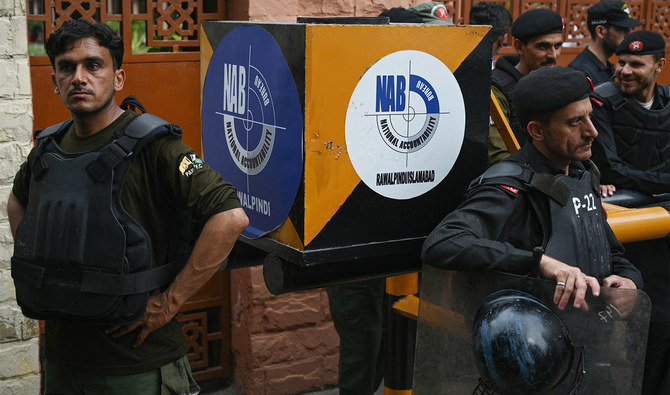
Pakistan's frontier constabulary personnel stand guard at the entrance of National Accountability Bureau (NAB) court, during the case hearing of former Pakistan's prime minister Imran Khan, in Islamabad, Pakistan, on May 23, 2023. (Photo courtesy: AFP/File)
Short Url
Updated 05 September 2023
Follow

Pakistan’s top court reserves verdict on petition against changes to accountability laws

  • Ex-PM Khan challenged amendments in top court last year, saying they provided benefit to influential persons
  • Changes made to accountability laws last year restrict NAB from acting on federal, provincial or local tax matters

ISLAMABAD: The Supreme Court of Pakistan on Tuesday reserved its verdict on former prime minister Imran Khan’s petition against amendments made to Pakistan’s accountability laws last year, local media widely reported. 

The NAB (Second Amendment) Bill 2021, passed by both houses of parliament in May 2022, states that all “pending inquiries, investigations, trials or proceedings under this ordinance, relating to persons or transactions... shall stand transferred to the authorities, departments and courts concerned under the respective laws.”

It also restricts the country’s anti-corruption watchdog, the National Accountability Bureau (NAB) from acting on federal, provincial or local tax matters and removes regulatory bodies from NAB’s domain. The bill reduces the four-year term of the NAB chairman and prosecutor-general to three years, sets a three-year term for judges of accountability courts, and makes it mandatory for them to decide a case within a year.

On June 25, 2022, Khan moved the Supreme Court against the NAB (Second Amendment) Bill 2021. Khan’s petition said the amendments were made to benefit influential accused persons and legitimize corruption, adding that the amendments were tantamount to “depriving the citizens of Pakistan of having access to law.”

A three-member bench of the apex court, comprising Chief Justice Umar Ata Bandial, Justice Ijazul Ahsan and Justice Syed Mansoor Ali Shah, heard Khan’s petition on Tuesday. During the hearing, the chief justice inquired whether there were any sections in the amendments according to which the cases could be transferred to another relevant forum. 

“After these amendments, a lot of the National Accountability Bureau’s work has come to an end,” Justice Bandial said, according to Pakistan’s English language newspaper Dawn, after he was told by Khan’s lawyer Khawaja Haris that a lot of pending NAB cases have returned after the amendments. 

Haris said that as per the amendments, an investigation would be conducted, after the review of which the cases could be sent to other forums. Khan’s counsel also informed the court that after changes to the law, neither did NAB have the authority to deal with the cases nor to send them to other relevant forums.

“After the amendments, the pending investigations and inquiries have gone to the mortuary,” Justice Ahsan was quoted as saying by Dawn. “Till the mechanism for the transfer of inquiries is formed, the public’s rights will be directly affected.”

The chief justice said toward the end of the hearing that ensuring the public prospers and is secure is the state’s responsibility. “We will soon announce a short and sweet verdict of the case,” Justice Bandial said, according to Dawn. 


Pakistan court directs authorities to form medical board to assess Imran Khan’s eye condition

Updated 11 sec ago
Follow

Pakistan court directs authorities to form medical board to assess Imran Khan’s eye condition

  • Islamabad High Court rejects jailed ex-PM’s request for immediate transfer to private hospital
  • Medical board comprising doctors from PIMS and Shifa to submit report on possible transfer

ISLAMABAD: A Pakistani high court on Thursday directed authorities to form a medical board of government doctors to assess whether jailed former prime minister Imran Khan needs to be transferred to a hospital, his party said, following a rejection of his request to be moved to a private facility for treatment.

The development comes after the Pakistan Institute of Medical Sciences (PIMS) said last week that Khan’s vision had “improved remarkably” since he was given an Anti-VEGF injection amid concerns related to his eyesight.

Anti-VEGF injections are commonly used to treat retinal vein occlusion and other retinal vascular disorders by reducing swelling and abnormal blood vessel growth inside the eye. Prior to the development, the ex-premier had complained of rapid deterioration in vision in one of his eyes.

“The Islamabad High Court has rejected Imran Khan’s request for immediate transfer to Shifa International Hospital,” the Pakistan Tehreek-e-Insaf (PTI) party said in a post on X.

“The court directed that the Chief Commissioner immediately constitute a medical board comprising doctors from PIMS and Shifa Hospital,” it continued. “The medical board will submit a report, on the basis of which the Chief Commissioner will decide whether a hospital transfer is to take place or not.”

The PTI said the court’s decision had raised questions over the judiciary’s independence.

“Delaying a medical emergency and handing it over to administrative discretion is a violation of human rights,” it said. “The issue of Imran Khan’s health is not just about one individual but reflects the entire judicial and state system.”

The 74-year-old cricketer-turned politician has been in prison since August 2023 in cases that he and his party say are politically motivated.

Khan was taken to PIMS for a medical procedure earlier this year, as his party questioned the transparency of the medical update and demanded independent access to his care.

Khan was removed from office in April 2022 through a parliamentary vote of no confidence that he says was orchestrated at the behest of the former administration in Washington by his political rivals with backing from the military. His allegation has been denied by all parties involved.

Since his imprisonment, Khan has faced multiple convictions and ongoing legal proceedings that authorities say follow due process, while his party describes them as efforts to sideline him from politics.