NEW DELHI: Prime Minister Narendra Modi’s government has replaced the name India with a Sanskrit word in dinner invitations sent to guests attending this week’s Group of 20 summit, in a move that reflects his Hindu nationalist party’s efforts to eliminate what it sees as colonial-era names.
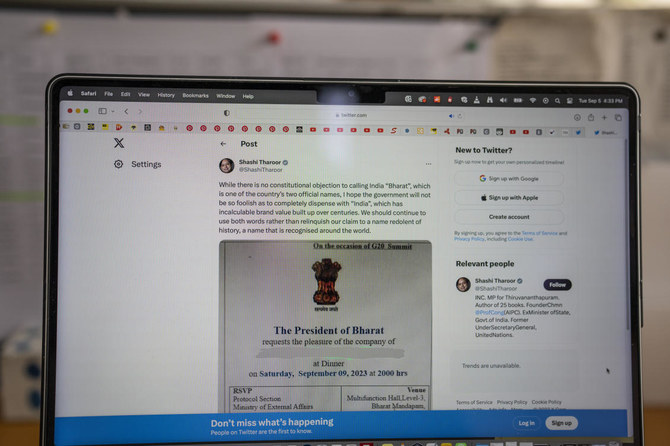
Indian President Droupadi Murmu is referred to as “President of Bharat” instead of “President of India” in the invitation sent to G20 attendees. The nation of more than 1.4 billion people is officially known by two names, India and Bharat, but the former is most commonly used, both domestically and internationally.
Bharat is an ancient Sanskrit word which many historians believe dates back to early Hindu texts. The word also means India in Hindi.
The change in nomenclature is backed by officials of Modi’s Bharatiya Janata Party. They argue that the name India was introduced by British colonials and is a “symbol of slavery.” The British ruled India for about 200 years until the country gained independence in 1947.
“Another blow to slavery mentality,” the top elected official of Uttarakhand state, Pushkar Singh Dhami, said on X, formerly known as Twitter. Dhami, who is a leader of Modi’s governing party, shared the dinner invitation sent to G20 guests in his post.
Modi’s party has long tried to erase names related to India’s Mughal and colonial past.
In 2015, New Delhi’s famous Aurangzeb Road, named after a Mughal king, was changed to Dr. APJ Abdul Kalam Road after protests from Modi’s party leaders. Last year, the government also renamed a colonial-era avenue in the heart of New Delhi that is used for ceremonial military parades.
Modi’s government says the name changes are an effort to reclaim India’s Hindu past.
India’s opposition parties, however, criticized the move.
“While there is no constitutional objection to calling India “Bharat,” which is one of the country’s two official names, I hope the government will not be so foolish as to completely dispense with “India,” which has incalculable brand value built up over centuries,” opposition lawmaker Shashi Tharoor said on X.
Tharoor said Indians should “continue to use both words rather than relinquish our claim to a name redolent of history, a name that is recognized around the world.”
Disputes over “India” versus “Bharat” have gained ground since opposition parties in July announced a new alliance — called INDIA — to unseat Modi and defeat his party ahead of national elections in 2024. The acronym stands for Indian National Developmental Inclusive Alliance.
Since then, some officials in Modi’s party have demanded that the country be called Bharat instead of India.


![]()

India’s government replaces ‘India’ with ancient name ‘Bharat’ in dinner invitation to G20 guests
Short Url
https://arab.news/jbh9j
India’s government replaces ‘India’ with ancient name ‘Bharat’ in dinner invitation to G20 guests
- Bharat is an ancient Sanskrit word which many historians believe dates back to early Hindu texts
- Modi’s government says the name changes are an effort to reclaim India’s Hindu past


Latest updates





© 2026 SAUDI RESEARCH & PUBLISHING COMPANY, All Rights Reserved And subject to Terms of Use Agreement.