

Gabon coup leader sworn in as interim president in scene of jubilation

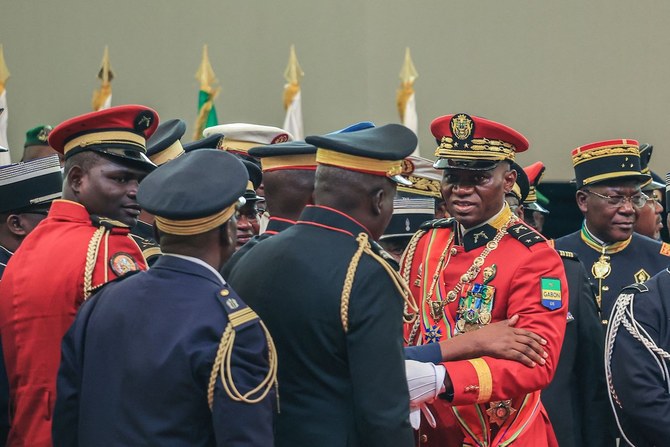
Gabon’s new strongman General Brice Oligui Nguema (2nd R) greets members of staff after he was inaugurated as Gabon’s interim President. (AFP)
Short Url
Updated 04 September 2023
Follow

Gabon coup leader sworn in as interim president in scene of jubilation

  • Nguema was given a standing ovation by military officers and officials as he arrived for the ceremony
  • State TV showed images of a cheering crowd and armored personnel carriers firing into the sea to mark the moment

LIBREVILLE: The leader of a coup that ousted Gabon’s President Ali Bongo was sworn in as interim president and cheered by jubilant supporters on Monday in a televised ceremony designed to cast the military as liberators of an oppressed society.
In West and Central Africa’s eighth coup in three years, army officers led by General Brice Oligui Nguema seized power on Aug. 30, minutes after an announcement that Bongo had won an election they annulled and said was not credible.
Nguema was given a standing ovation by military officers and officials as he arrived for the ceremony, and again just after he was sworn in by a panel of constitutional court judges.
State TV showed images of a cheering crowd and armored personnel carriers firing into the sea to mark the moment.
In a speech, Nguema proposed reforms including a new constitution to be adopted by referendum, new electoral and penal codes, and measures to prioritize local banks and companies for economic development. He also said political exiles would be welcomed back and political prisoners freed.
Repeatedly interrupted by cheers, he described the coup, which ended the Bongo family’s 56-year hold on power in the oil-producing country, as a moment of national liberation and a manifestation of God’s will.
“When the people are crushed by their leaders ... it’s the army that gives them back their dignity,” he said. “People of Gabon, today the times of happiness that our ancestors dreamt of are finally coming.”
Several figures from Bongo’s government, including the vice president and prime minister, attended the ceremony.
Bongo himself remains under house arrest. He was elected in 2009, taking over from his late father who came to power in 1967. Opponents say the family did too little to share Gabon’s oil and mining wealth with the country’s 2.3 million people.

Pledge to return power to civilians
Nguema reiterated that his administration would organize free and fair elections, though he gave no timetable.
“After this transition ... we intend to return power to civilians by organizing new elections that will be free, transparent, credible and peaceful,” he said.
Previously, Nguema had said the junta would proceed “quickly but surely,” but cautioned that too much haste could lead to elections that lack credibility.
The coup had drawn cheering crowds onto the streets of the capital Libreville but condemnation from abroad.
Leaders of the Central African regional bloc ECCAS are due to meet in person on Monday to discuss their response. Last week they urged partners led by the United Nations and the African Union to support a rapid return to constitutional order.
Gabon’s main opposition group, Alternance 2023, which says it is the rightful winner of the Aug. 26 election, has called on the international community to encourage the junta to hand power back to civilians.
Members of Alternance 2023 met Nguema on Sunday for talks, a source in the alliance told Reuters, without sharing further details.
Gabon’s international bonds continued to claw back ground after their sharp tumble last Wednesday. The 2025 bond recorded the biggest gains, up 1.8 cents in the dollar according to Tradeweb data.
However, the bonds which are trading between 91.3 cents from 2024 maturities and 74 cents for issues coming due in 2031, are still down around 5 cents from their pre-coup levels.


Peru Congress to debate impeachment of interim president

Updated 6 sec ago
Follow

Peru Congress to debate impeachment of interim president

LIMA: Peru’s Congress is set to consider Tuesday whether to impeach interim president Jose Jeri, the country’s seventh head of state in 10 years, accused of the irregular hiring of several women in his government.
A motion to oust Jeri, 39, received the backing of dozens of lawmakers on claims of influence peddling, the latest of a series of impeachment bids against him.
The session, set for 10:00 am local time (1500 GMT), is expected to last several hours.
Jeri, in office since October, took over from unpopular leader Dina Boluarte who was ousted by lawmakers amid protests against corruption and a wave of violence linked to organized crime.
Prosecutors said Friday they were opening an investigation into “whether the head of state exercised undue influence” in the government appointments of nine women on his watch.
On Sunday, Jeri told Peruvian TV: “I have not committed any crime.”
Jeri, a onetime leader of Congress himself, was appointed to serve out the remainder of Boluarte’s term, which runs until July, when a new president will take over following elections on April 12.
He is constitutionally barred from seeking election in April.
The alleged improper appointments were revealed by investigative TV program Cuarto Poder, which said five women were given jobs in the president’s office and the environment ministry after visiting with Jeri.
Prosecutors spoke of a total of nine women.
Jeri is also under investigation for alleged “illegal sponsorship of interests” following a secret meeting with a Chinese businessman with commercial ties with the government.

- Institutional crisis -

The speed with which the censure process is being handled has been attributed by some political observers as linked to the upcoming presidential election, which has over 30 candidates tossing their hat into the ring, a record.
The candidate from the right-wing Popular Renewal party, Rafael Lopez Aliaga, who currently leads in polls, has been among the most vocal for Jeri’s ouster.
If successfully impeached, Jeri would cease to exercise his functions and be replaced by the head of parliament as interim president.
But first a new parliamentary president would have to be elected, as the incumbent is acting in an interim capacity.
“It will be difficult to find a replacement with political legitimacy in the current Congress, with evidence of mediocrity and strong suspicion of widespread corruption,” political analyst Augusto Alvarez told AFP.
Peru is experiencing a prolonged political crisis, which has seen it burn through six presidents since 2016, several of them impeached or under investigation for wrongdoing.
It is also gripped by a wave of extortion that has claimed dozens of lives, particularly of bus drivers — some shot at the wheel if their companies refuse to pay protection money.
In two years, the number of extortion cases reported in Peru jumped more than tenfold — from 2,396 to over 25,000 in 2025.