Western firms still in Russia weigh pros and cons of leaving

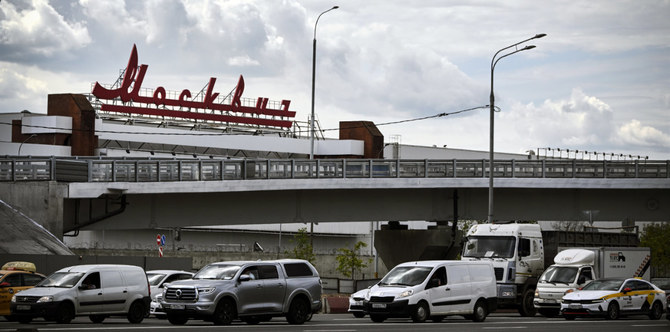
Cars roll past the main building of Moskvich (Muscovite) automobile plant in Moscow on July 31, 2023, which Renault acquired but had agreed to sell back following Russia's invasion of Ukraine last year. (AFP)
Short Url
Updated 04 September 2023
Follow

Western firms still in Russia weigh pros and cons of leaving

  • Around 100 companies from the G7 nations are still operating in Russia, but the numbers appear to be dropping: Yale University
  • European multinational firms have lost at least 100 billion euros ($108 billion) in total in Russia: FT analysis

PARIS: Should they stay or should they go now? Eighteen months after the start of the war in Ukraine, many Western companies in Russia are still assessing the pros and cons.

According to a count by the Yale University, around a hundred companies from the G7 nations are still operating in Russia, but the numbers appear to be dropping.
“We are continuing to see a trend toward a reduction in the activities of Western companies on Russian territory,” Julien Vercueil, an economist specializing in Russia, told AFP.
On August 21, faced with an “increasingly difficult environment,” US pizza chain Domino’s decided to throw in the towel, announcing the bankruptcy of its Russian operations, which it had been trying to sell since December, and closing 142 establishments across the country.
“The war is creating unfavorable conditions for foreign companies in Russia, whatever they decide to do,” Vercueil said. If they quit Russia, especially if they do so in a hurry, these companies “can lose a lot, but it will be once and for all,” he said.
According to analysis by The Financial Times, which examined the annual accounts of 600 European multinationals, they lost at least 100 billion euros ($108 billion) in total “following the sale, closure or reduction of their Russian activities.”
French carmaker Renault, for example, suffered a loss of 2.2 billion euros as it pulled out of Russia, one of its main markets, in May 2022.
But it is the oil majors that have lost the most. BP, one of the first to fully withdraw from Russia shortly after the fighting began in Ukraine in February 2022, has taken an estimated hit of more than 22 billion euros.

On the other hand, to keep doing business in Russia exposes Western firms to “significant reputational costs,” Vercueil said.
Ukrainians, and in particular their high-profile President Volodymyr Zelensky, are vocal in accusing such companies of “financing the Russian war through the profits they make on Russian territory,” he said.
Food, agriculture and distribution giants, many of whom have remained in Russia, are often targeted.
French supermarket chain Auchan is a case in point.
Ukraine said Wednesday that fragments of a Russian missile fell on a mall housing an Auchan in Kyiv, and repeated calls for the company to end its Russian operations.
“Cynicism, masochism, or stupidity? Exit Russia: this money is too bloody,” the defense ministry said.
Many Western companies that have stayed in Russia say they are ensuring the livelihoods of their employees, and keeping their businesses from falling into the hands of Russian officials.
Those arguments have not convinced everyone.
“Those companies explain that they stay for humanitarian reasons — that’s a cynical lie,” said Jeffrey Sonnenfeld, a professor specializing in corporate social responsibility at Yale University, who has compiled a list of Western companies leaving, or remaining, in Russia.
In his view, not only are these major groups helping to keep the Russian economy going, they are also playing into President Vladimir Putin’s hands by reassuring consumers with their presence.
The remainers have been targeted by boycotts in some cases.
Scandinavian organizations are boycotting US group Mondelez, maker of snacks like Oreo and Toblerone, due to its continued presence in Russia.
SAS airline, the Norwegian football federation and the Swedish military are among those rejecting products made by the company formerly known as Kraft Foods, as well as its subsidiaries Freia in Norway and Marabou in Sweden.


Companies continuing to operate in Russia also face the threat of having businesses and their profits seized.
“It’s dangerous to stay when the legal environment is now openly characterised by arbitrariness and state predation to the detriment of foreign interests,” Vercueil said.
According to one decree, Russia can “temporarily take control of companies” from countries considered “unfriendly,” Vladimir Tchikine, a lawyer specializing in corporate law in Russia, told AFP.
In recent months the Danish brewer Carlsberg and French food giant Danone have felt the force of this retaliatory policy.
While the two industrial giants were in the process of selling their Russian activities, the Russian state surprised them by unilaterally taking control of their assets in the country.


Russia puts death toll from Ukrainian strike on occupied village at 27. Kyiv rejects accusation

Updated 7 sec ago
Follow

Russia puts death toll from Ukrainian strike on occupied village at 27. Kyiv rejects accusation

Russian authorities said Friday that the death toll from a Ukrainian drone strike they said struck a café in a Russian-occupied village in Ukraine’s Kherson region rose to 27 people. Kyiv denied attacking civilian targets.
Svetlana Petrenko, spokeswoman of Russia’s main criminal investigation agency, the Investigative Committee, said in a statement that a Ukrainian drone strike on a café and hotel in the village of Khorly, where at least 100 civilians were celebrating New Year’s Eve overnight into Thursday, killed 27 people, including two minors. A total of 31, including five minors, were hospitalized with injuries.
A criminal probe on the charges of carrying out an act of terrorism has been opened, Petrenko said.
Kyiv denied attacking civilians. Spokesman of Ukraine’s General Staff, Dmytro Lykhovii, told Ukraine’s public broadcaster Suspilne on Thursday that Ukrainian forces “adhere to the norms of international humanitarian law” and “carry out strikes exclusively against Russian military targets, facilities of the Russian fuel and energy sector, and other lawful targets.”
Lykhovii said that General Staff has published an explicit list of targets that the Ukrainian army struck on the night of New Year’s Eve. The list did not include strikes on occupied parts of the Kherson region.
Lykhovii noted that Russia has repeatedly used disinformation and false statements to disrupt the ongoing peace negotiations.
The Associated Press could not independently verify claims made about the attack.
Russia’s accusations against Ukraine come amid a US-led diplomatic push to end the nearly four-year war in Ukraine. Earlier this week, Moscow alleged that Kyiv launched a long-range drone attack against a residence of Russian President Vladimir Putin in northwestern Russia overnight from Sunday to Monday.
Kyiv has called the allegations of an attack on Putin’s residence a ruse to derail ongoing peace negotiations, which have ramped up in recent weeks on both sides of the Atlantic.
In his New Year’s address, Ukrainian President Volodymyr Zelensky said that a peace deal was “90 percent ready” but warned that the remaining 10 percent, believed to include key sticking points such as territory, would “determine the fate of peace, the fate of Ukraine and Europe, how people will live.”
Trump’s special envoy Steve Witkoff said Wednesday that he, Secretary of State Marco Rubio and Trump’s son-in-law and adviser Jared Kushner had a “productive call” with the national security advisers of Britain, France, Germany and Ukraine “to discuss advancing the next steps in the European peace process.”
Elsewhere in Ukraine, Russia conducted what local authorities called “one of the most massive” drone attacks at Zaporizhzhia overnight.
At least nine Russian drones struck the city, damaging dozens of residential buildings and other civilian infrastructure, head of the regional administration, Ivan Fedorov, wrote on Telegram on Friday. There were no casualties, the official said.
Overall, Russia fired 116 long-range drones at Ukraine last night, according to Ukraine’s Air Force, which said that 86 drones were intercepted, while 27 more have reached their targets.
The Russian Defense Ministry reported Friday that its air defenses intercepted 64 Ukrainian drones overnight over multiple Russian regions.
Vyacheslav Gladkov, governor of Russia’s Belgorod region on the border with Ukraine, on Friday also accused Ukrainian forces of carrying out a missile strike on the city of Belgorod. Two women were hospitalized with injuries, Gladkov said. The strike shattered windows in multiple residential buildings and damaged an unspecified “commercial” facility and a number of cars, according to the official.