Algeria says jet skiers ‘refusal to comply’ led to shooting; victims’ kin to file action in France

1 / 2
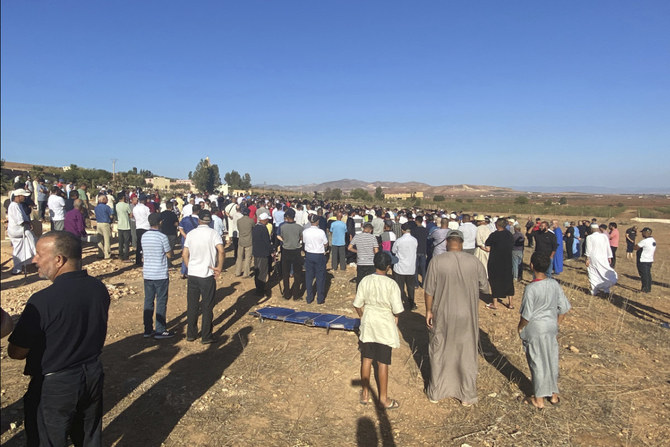
People attend the funeral of Bilal Kissi, one of two jet skiers who was killed by Algerian border guards, in the city of Saidia, Morocco, on Aug. 31, 2023. (AP Photo)
2 / 2
People attend the funeral of Bilal Kissi, one of two jet skiers who was killed by Algerian border guards, in the city of Saidia, Morocco, on Aug. 31, 2023. (AP Photo)
Short Url
Updated 03 September 2023
Follow

Algeria says jet skiers ‘refusal to comply’ led to shooting; victims’ kin to file action in France

  • Two of the skiers were killed, a third was wounded and detained, while a fourth one managed to escape
  • The survivor said his group got lost and ran out of fuel while jet-skiing along Moroccan waters
  • The killings come at a time of increased tensions between Algeria and Morocco

ALGIERS: Algeria said Sunday its security forces had opened fire this week after a group of jet skiers from Morocco ignored warning shots and refused to comply with orders to stop.

Lawyers for two men shot dead in the incident plan to file a complaint in France. One was French-Moroccan and the other held a residence permit in France.
“During a security patrol inside our territorial waters, a coast guard unit intercepted on Tuesday at 7:47 p.m. (18:47 GMT), three jet skis that clandestinely entered our territorial waters,” a defense ministry press release said.
“After issuing an audible warning and ordering them to stop several times, the suspects refused to comply and fled,” it added of Tuesday’s incident in which two tourists were killed.
The defense ministry said that after several warning rounds, “shots were fired, forcing one of the jet skis to stop, and the other two fled.”
The ministry said the shootings happened “because of increased activity by drugs-trafficking gangs and organized crime” in the border zone, and because of “the obstinacy of those on the jet skis.”
The statement said one body was recovered on Wednesday, “of an unidentified man with a gunshot wound.”
His body was taken to Tlemcen for an autopsy, it added.
The defense ministry statement said people should “not pay attention to false information that aims to sully the honorable image of the Algerian forces.”

Reports from Morocco said French-Moroccan tourist Bilal Kissi, 29, and his Moroccan cousin Abdelali Mechouar, 40, were killed.
A third man, Smail Snabe, was wounded and detained in Algeria, according to media reports in Morocco on Friday.
Kissi’s brother Mohamed, who had also been in the group, said they got lost and ran out of fuel after leaving the Moroccan resort of Saidia, near the border with Algeria.
He said he managed to leave the area after the incident and was picked up by the Moroccan navy.
Bilal Kissi’s body was recovered on Saidia beach on the Moroccan side of the border.
Saidia is a popular Moroccan summer resort known for its long beach and water sports.
Kissi was buried on Thursday in Bni Drar village near Oujda, in the presence of dozens of relatives.
Sunday’s statement from the defense ministry was the first official reaction from Algeria to Tuesday’s incident.
In Morocco, the prosecutor’s office in the city of Oujda has opened an investigation, a judicial source told the official Moroccan news agency MAP on Friday.
The family of the two tourists killed are to launch a legal action in France, their lawyers announced on Sunday.
Hakim Chergui, who is acting for the families of the victims, said the legal action would be submitted on Monday or Tuesday.
They are accusing the Algerian authorities of aggravated murder, attempted aggravated murder, the hijacking of a vessel and failure to assist a person in danger.

The break in diplomatic relations between Morocco and Algeria “does not justify the committing of the least crime and even less so the impunity of those responsible,” said a statement from the lawyers.
It was issued shortly before the Algerian defense ministry statement was released.
It comes at a time of increased tensions between Algeria and Morocco, exacerbated by antagonism over the disputed Western Sahara territory.
The border between the two North African countries has been closed since 1994, and Algiers severed diplomatic ties in August 2021, accusing Morocco of “hostile acts” — a decision Rabat called “completely unjustified.”
There has been no official statement yet from Rabat about the incident.
However, Morocco’s state-run National Human Rights Council (CNDH) condemned the use of live fire by the Algerian coast guard against “defenseless citizens, instead of helping people lost at sea.”
It said this was “a grave violation of international norms.”
The CNDH also said that a third person was still in intensive care in Oujda, without naming him.
It said Snabe had been “sentenced to 18 months” in prison in Algeria.


Washington presses Syria to shift from Chinese telecom systems

Updated 26 February 2026
Follow

Washington presses Syria to shift from Chinese telecom systems

  • Syria is exploring the possibility of procuring Chinese technology
  • It was unclear whether the United States ⁠pledged financial or logistical support to Syria to do so

DAMASCUS: The United States has warned Syria against relying on Chinese technology in its telecommunications sector, arguing it conflicts with US interests and threatens US national security, according to three sources familiar with the matter.
The message was conveyed during an unreported meeting between a US State Department team and Syrian Communications Minister Abdulsalam Haykal in San Francisco on Tuesday. Washington has been coordinating closely with Damascus since 2024, when Syria’s now President Ahmed Al-Sharaa ousted longtime leader Bashar Assad, who had a strategic partnership with China.
Syria is exploring the possibility of procuring Chinese technology to support its telecommunications towers and the infrastructure of local Internet service providers, according to a Syrian businessman involved in the procurement talks.
“The US side asked for clarity on the ministry’s plans regarding Chinese telecom equipment,” said ⁠another source briefed on ⁠the talks.
But Syrian officials said infrastructure development projects were time-critical and that Damascus was seeking greater vendor diversity, the source added.
SYRIAN OFFICIALS CITE US EXPORT CONTROLS AS TELECOMS BARRIER
Syria is open to partnering with US firms but the matter was urgent and export controls and “over-compliance” remained an issue, according to person familiar with the meeting in San Francisco.
A US diplomat familiar with the discussions told Reuters that the US State Department “clearly urged Syrians to use American technology or technology from allied countries in the telecoms sector.”
It was unclear whether the United States ⁠pledged financial or logistical support to Syria to do so.
Responding to Reuters questions, a US State Department spokesperson said: “We urge countries to prioritize national security and privacy over lower-priced equipment and services in all critical infrastructure procurement. If it seems too good to be true, it probably is.”
The spokesperson added that Chinese intelligence and security services “can legally compel Chinese citizens and companies to share sensitive data or grant unauthorized access to their customers’ systems” and promises by Chinese companies to protect customers’ privacy were “entirely inconsistent with China’s own laws and well-established practices.”
China has repeatedly rejected allegations of it using technology for spying purposes.
The Syrian Ministry of telecommunications told Reuters any decisions related to equipment and infrastructure are made “in accordance with national technical and security standards, ensuring data protection and service continuity.”
The ministry said it is also prioritizing the diversification of partnerships and technology sources to ⁠serve the national interest.
Syria’s telecom ⁠infrastructure has relied heavily on Chinese technology due to US sanctions imposed on successive Assad governments over the civil war that grew from a crackdown on anti-government protests in 2011.
Huawei technology accounts for more than 50 percent of the infrastructure of Syriatel and MTN, the country’s only telecom operators, according to a senior source at one of the companies and documents reviewed by Reuters. Huawei did not immediately respond to a request for comment.
Syria is seeking to develop its private telecommunications sector, devastated by 14 years of war, by attracting foreign investment.
In early February, Saudi Arabia’s largest telecom operator, STC, announced it would invest $800 million to “strengthen telecommunications infrastructure and connect Syria regionally and internationally through a fiber-optic network extending over 4,500 kilometers.”
The ministry of telecommunications says that US restrictions “hinder the availability of many American technologies and services in the Syrian market,” emphasizing that it welcomes expanding cooperation with US companies when these restrictions are lifted.
Syria has inadequate telecommunications infrastructure, with network coverage weak outside city centers and connection speeds in many areas barely exceeding a few kilobits per second.