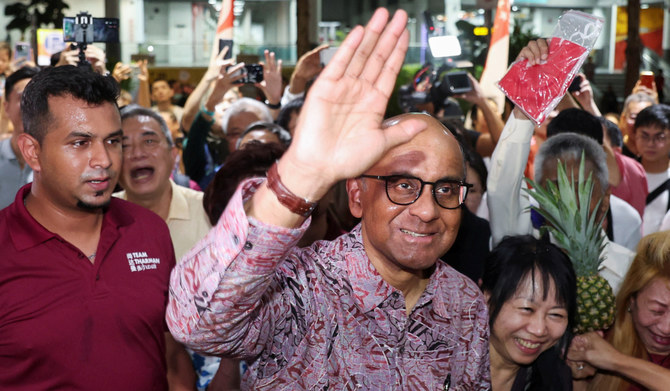

SINGAPORE: Singapore’s former deputy Prime Minister Tharman Shanmugaratnam was elected president, earning a landslide victory in the city-state’s first contested vote for the largely ceremonial position in more than a decade.
Singaporeans headed to the polls that were closely watched as an indication of support for the ruling party after a rare spate of scandals, but the longtime stalwart of the party won more than two-thirds of the vote over two rivals.
“I believe that it’s a vote of confidence in Singapore. It’s a vote of optimism for a future in which we can progress together and support each other as Singaporeans,” the former finance minister said in a speech before the results were announced.
“I’m humbled by this vote. It is not just a vote for me, it is a vote for Singapore’s future.”
He won 70.4 percent of the vote to win a six-year term.
His main rival Ng Kok Song, a former chief investment officer of Singapore sovereign wealth fund GIC, which manages the country’s foreign reserves, conceded after winning only 15.7 percent of the vote.
“The result is clear,” he told reporters, adding Shanmugaratnam “has indeed earned a mandate from the people of Singapore.”
Shanmugaratnam acknowledged the “changing and evolving” nature of Singapore, notably its diversity, and said he believes the election was seen as “another milestone in that process of evolution.”
There are stringent requirements for the position, which formally oversees the city’s accumulated financial reserves and holds the power to veto certain measures and approve anti-graft probes.
While the presidency is a non-partisan post under the constitution, political lines had already been drawn ahead of the election to replace incumbent Halimah Yacob, who ran unopposed for her six-year term in 2017.
Shanmugaratnam was widely viewed as the favorite for the position and had resigned as a member of the ruling People’s Action Party or PAP and as a senior minister in the Cabinet ahead of the election as all presidential candidates must be independent.
The 66-year-old economist is perceived as having the government’s backing and was questioned about his independence during the campaign.
The city-state’s government is run by the prime minister, currently Lee Hsien Loong of the PAP, which has ruled Singapore continuously since 1959.
“Singaporeans have chosen Mr. Tharman Shanmugaratnam to be our next President by a decisive margin,” Lee said in a statement.
The US sent a congratulatory message to Shanmugaratnam that pointed to “mutual respect, shared values and common interests” with Singapore. Observers said the vote would indicate the level of PAP support ahead of general elections due in 2025 or discontent after recent scandals that include a corruption probe into the transport minister and the resignations of two PAP legislators over an affair.
“What we want is a prosperous Singapore,” self-employed worker Patrick Low, 70, said after casting his vote.
Another candidate, former insurance executive Tan Kin Lian, 75, had gained the support of several opposition leaders but only picked up 13.88 percent of votes.
“The presidential election is increasingly being treated as a general election,” said Mustafa Izzuddin, a political analyst with consultancy Solaris Strategies Singapore.
Voting is compulsory for Singapore’s more than 2.7 million eligible citizens.
Long but orderly lines snaked from polling centers absent the raucous environment that can accompany elections in other countries, where supporters chant or distribute flyers to lobby for last-minute votes.
Izzuddin said an increase in protest voting had been expected but Shanmugaratnam secured an overwhelming win despite what experts had said was shifting opinions about the ruling party.
The PAP suffered its worst-ever election performance in 2020 but maintained its more than two-thirds majority.
Singapore requires presidential candidates to have served either as a senior civil servant or the chief executive of a company with shareholder equity of at least 500 million Singaporean dollars ($370 million).
Perhaps the president’s most crucial function is to serve as a custodian of Singapore’s financial reserves, which can only be drawn upon in exceptional circumstances, such as the Covid-19 pandemic and the 2009 global financial crisis.