

Army major among three soldiers killed in shootouts in northwest Pakistan 

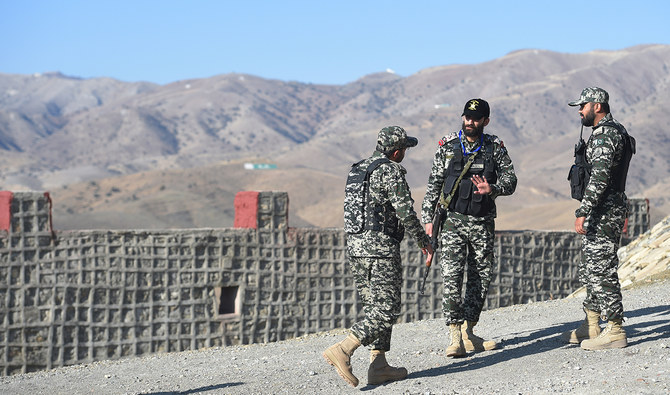
Pakistani army soldier stand guard on a border terminal in Ghulam Khan, a town in North Waziristan, on January 27, 2019. (AFP/File)
Short Url
Updated 02 September 2023
Follow

Army major among three soldiers killed in shootouts in northwest Pakistan 

  • The shootouts took place in North Waziristan and Khyber tribal districts 
  • Two militants were also killed in the exchange of fire, the military says 

ISLAMABAD: An army major was among three soldiers killed in separate shootouts in northwest Pakistan, the military said late on Friday, a day after nine soldiers were killed in a suicide bombing in the restive region. 

A team of Pakistani troops, led by Major Amir Aziz, intercepted an unknown number of militants during an intelligence-based operation in North Waziristan district, according to the Inter-Services Public Relations (ISPR), the military’s media wing. 

It led to an exchange of fire between the two sides that killed the army major among two soldiers and a militant. 

“As result of heavy exchange of fire, two brave sons of the nation, Major Amir Aziz (age 29 years, resident of Sargodha District) and Sepoy Muhammad Arif (age 27 years, resident of Sahiwal District) having fought gallantly, embraced Shahadat (martyrdom),” the ISPR said in a statement. 

“Sanitization of the area is being carried out to eliminate the terrorists present in the area.” 

In the second incident, a fire exchange took place between Pakistani troops and militants in the Khyber tribal district in the northwestern Khyber Pakhtunkhwa province, according to the ISPR. The intense exchange of fire left a soldier and a militant dead. 

“The killed terrorist remained actively involved in numerous terrorist activities against security forces and killing of innocent civilians,” the ISPR added. 

The shootouts came a day after a suicide bomber riding a motorcycle targeted a security convoy in the Bannu district and killed at least nine soldiers, according to security officials. 

Pakistan has been witnessing an uptick in militant violence in its northwestern and southwestern regions that border Afghanistan. 

The attacks have increased particularly after the Pakistani Taliban, or the Tehreek-e-Taliban Pakistan (TTP), called off a fragile, months-long truce with the central government in Islamabad in November last year. The militant group, which is said to have sanctuaries in neighboring Afghanistan, is separate from but a close ally of the Afghan Taliban. 

Islamabad says it has time and again raised the matter of TTP with the Afghan Taliban authorities, but there has been a lukewarm response from Kabul. 


Pakistan, Egypt reaffirm support for dialogue, diplomacy to resolve regional issues

Updated 04 January 2026
Follow

Pakistan, Egypt reaffirm support for dialogue, diplomacy to resolve regional issues

  • The development comes amid tensions over Yemen following the Southern Transitional Council advance into Hadramaut, Al-Mahra
  • Saudi Arabia has invited factions in south Yemen to hold a dialogue in Riyadh to 'discuss just solutions to the southern cause'

ISLAMABAD: Pakistan and Egypt have reaffirmed their support for dialogue and diplomacy as the preferred means to resolve regional issues, the Pakistani foreign office said on Sunday, amid tensions over Yemen.

The development comes days after Saudi Arabia-led Coalition to Support Legitimacy in Yemen said it conducted a “limited” airstrike targeting two shipments of smuggled weapons and other military hardware coming from the Emirati port of Fujairah into Mukalla in southern Yemen.

Coalition Forces spokesman Major General Turki Al-Maliki said the weapons and combat vehicles were meant to support the Southern Transitional Council (STC) forces, backed by the United Arab Emirates (UAE), in Yemen's Hadramaut and Al-Mahra "with the aim of fueling the conflict." The UAE has since announced withdrawal of its remaining troops from Yemen, rejecting any actions that could threaten the Kingdom or undermine regional stability.

Pakistan's Foreign Minister Ishaq Dar on Sunday spoke with his Egyptian counterpart Badr Ahmed Mohamed Abdelatty over the phone and discussed the current regional situation with him, according to a Pakistani foreign office statement.

"Both leaders reviewed current regional situation and appreciated efforts of all parties in resolving issues through dialogue and diplomacy," the statement said.

Separately, Saudi Arabia’s foreign ministry has invited factions in south Yemen to hold a dialogue in Riyadh to “discuss just solutions to the southern cause.” The STC on Saturday welcomed Saudi Arabia’s invitation to take part in the inclusive dialogue among southern Yemeni factions.

Disregarding previous agreements with the Arab Coalition, the STC group had launched a sweeping military campaign early in December, seizing the governorates of Hadramaut along the Saudi border and the eastern governorate of Al-Mahra in Yemen’s border with Oman. It also took control of the strategic PetroMasila oilfields, which account for a massive portion of Yemen’s remaining oil wealth.

Pakistan this week expressed solidarity with Saudi Arabia and reaffirmed Islamabad’s commitment to the Kingdom’s security.

“Pakistan expresses complete solidarity with the Kingdom of Saudi Arabia and reaffirms its commitment to security of the Kingdom,” Pakistani foreign office spokesperson Tahir Andrabi told reporters at a weekly news briefing.

“Pakistan maintains its firm support for the resolution of Yemen issue through dialogue and diplomacy and hopes that Yemen’s people and regional powers work together toward inclusive and enduring settlement of the issue, safeguarding regional stability.”

Pakistan and Saudi Arabia signed a landmark defense pact in September last year, according to which aggression against one country will be treated as an attack against both. The pact signaled a push by both governments to formalize long-standing military ties into a binding security commitment.