Pakistani artists pay sandy tribute to Saudi crown prince on 38th birthday

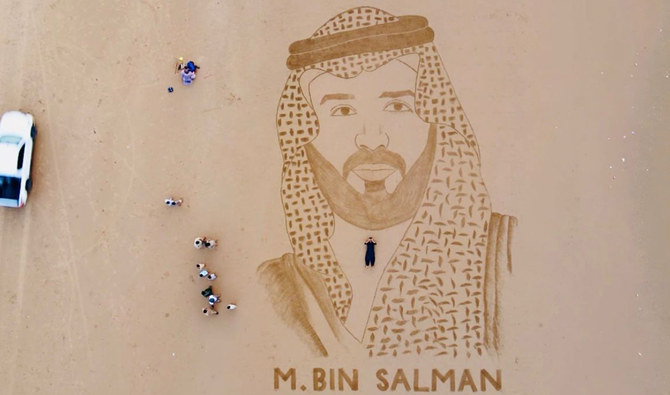
The photo taken on August 31, 2023, shows a sand portrait of Saudi Crown Prince Mohammed bin Salman on Gadani Beach, Pakistan. (Photo courtesy: @sameershoukat47/Twitter)
Short Url
Updated 02 September 2023
Follow

Pakistani artists pay sandy tribute to Saudi crown prince on 38th birthday

  • Rashidi Artists Gaddani have made over 100 beach sketches of world leaders, sportsmen, film stars
  • Six artists took part in making portrait, completed it in three hours with rake sticks and ropes in southwest Pakistan

QUETTA: A group of sand artists have made a 70-feet-long portrait of Saudi Crown Prince Mohammed bin Salman on Gadani Beach in Pakistan’s southwest Balochistan province as a tribute on his 38th birthday.

The Rashidi Artists Gaddani group has made more than 100 beach sketches of world’s leaders, sportspeople and film stars in the last four years. Some of the group’s memorable portraits of heads of state include those of the ruler of the United Arab Emirates and the Emir of Qatar. 

In November last year, they also made a sand portrait of Babar Azam, Pakistan’s all-format cricket captain and considered one of the world’s top batters, as a tribute to the Pakistan team as it faced New Zealand in a semifinal game of the ICC T20 World Cup.

“We wanted to wish the crown prince on his 38th birthday, thus we have made his 70-feet-long sandy portrait on Gadani beach,” Sameer Shoukat, a 19-year-old beach artist from Balochistan, told Arab News, a day after the Saudi royal turned 38 on August 31.

The group shared drone footage of the portrait on Gadani beach, some 51 kilometers away from Pakistan’s port city of Karachi.

“Six members of the group took part in making the sandy portrait of the crown prince and we completed the pictures in three hours with rake sticks and ropes.”

Shoukat said he hoped Crown Prince Mohammed would visit Pakistan soon, amid reports he might visit Islamabad after his trip to India for the summit of G-20 nations later this month. There has been no official confirmation of the trip from either side. 


Pakistan expands pilgrim travel system for Iran, Iraq with licenses to 67 new operators

Updated 16 December 2025
Follow

Pakistan expands pilgrim travel system for Iran, Iraq with licenses to 67 new operators

  • New system requires all Iraq-Iran pilgrimages to be organized by licensed groups under state oversight
  • Long-running “Salar” model relied on informal caravan leaders, leading to overstays and missing pilgrims

ISLAMABAD: Pakistan has issued registration certificates to 67 additional licensed pilgrimage companies, expanding a tightly regulated travel system designed to curb overstays, undocumented migration and security risks linked to religious travel to Iran and Iraq, the ministry of religious affairs said on Tuesday.

The move is part of a broader overhaul of Pakistan’s pilgrim management framework after authorities confirmed that tens of thousands of Pakistani pilgrims had overstayed or gone missing abroad over the past decade, raising concerns with host governments and triggering diplomatic pressure on Islamabad to tighten oversight.

“The dream of safe travel for pilgrims to Iran and Iraq through better facilities and a transparent mechanism is set to be realized,” the religious affairs ministry said in a statement, quoting Federal Minister for Religious Affairs Sardar Muhammad Yousaf, who announced that 67 new Ziyarat Group Organizers had been registered.

Pakistan’s government has dismantled the decades-old “Salar” system, under which informal caravan leaders arranged pilgrimages with limited state oversight. The model was blamed for weak documentation, poor accountability and widespread overstays, particularly during peak pilgrimage seasons. 

Under the new framework, only licensed companies are allowed to organize pilgrimages, and they are held directly responsible for ensuring pilgrims return within approved timelines.

Authorities say pilgrimages to Iran and Iraq will be conducted exclusively under the new system from January 2026, marking a full transition to regulated travel. The religion ministry said it has now completed registration of 24 operators in the first phase and 67 more in the second, with remaining applicants urged to complete documentation to obtain licenses.

The religious affairs ministry said a digital management system is being developed with the National Information Technology Board to monitor pilgrim movements and operator compliance, while a licensed ferry operator has also secured approval to explore future sea travel options.

The overhaul has been accompanied by tighter coordination with host countries. Earlier this month, Pakistan and Iraq agreed to share verified pilgrim data and restrict entry to travelers cleared under the new system, following talks between interior ministers in Islamabad and Baghdad. Pakistan has also barred overland pilgrim travel for major religious events, citing security risks in its southwestern Balochistan province, meaning travel to Iran and Iraq is now limited to approved air routes.

Officials say the reforms are aimed at balancing facilitation with accountability, as tens of thousands of Pakistani pilgrims travel annually to key Shia shrines, including Karbala and Najaf in Iraq and Mashhad and Qom in Iran. Travel peaks during religious occasions such as Arbaeen, when millions of worshippers converge on Iraq, placing heavy logistical and security demands on regional authorities.

The government says the new system is intended to restore confidence among host countries while ensuring safer, more transparent travel for Pakistani pilgrims.