

Pope praises Mongolia’s tradition of religious freedom from times of Genghis Khan at start of visit

1 / 6
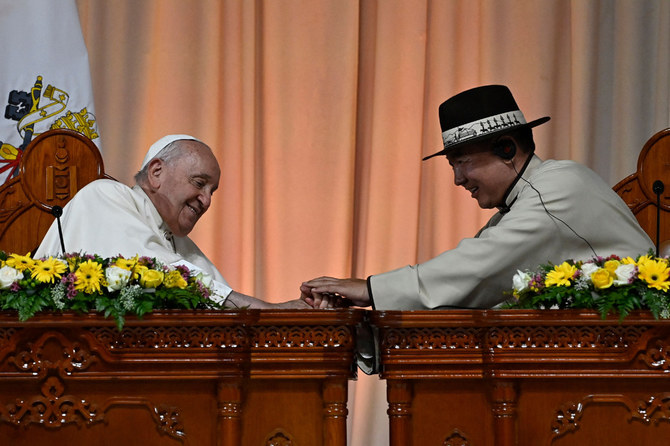
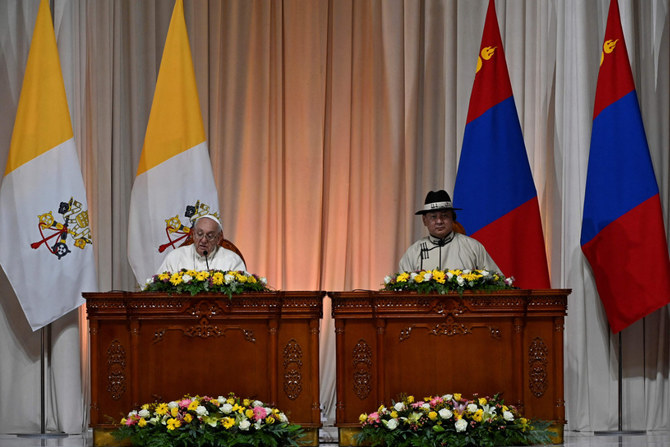
Mongolia's President Ukhnaagiin Khurelsukh (R) and Pope Francis attend a meeting with Mongolian authorities, members of the civil society and the diplomatic corps at the Mongol hall of the State Palace in Ulaanbaatar on September 2, 2023. (Pedro Pardo/AFP)
2 / 6
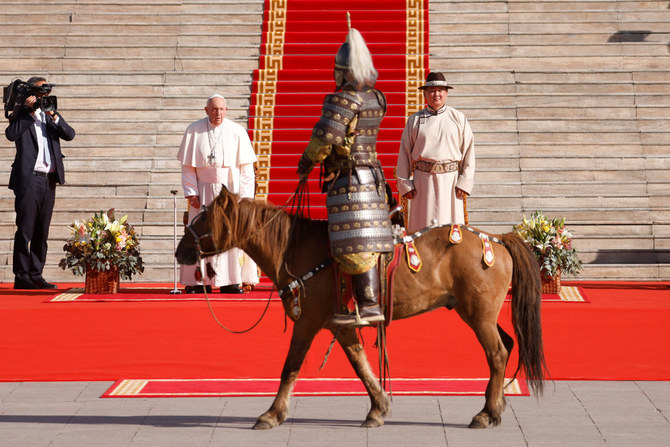
Pope Francis attends a welcome ceremony with President Ukhnaagiin Khurelsukh at Sukhbaatar Square, during his Apostolic Journey in Ulaanbaatar, Mongolia September 2, 2023. (REUTERS/Carlos Garcia Rawlins)
3 / 6
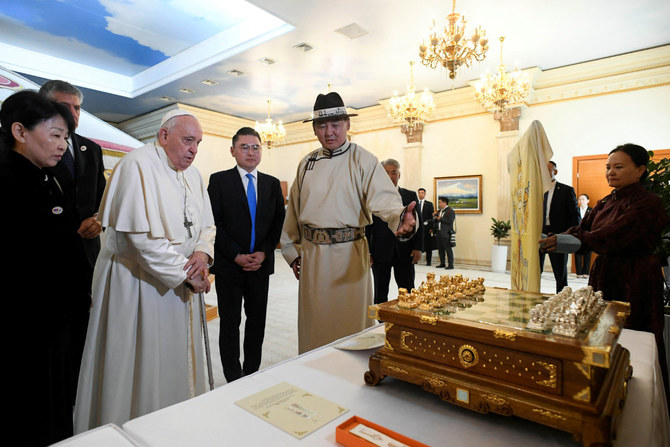
Mongolian President Ukhnaagiin Khurelsukh speaks to Pope Francis during a courtesy visit at the State Palace in Sukhbaatar Square in Ulaanbaatar on September 2, 2023. (Vatican Media/Handout via REUTERS)
4 / 6
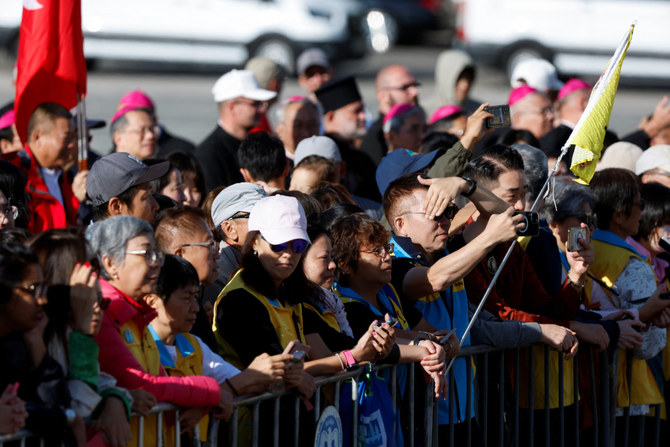
People gather ahead of Pope Francis's welcome ceremony with President Ukhnaagiin Khurelsukh at Sukhbaatar Square in Ulaanbaatar on September 2, 2023. (REUTERS/Carlos Garcia Rawlins)
5 / 6
Pope Francis attends a welcome ceremony with President Ukhnaagiin Khurelsukh at Sukhbaatar Square, during his Apostolic Journey in Ulaanbaatar, Mongolia September 2, 2023. (REUTERS/Carlos Garcia Rawlins)
6 / 6
Mongolia's President Ukhnaagiin Khurelsukh (R) and Pope Francis attend a meeting with Mongolian authorities, members of the civil society and the diplomatic corps at the Mongol hall of the State Palace in Ulaanbaatar on September 2, 2023. (Pedro Pardo/AFP)
Short Url
Updated 02 September 2023
Follow

Pope praises Mongolia’s tradition of religious freedom from times of Genghis Khan at start of visit

  • Warns about the threat represented by today’s consumerist spirit and said religions can help guard against it
  • Also cites the need to combat corruption; Mongolia has declared 2023 to be an “anti-corruption year”

ULAANBAATAR, Mongolia: Pope Francis on Saturday praised Mongolia’s tradition of religious freedom dating to the times of its founder, Genghis Khan, as he opened the first-ever papal visit to the Asian nation with a plea for peace and an end to the “insidious threat of corruption.”
Francis met with President Ukhnaagiin Khurelsukh inside a traditional Mongolian ger, or round yurt, set up inside the state palace, and wrote a message in the guest book that he was visiting Mongolia, “a country young and ancient, modern and rich of tradition,” as a pilgrim of peace.
“May the great clear sky, which embraces the Mongolian land, illuminate new paths of fraternity,” he wrote.
Francis is visiting Mongolia to minister to its young Catholic community of 1,450 and make a diplomatic foray into a region where the Holy See has long had troubled relations, with Russia to the north and China to the south.
While Christianity has been present in the region for hundreds of years, the Catholic Church has only had a sanctioned presence in Mongolia since 1992, after the country abandoned its Soviet-allied communist government and enshrined religious freedom in its constitution.

In his remarks, Francis praised Mongolia’s tradition of religious liberty, noting that such tolerance existed even during the period of the Mongol Empire’s vast expansion over much of the world. At its height, the empire stretched as far west as Hungary and remains the largest contiguous land empire in world history.
“The fact that the empire could embrace such distant and varied lands over the centuries bears witness to the remarkable ability of your ancestors to acknowledge the outstanding qualities of the peoples present in its immense territory and to put those qualities at the service of a common development,” Francis said. “This model should be valued and re-proposed in our own day.”
Francis, however, noted the need to combat corruption, an apparent reference to a scandal over Mongolia’s trade with China over the alleged theft of 385,000 tons of coal. In December, hundreds of people braved freezing cold temperatures in the capital to protest the scandal.
Francis warned about the threat represented by today’s consumerist spirit and said religions can help guard against an “individualistic mindset that cares little for others and for sound, established traditions.”


People gather ahead of Pope Francis's welcome ceremony with President Ukhnaagiin Khurelsukh at Sukhbaatar Square in Ulaanbaatar on September 2, 2023. (REUTERS/Carlos Garcia Rawlins)

“At the same time, they also represent a safeguard against the insidious threat of corruption, which effectively represents a serious menace to the development of any human community; corruption is the fruit of a utilitarian and unscrupulous mentality that has impoverished whole countries,” he said. “It is a sign of a vision that fails to look up to the sky and flees the vast horizons of fraternity, becoming instead self-enclosed and concerned with its own interests alone.”
The Mongolian government has declared 2023 to be an “anti-corruption year” and says it is carrying out a five-part plan based on Transparency International, the global anti-graft watchdog that ranked Mongolia 116th last year in its corruption perceptions index.
Later Saturday, Francis was to meet with the priests and missionaries who tend to the country’s tiny Catholic community at the capital’s St. Peter and Paul Cathedral.


Trump says no talks with Iran until ‘unconditional surrender’

Updated 8 sec ago
Follow

Trump says no talks with Iran until ‘unconditional surrender’

  • Earlier Trump demanded right to help name new Iranian leader
  • Iran’s president says countries have begun mediation efforts

BEIRUT/WASHINGTON/JERUSALEM: US President Donald Trump demanded Iran’s “unconditional surrender” on Friday, a dramatic escalation of his demands a week into the war he launched alongside Israel.

Trump made the remarks on social media just hours after Iran’s president announced that unspecified countries had begun mediation efforts in one of ‌the first signals ‌of any diplomatic initiative to end ​the ‌conflict.

“There ⁠will be ​no ⁠deal with Iran except UNCONDITIONAL SURRENDER!” Trump wrote.

“After that, and the selection of a GREAT & ACCEPTABLE Leader(s), we, and many of our wonderful and very brave allies and partners, will work tirelessly to bring Iran back from the brink of destruction, making it economically bigger, better, and stronger than ever before.”

On Thursday ⁠Trump had told Reuters in a telephone ‌interview that he was demanding the ‌right to help select Iran’s new supreme ​leader, to replace Ayatollah ‌Ali Khamenei, killed in the war’s first day.

Israel pounded the ‌Lebanese capital Beirut on Friday after ordering an unprecedented evacuation of the entire southern suburbs of the city, in a major expansion of the war.

It also launched a new wave of attacks on ‌Iran, saying 50 of its warplanes had struck a bunker beneath the destroyed Tehran compound of ⁠Khamenei, still ⁠being used by Iran’s leadership after he was killed.

Iran’s President Masoud Pezeshkian posted on X: “Some countries have begun mediation efforts.” He did not identify the countries or provide further details.

“Let’s be clear: we are committed to lasting peace in the region, but we have not the slightest hesitation in defending the dignity and authority of our country. Mediation should address those who underestimated the Iranian people and ignited this conflict,” he added.

Under Iran’s system, the president is subordinate ​to the supreme leader, but ​Pezeshkian is now serving on a panel that has assumed Khamenei’s duties.