Pakistan pitches projects under new investment council to diplomatic missions in Islamabad

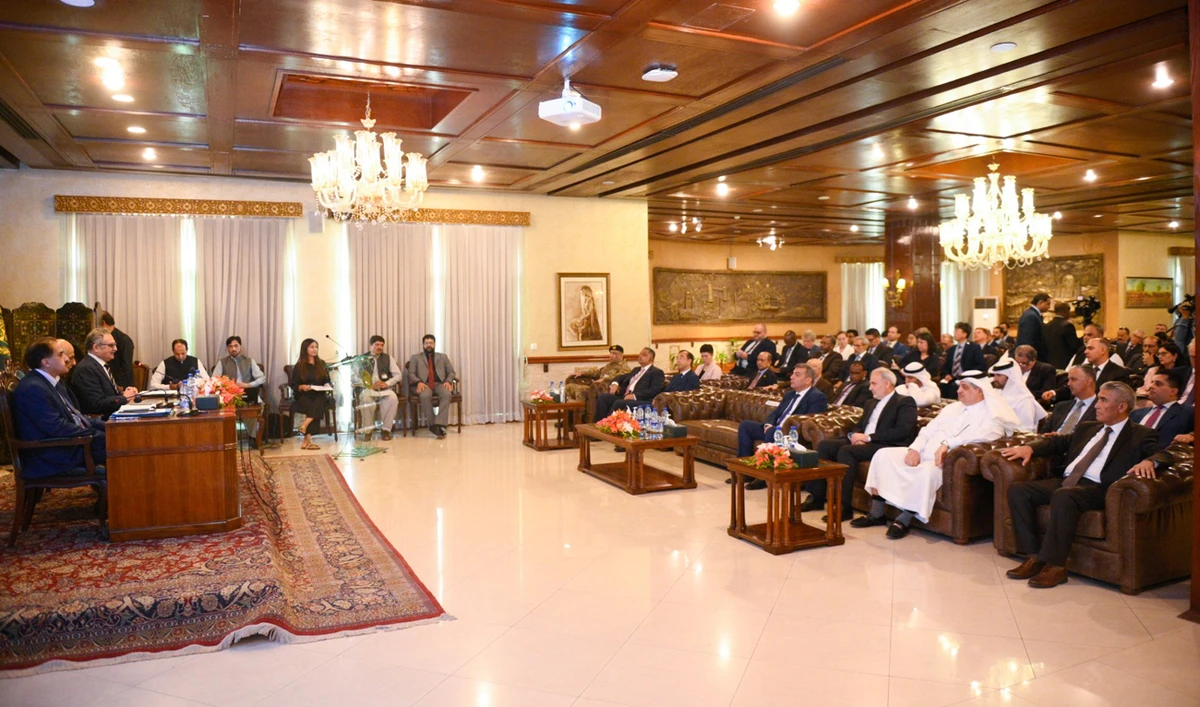
In this handout photo, taken and released by Ministry of Foreign Affairs, officials from Special Investment Facilitation Council hold briefing session arranged with ambassadors of foreign missions in Pakistan in Islamabad on September 1, 2023. (Photo courtesy: MOFA)
Short Url
Updated 01 September 2023
Follow

Pakistan pitches projects under new investment council to diplomatic missions in Islamabad

  • SIFC is hybrid civil-military forum aimed to fast-track decision making, promote investment from foreign nations
  • Pakistan has approved 20 projects to pitch for multibillion-dollar investments from Gulf and other states under SIFC

ISLAMABAD: Pakistan on Friday held a briefing session for diplomatic missions in Islamabad on the Special Investment Facilitation Council (SIFC), formed in June to attract foreign investment.

SIFC is a hybrid civil-military forum aimed to fast-track decision making and promote investment from foreign nations, particularly Gulf countries.

A notification dated June 17 from then Prime Minister Shehbaz Sharif’s Office said SIFC would seek investments in the energy, IT, minerals, defence and agriculture sectors from GCC countries. The body, which has the army chief and other military leaders in key roles, aims to take a “unified approach” to steer the country out of economic crisis.

“Dr Jehanzeb Khan, Special Assistant to Prime Minister on Government Effectiveness, made a detailed presentation informing the diplomatic corps on the establishment and various aspects of the Council,” the foreign office said in a statement.

“He particularly highlighted investment opportunities in Pakistan in four key areas: IT, Agriculture, Energy and Mining. The participating diplomatic missions were requested to brief and encourage their countries to profit from the promise of Pakistan being a resource-rich country.”

Pakistan has reportedly approved 20 projects to pitch for multibillion-dollar investments from Gulf and other states under the SIFC umbrella. 

The identified projects include the Saudi Aramco Refinery, TAPI Gas Pipeline, Thar Coal Rail Connectivity, hydropower projects of 245 MW in Gilgit-Baltistan, handing over of 85,000 acres of land to a single investor, the establishment of cloud infrastructure, and telecom infrastructure deployment.
Rating firm S&P says it won’t rush Iran war downgrades, sees risks for countries like Pakistan

Updated 4 sec ago
Follow

Rating firm S&P says it won’t rush Iran war downgrades, sees risks for countries like Pakistan

  • Agency says it is monitoring indebted energy importers as higher oil prices strain finances
  • Gulf economies seen better placed to weather shock, though Bahrain flagged as vulnerable

LONDON: S&P Global ‌said it would not make any knee-jerk sovereign rating cuts following the outbreak of war in the ​Middle East, but warned on Thursday that soaring oil and gas prices were putting a number of already cash-strapped countries at risk.

The firm’s top analysts said in a webinar that the conflict, which has involved US and Israeli strikes ‌against Iran and Iranian ‌strikes against Israel, ​US ‌bases ⁠and Gulf ​states, ⁠was now moving from a low- to moderate-risk scenario.

Most Gulf countries had enough fiscal buffers, however, to weather the crisis for a while, with more lowly rated Bahrain the only clear exception.

Qatar’s banking sector could ⁠also struggle if there were significant ‌deposit outflows in ‌reaction to the conflict, although there ​was no evidence ‌of such strains at the moment, they ‌said.

“We don’t want to jump the gun and just say things are bad,” S&P’s head global sovereign analyst, Roberto Sifon-Arevalo, said.

The longer the crisis ‌was prolonged, though, “the more difficult it is going to be,” he ⁠added.

Sifon-Arevalo ⁠said Asia was the second-most exposed region, due to many of its countries being significant Gulf oil and gas importers.

India, Thailand and Indonesia have relatively lower reserves of oil, while the region also had already heavily indebted countries such as Pakistan, Bangladesh and Sri Lanka whose finances would be further hurt by rising energy prices.

“We ​are closely monitoring ​these (countries) to see how the credit stories evolve,” Sifon-Arevalo said.