

Russian veto terminates all UN sanctions on Mali junta, abolishes panel critical of Wagner

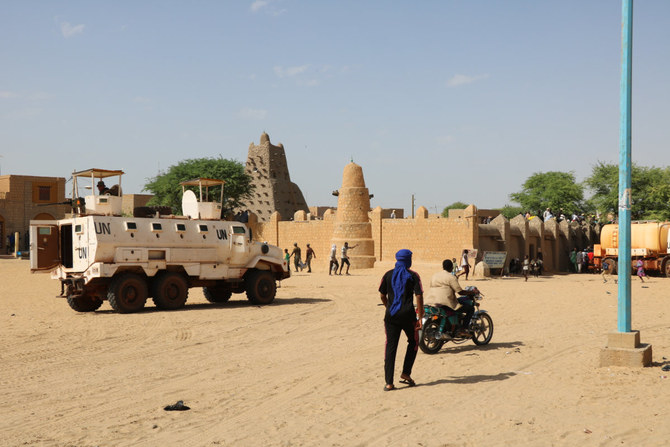
A United Nations peacekeeping force patrols in the streets of Timbuktu, Mali, on Sept. 26, 2021. UN forces are gradually pulling out of Mali on orders of the West African nation's military junta, which has brought in mercenaries from Russia's Wagner Group to help fight Daesh and Al-Qaeda insurgencies. (AP/File)
Short Url
Updated 31 August 2023
Follow

Russian veto terminates all UN sanctions on Mali junta, abolishes panel critical of Wagner

  • Resolution seeking to extend sanctions regime until Aug. 31, 2024 and the mandate of aUN panel of experts monitoring sanctions until Sept. 30, 2024 gets vetoed by Russia

UNITED NATIONS: Mali’s military junta succeeded in kicking out the UN peacekeeping force, and on Wednesday its Russian allies scored yet another victory against the UN: They were able to terminate all UN sanctions on Malians and abolish a panel of experts which has been critical of activities of Russia’s Wagner Group in the West African nation.

The travel ban and asset freeze, currently affecting eight Malians on the UN blacklist for threatening peace efforts, and the mandate of the panel of experts monitoring the implementation of sanctions were up for renewal in the UN Security Council.
A French and United Arab Emirates-drafted resolution that would have extended the sanctions regime until Aug. 31, 2024 and the mandate of the UN panel of experts monitoring sanctions until Sept. 30, 2024 was put to a vote first. It got 13 “yes” votes in the 15-member council but was vetoed by Russia. China abstained.
A rival Russian resolution that would have extended sanctions “for the final period of 12 months” until Aug. 31, 2024 and abolished the panel of experts “with immediate effect” failed to get the minimum nine “yes” votes needed for adoption. In the vote, Russia was the only country to vote in favor, Japan voted against, and 13 countries abstained.
The result is that after Thursday, Aug. 31, when the current sanctions regime ends there will be no sanctions on the Malians. The panel of experts submitted their last report which was circulated last week and its mandate will officially end on Sept. 30.
Russia’s UN Ambassador Vassily Nebenzia told council members before the vote that it would not allow another resolution to be put forward on sanctions and the panel of experts.
Nebenzia called for consultations before the votes, which the US agreed to after a long break, but Russia’s demands on sanctions and the experts were not acceptable to supporters of the France-UAE resolution, so the voting went ahead. Nebenzia said after casting the veto on that resolution that its views and those of the Mali rulers were not taken into consideration.
US deputy ambassador Robert Wood, who chaired the meeting, called sanctions “necessary to stem the illicit financial transfers and ill-gotten gains both from Mali and into a region in which numerous malign actors operate and have sadly proliferated.”
He called the panel of experts’ reporting “a central source of information on the situation in Mali,” and said Russia wanted to eliminate its mandate “to stifle publication of uncomfortable truths about Wagner’s actions in Mali, which require attention.” He said Russia’s draft was “lamentably short” on providing sustained support for Mali.
France’s deputy UN ambassador Nathalie Broadhurst expressed deep regret at Russia’s veto at a crucial time for Mali and the region. “The choice made by Russia follows the participation of Wagner mercenaries in fighting” in northern Ber, where the UN was evacuating a peacekeeping base, and in airstrikes that “imperil” a cease-fire and a 2015 peace agreement, she noted.
In their final report to the council, the panel of experts said they remain particularly concerned with persistent conflict-related sexual violence in Mali’s eastern Menaka and central Mopti regions, “especially those involving the foreign security partners of the Malian Armed Force” – the Wagner Group.
“The panel believes that violence against women, and other forms of grave abuses of human rights and international humanitarian law are being used, specifically by the foreign security partners, to spread terror among populations,” the report said.
The experts also said Daesh extremists have almost doubled the territory they control in Mali in less than a year, and their Al-Qaeda-linked rivals are capitalizing on the deadlock and perceived weakness of armed groups that signed a 2015 peace agreement.
The stalled implementation of the peace deal and sustained attacks on communities have offered the Daesh group and Al-Qaeda affiliates a chance “to re-enact the 2012 scenario,” they said.
That’s the year when a military coup took place in the West African country and rebels in the north formed an Islamic state two months later.
The extremist rebels were forced from power in the north with the help of a French-led military operation, but they moved from the arid north to more populated central Mali in 2015 and remain active.
In August 2020, Mali’s president was overthrown in a coup that included an army colonel who carried out a second coup and was sworn in as president in June 2021. He developed ties to Russia’s military and the Wagner group whose head, Yevgeny Prigozhin, was reportedly killed in a plane crash on a flight from Moscow last week.
In June, Mali’s junta ordered the nearly 15,000-strong UN peacekeeping force to leave after a decade of working on stemming the jihadi insurgency The Security Council terminated the mission’s mandate on June 30 and the UN is in the throes of what Secretary-General António Guterres calls an “unprecedented” six-month exit from Mali.
The UN special envoy for Mali, El-Ghassim Wane, laid out the scale of the operation to the council on Monday: All 12,947 UN peacekeepers and police must be sent home, their 12 camps and one temporary base handed over to the government, and 1,786 civilian staff terminated by the Dec. 31 deadline.


Britain’s Starmer seeks to bolster China ties despite Trump warning

Updated 31 January 2026
Follow

Britain’s Starmer seeks to bolster China ties despite Trump warning

  • “The UK has got a huge amount to offer,” he said in a short speech at the UK-China Business Forum at the Bank of China

SHANGHAI: Visiting Prime Minister Keir Starmer said on Friday Britain has a “huge amount to offer” China, after his bid to forge closer ties prompted warnings from US President Donald Trump.
Starmer’s trip is the first to China by a British prime minister in eight years, and follows in the footsteps of other Western leaders looking to counter an increasingly volatile United States.
Leaders from France, Canada and Finland have flocked to Beijing in recent weeks, recoiling from Trump’s bid to seize Greenland and tariff threats against NATO allies.
Trump warned on Thursday it was “very dangerous” for Britain to be dealing with China.
Starmer brushed off those comments on Friday, noting that Trump was also expected to visit China in the months ahead.
“The US and the UK are very close allies, and that’s why we discussed the visit with his team before we came,” Starmer said in an interview with UK television.
“I don’t think it is wise for the UK to stick its head in the sand. China is the second-largest economy in the world,” he said.
Asked about Trump’s comments on Friday, Beijing’s foreign ministry said “China is willing to strengthen cooperation with all countries in the spirit of mutual benefit and win-win results.”
Starmer met top Chinese leaders, including President Xi Jinping and Premier Li Qiang, on Thursday, with both sides highlighting the need for closer ties.
He told business representatives from Britain and China on Friday that both sides had “warmly engaged” and “made some real progress.”
“The UK has got a huge amount to offer,” he said in a short speech at the UK-China Business Forum at the Bank of China.
The meetings the previous day provided “just the level of engagement that we hoped for,” Starmer said.
He signed a series of agreements on Thursday, with Downing Street announcing Beijing had agreed to visa-free travel for British citizens visiting China for under 30 days, although Starmer acknowledged there was no start date for the arrangement yet.
The Chinese foreign ministry said only that it was “actively considering” the visa deal and would “make it public at an appropriate time upon completing the necessary procedures.”
Starmer hailed the agreements as “symbolic of what we’re doing with the relationship.”
He also said Beijing had lifted sanctions on UK lawmakers targeted since 2021 for their criticism of alleged human rights abuses against China’s Muslim Uyghur minority.
“President Xi said to me that that means all parliamentarians are welcome,” Starmer said in an interview with UK television.
He traveled from Beijing to economic powerhouse Shanghai, where he spoke with Chinese students at the Shanghai International College of Fashion and Innovation, a joint institute between Donghua University and the University of Edinburgh.

- Visas and whisky -

The visa deal could bring Britain in line with about 50 other countries granted visa-free travel, including France, Germany, Australia and Japan, and follows a similar agreement made between China and Canada this month.
The agreements signed included cooperation on targeting supply chains used by migrant smugglers, as well as on British exports to China, health and strengthening a bilateral trade commission.
China also agreed to halve tariffs on British whisky to five percent, according to Downing Street.
British companies sealed £2.2 billion in export deals and around £2.3 billion in “market access wins” over five years, and “hundreds of millions worth of investments,” Starmer’s government said in a statement.
Xi told Starmer on Thursday that their countries should strengthen dialogue and cooperation in the context of a “complex and intertwined” international situation.
Relations between China and the UK deteriorated from 2020 when Beijing imposed a national security law on Hong Kong and cracked down on pro-democracy activists in the former British colony.
However, China remains Britain’s third-largest trading partner, and Starmer is hoping deals with Beijing will help fulfil his primary goal of boosting UK economic growth.
British pharmaceutical group AstraZeneca said on Thursday it would invest $15 billion in China through 2030 to expand its medicines manufacturing and research.
And China’s Pop Mart, makers of the wildly popular Labubu dolls, said it would set up a regional hub in London and open 27 stores across Europe in the coming year, including up to seven in Britain.
Starmer will continue his Asia trip with a brief stop in Japan on Saturday to meet Prime Minister Sanae Takaichi.