

As Asia Cup kicks off in Multan, Pakistanis left ‘disappointed’ over India’s absence

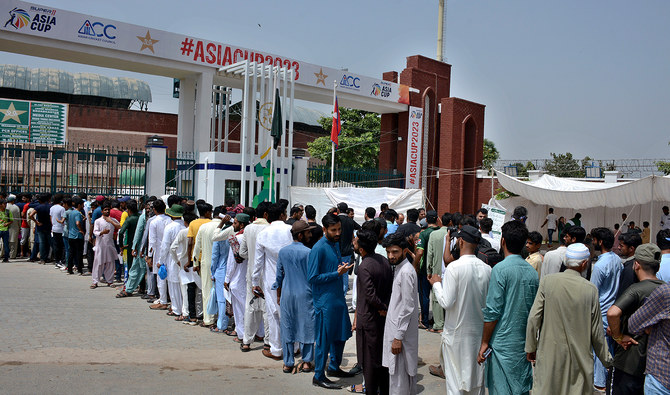
Cricket fans stand in a queue for security checkpoint as they arrive for opening one-day international cricket match of Asia Cup between Pakistan and Nepal, in Multan on August 30, 2023. (AP)
Short Url
Updated 30 August 2023
Follow

As Asia Cup kicks off in Multan, Pakistanis left ‘disappointed’ over India’s absence

  • Pakistan are playing against Nepal in Multan as Asia Cup tournament gets underway in Pakistan
  • Due to India’s refusal to play in Pakistan, nine other Asia Cup matches would be played in Sri Lanka

MULTAN: As the Asia Cup kicks off in Multan on Wednesday with the hosts taking on minnows Nepal, Pakistanis felt “disappointed” over the Indian team’s decision to stay away from Pakistan’s shores.

Political tensions between India and Pakistan mean the two South Asian rivals only play each other at international tournaments. The last time the Indian cricket team arrived in Pakistan was in 2008 for the 50-over Asia Cup tournament.

India’s refusal to play on Pakistani soil forced the Pakistan Cricket Board (PCB) to settle for a “hybrid model” according to which only four of the 13 Asia Cup matches would be played in Pakistan. The other nine would be played in Sri Lanka.

Since gaining independence from British colonial India in 1047, India and Pakistan have fought three wars against each other. However, the people of the two cricket-mad nations have immense respect for each other’s cricket stars and an India-Pakistan match is always a big-ticket spectacle. Often, it is one of the biggest and most watched events in the global sporting calendar.

“India is our neighbor and we harbor positive feelings for them,” Muhammad Tariq, a 28-year-old shop owner, told Arab News at the Hussain Agahi Market, one of Multan’s busiest marketplaces.

“Had they come to Multan, we would have been happy to see them in action,” he said. “But if they didn’t come, then it is their wish. We can’t force anyone.”

“It’s disappointing that they did not come to Pakistan,” Ahmed, 31, the owner of a sports shop, told Arab News. “We wanted the entire Asia Cup to take place in Pakistan and watch Virat Kohli and Rohit Sharma bat here [in Pakistan]. They also have a lot of good bowlers.”

Muhammad Raza Baqir, the owner of another sports shop, welcomed the fact that the Asia Cup opener was taking place in Multan.

However, he said people were also facing hardships due to the stringent security measures taken by authorities.

“It’s good that these sports events are taking place in Multan and they also have a positive effect on our businesses,” he said. “But when the administration closes roads [due to security], it creates hardships for people.”

Like others too, Baqir was also looking forward to the Indian cricket squad playing in Pakistan.

“Our stakeholders, however, should think about this: if a country does not want to tour you, despite the fact that you invited them as guests, there is some fault in us for sure,” he said.

While Sharma and Babar Azam’s team may not square off on Pakistani soil, India and Pakistan will lock horns against each other on September 2 in Kandy, Sri Lanka.

The two teams may even face each other thrice in the tournament if they make it to the final.

And Ahmed wants just that.

“We are praying that Pakistan and India face each other in the final,” Ahmed said with a grin. “And I hope Pakistan wins.”


Pakistan finance minister highlights economic stability, improving debt outlook at AlUla Conference

Updated 6 sec ago
Follow

Pakistan finance minister highlights economic stability, improving debt outlook at AlUla Conference

  • Global public debt remains at historic highs, exerting pressure on emerging countries, says Pakistani finance minister
  • Muhammad Aurangzeb says Pakistan’s debt-to-GDP ratio has declined to 70 percent from 74 percent over three years

ISLAMABAD: Pakistan’s Finance Minister Muhammad Aurangzeb highlighted the country’s improving debt outlook and efforts to restore economic stability at the AlUla Conference for Emerging Market Economies on Monday, calling for enhanced global coordination to address sovereign debt vulnerabilities. 

The second edition of the annual AlUla conference was launched by the Saudi Arabia’s Ministry of Finance and the International Monetary Fund (IMF) on Sunday. The conference brings together economic decision-makers, finance ministers, central bank governors, leaders of international financial institutions and a select group of experts and specialists from around the world.

This year’s conference highlights the rapid transformations in the global economy and challenges and the opportunities they present for emerging market economies, particularly in international trade, monetary and financial systems. 

Speaking at a roundtable titled: ‘Addressing Sovereign Debt Vulnerabilities,’ Aurangzeb noted that global public debt remains at historic highs, exerting pressure on emerging and developing economies through higher debt servicing costs, tighter financing conditions and constrained fiscal space, the Finance Division said. 

“The finance minister highlighted that Pakistan has made initial but meaningful progress in restoring stability through disciplined macroeconomic policies, institutional reforms, and proactive debt management, while acknowledging that the reform journey remains ongoing,” the Finance Division said. 

The minister said Pakistan remains on track to contain and better manage public debt, extending maturities, reducing costs and undertaking early debt repayments. Aurangzeb noted that these efforts have contributed to a decline in the debt-to-GDP ratio to around 70 percent from about 74 percent over the past three years.

Aurnagzeb also spoke about Pakistan’s progress in domestic resource mobilization, noting that Islamabad has raised its tax-to-GDP ratio, adding that it is now moving to the figure of 12 percent from single-digit levels in earlier years. The minister cited by tax reforms, digitization and base-broadening measures as reasons for the improvement.

“Concluding his remarks, the finance minister stressed that addressing sovereign debt vulnerabilities requires early action, strong institutions, transparency, and credible policy frameworks, supported by enhanced global coordination,” the statement said. 

“Strengthening creditor cooperation, expanding the effective use of liability management operations, and integrating climate resilience into debt frameworks, he noted, will be essential to help emerging economies manage debt sustainably while preserving growth and development priorities.”

Pakistan has recently undertaken reforms mandated by the IMF under its $7 billion loan program to strengthen its fragile economy. While the IMF has acknowledged progress on Islamabad’s part, it has also cautioned that the country’s recovery remains fragile and warned that high public debt, fiscal pressures and exposure to external shocks continue to pose risks to long-term stability.

Pakistan faced a prolonged economic crisis in recent years, marked by fiscal pressure, high debt levels and balance-of-payments difficulties, and subsequently entered an IMF-supported program to stabilize the economy.

Pakistani officials say decreasing levels of inflation and higher foreign exchange reserves reflect the government’s prudent fiscal policies and debt management.