India’s moon rover confirms sulfur and detects several other elements near the lunar south pole

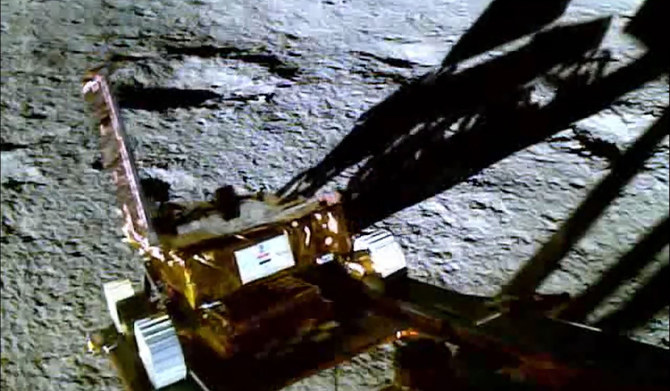
This handout screen grab taken and released by the Indian Space Research Organisation (ISRO) on August 25, 2023, shows the Chandrayaan-3 rover as it manoeuvred from the lunar lander to the surface of the Moon. (AFP)
Short Url
Updated 29 August 2023
Follow

India’s moon rover confirms sulfur and detects several other elements near the lunar south pole

  • The rover “unambiguously confirms the presence of sulfur,” ISRO said. It also is searching for signs of frozen water that could help future astronaut missions, as a potential source of drinking water or to make rocket fuel

NEW DELHI: India’s moon rover confirmed the presence of sulfur and detected several other elements near the lunar south pole as it searches for signs of frozen water nearly a week after its historic moon landing, India’s space agency said Tuesday.
The rover’s laser-induced spectroscope instrument also detected aluminum, iron, calcium, chromium, titanium, manganese, oxygen and silicon on the lunar surface, the Indian Space Research Organization, or ISRO, said in a post on its website.
The lunar rover had come down a ramp from the lander of India’s spacecraft after last Wednesday’s touch-down near the moon’s south pole. The Chandrayan-3 Rover is expected to conduct experiments over 14 days, the ISRO has said.
The rover “unambiguously confirms the presence of sulfur,” ISRO said. It also is searching for signs of frozen water that could help future astronaut missions, as a potential source of drinking water or to make rocket fuel.
The rover also will study the moon’s atmosphere and seismic activity, ISRO Chairman S. Somnath said.
On Monday, the rover’s route was reprogrammed when it came close to a 4-meter-wide (13-foot-wide) crater. “It’s now safely heading on a new path,” the ISRO said.
The craft moves at a slow speed of around 10 centimeters (4 inches) per second to minimize shock and damage to the vehicle from the moon’s rough terrain.
After a failed attempt to land on the moon in 2019, India last week joined the United States, the Soviet Union and China as only the fourth country to achieve this milestone.
The successful mission showcases India’s rising standing as a technology and space powerhouse and dovetails with the image that Prime Minister Narendra Modi is trying to project: an ascendant country asserting its place among the global elite.
The mission began more than a month ago at an estimated cost of $75 million.
India’s success came just days after Russia’s Luna-25, which was aiming for the same lunar region, spun into an uncontrolled orbit and crashed. It would have been the first successful Russian lunar landing after a gap of 47 years. Russia’s head of the state-controlled space corporation Roscosmos attributed the failure to the lack of expertise due to the long break in lunar research that followed the last Soviet mission to the moon in 1976.
Active since the 1960s, India has launched satellites for itself and other countries, and successfully put one in orbit around Mars in 2014. India is planning its first mission to the International Space Station next year, in collaboration with the United States.


Fourth pair of Filipino twins set to fly to Riyadh next week for separation surgery

Updated 4 sec ago
Follow

Fourth pair of Filipino twins set to fly to Riyadh next week for separation surgery

  • Born in April 2024, Olivia and Gianna Manuel are joined from the chest to the abdomen
  • Their mother learned about Saudi Conjoined Twins Program from social media updates

MANILA: As they prepare to travel to Riyadh next week for separation surgery, the parents of Olivia and Gianna Manuel have renewed hopes that their children will grow up like others, as they have become the fourth pair of Filipino twins to be taken care of by the Saudi Conjoined Twins Program.

The girls from the town of Talavera in the central Philippine province of Nueva Ecija were born in April 2024.

They are joined from the chest to the abdomen, a condition known as omphalopagus.

“They can’t eat properly. It’s really difficult for them. When one is lying down, the other often gets pinned down because the bigger one is very hyper. The smaller one is usually underneath,” the children’s mother, Ginalyn Manuel, told Arab News.

“When they’re lying down or sleeping, even if one still wants to sleep, she’s forced to wake up because the other keeps moving.”

She first learned about the Saudi Conjoined Twins Program when she followed social media updates on Akhizah and Ayeesha Yusoph, the second pair of Filipino twins to undergo separation surgery in Saudi Arabia.

At that time, she was still in the hospital with the girls, closely monitored by doctors for three months after they were born. She then reached out to the King Salman Humanitarian Aid and Relief Center, which runs the conjoined twins program, and in July last year, a hospital in Riyadh got in touch with her.

After various steps of medical qualification, the Saudi Embassy in Manila announced the girls would soon travel to the Kingdom with their parents to undergo the separation procedure.

They are scheduled to fly to Riyadh on Jan. 26.

“Out of so many people, we were given the chance for our twins to be separated. If it were just us, we really couldn’t afford it. The help from the Saudi government is truly enormous,” Manuel said.

“I imagine them playing here, already apart, walking on their own. It feels so good just thinking about it. That’s what I always include in my prayers — that their separation surgery will be successful.”

Saudi Arabia is known as a pioneer in the field of separation surgery. KSrelief was established by King Salman in 2015 and is headed by Dr. Abdullah Al-Rabeeah, one of the world’s most renowned pediatric surgeons.

Since 1990, he and his team have separated more than 140 children from 27 countries who were born sharing internal organs with their twins.

The first pair of Filipino conjoined twins, Ann and Mae Manzo, were separated under the program in March 2004. They were joined at the abdomen, pelvis and perineum.

They were followed by the Yusoph twins, who were joined at the lower chest and abdomen and shared one liver. Their successful separation procedure was in September 2024.

The third pair of Filipino conjoined twins, Maurice Ann and Klea Misa, who are joined at the head, flew to Riyadh in May and are currently being prepared for their surgery.