

Powerful earthquakes rock Indonesia’s Bali and Java islands, no casualties reported

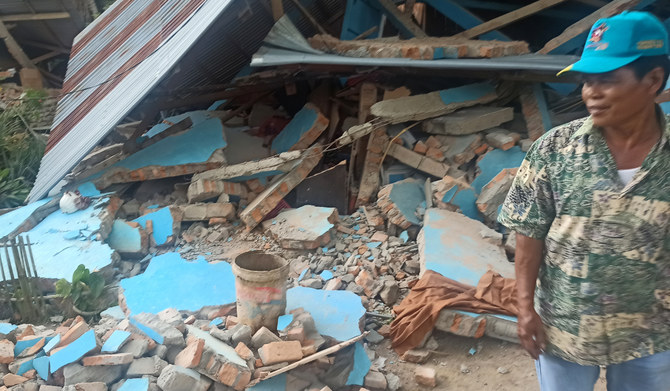
A man stands near a damaged house following an earthquake in Pasaman, West Sumatra, Indonesia, Friday, Feb. 25, 2022. (AP)
Short Url
Updated 29 August 2023
Follow

Powerful earthquakes rock Indonesia’s Bali and Java islands, no casualties reported

  • The US Tsunami Warning System said there were no threats of a tsunami as a result of the earthquake that struck deep under the seabed

DENPASAR, Indonesia: A powerful earthquake and an aftershock rocked Indonesia’s resort island of Bali and other parts of the country on Tuesday, causing panic but no immediate reports of damage or casualties.
The US Geological Survey said the magnitude 7.1 earthquake was centered 181 kilometers (112 miles) northeast of Gili Air, a tiny island near the coast of Lombok Island, next to Bali, at a depth of 513.5 kilometers (319 miles).
Indonesia’s Meteorology, Climatology and Geophysical Agency said there was no danger of a tsunami but warned of possible aftershocks. The agency put a preliminary magnitude at 7.4. Variations in early measurements are common.
A 5.4 magnitude aftershock hit the same area a few minutes later just before dawn.
Many residents and tourists rushed out of their homes and hotels toward higher ground after reporting powerful shockwaves, but the situation returned to normal after they received text messages saying the quake had no potential to trigger a tsunami.
“I thought the walls were going to come down on the hotel,” an Australian tourist said on social media.
People in neighboring provinces of East Java, Central Java, West Nusa Tenggara and East Nusa Tenggara provinces also felt the tremors and panicked as houses and buildings swayed for several seconds.
Indonesia, a vast archipelago of 270 million people, is frequently struck by earthquakes, volcanic eruptions and tsunamis because of its location on the “Ring of Fire,” an arc of volcanoes and fault lines that arcs the Pacific.
An earthquake in the hilly Karangasem in 2021 triggered landslides and cut off at least three villages, killing at least three people.
A magnitude 5.6 earthquake on Nov. 21 killed at least 331 people and injured nearly 600 in West Java’s Cianjur city. It was the deadliest in Indonesia since a 2018 quake and tsunami in Sulawesi killed about 4,340 people.
In 2004, an extremely powerful Indian Ocean quake set off a tsunami that killed more than 230,000 people in a dozen countries, most of them in Indonesia’s Aceh province.


Kremlin welcomes US sanctions waiver says US and Russia share interest in stable energy markets

Updated 6 sec ago
Follow

Kremlin welcomes US sanctions waiver says US and Russia share interest in stable energy markets

DUBAI: Russia sees ​a U.S. sanctions waiver on its oil as ‌an ‌attempt ​by ‌Washington ⁠to stabilise ​global energy ⁠markets, and the two countries ⁠have a shared ‌interest ‌in ​this, ‌Kremlin ‌spokesman Dmitry Peskov said on Friday.

"We see ‌actions by the United States aimed ‌at trying to stabilise energy markets. In this respect, our interests coincide," he said.

US Treasury Secretary Scott Bessent announced a temporary authorisation allowing countries around the world to purchase Russian oil currently stranded at sea on Thursday extending a measure that had previously been granted only to Indian refiners.

Bessent stressed in a post on X that the authorisation would not provide significant financial benefit to the Russian government. 

“This narrowly tailored, short-term measure applies only to oil already in transit and will not provide significant financial benefit to the Russian government, which derives the majority of its energy revenue from taxes assessed at the point of extraction,” Bessent said on a post on X. 

However, the measure received mix reviews in European capitals, with many fearing it could help replenish Russia's assualt on Ukraine. 

"I am concerned that we are further filling Putin's war chest," German Economy Minister Katherina Reiche said in Berlin on Friday.

Reiche said that she saw both sides to the United States' decision to issue ‌a 30-day ‌waiver ​for ‌the purchase ⁠of ​Russian oil ⁠products, understanding the increasing ecnomic and political turnout from the oil crisis, particurlarly in South Korea and Japan. 

"It seems to me that domestic political pressure in the United ⁠States is very, ‌very ‌high," ​Reiche said.

German ​Chancellor Friedrich Merz was more direct, saying on Friday that it was ‌wrong to ‌ease ​sanctions against ‌Russia ⁠for ​whatever reason. The sentiment was echoed by Norway’s Prime Minister, who also said sanctions should not be eased. 

Oil prices held gains above $100 Friday and most equity markets dropped after Iran's leader called for the blocking of the crucial Strait of Hormuz and the opening up of new fronts in the war against the United States and Israel.

With the conflict heading towards its third week and showing no signs of ending, investors are growing increasingly worried about an extended crisis that could fan inflation and hammer the global economy.