

Saudi and Turkish authorities sign agreement for cooperation in mining sector

1 / 4
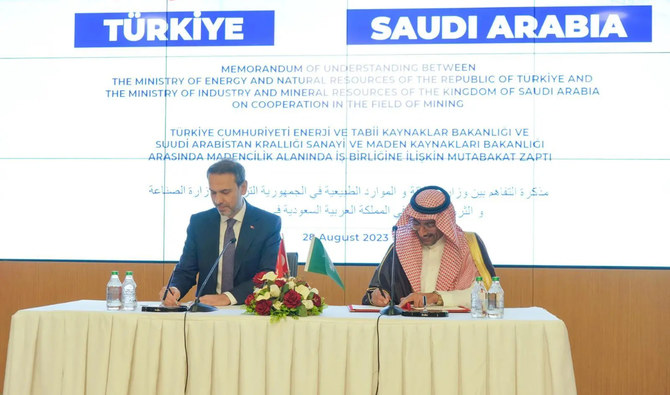
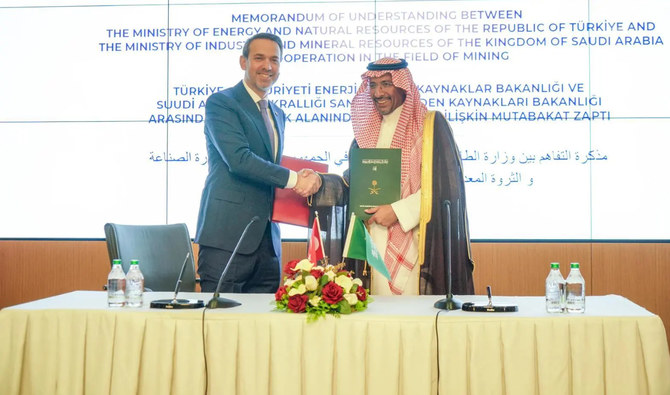
The deal aims to foster greater cooperation in research and development. (SPA)
2 / 4
The deal aims to foster greater cooperation in research and development. (SPA)
3 / 4
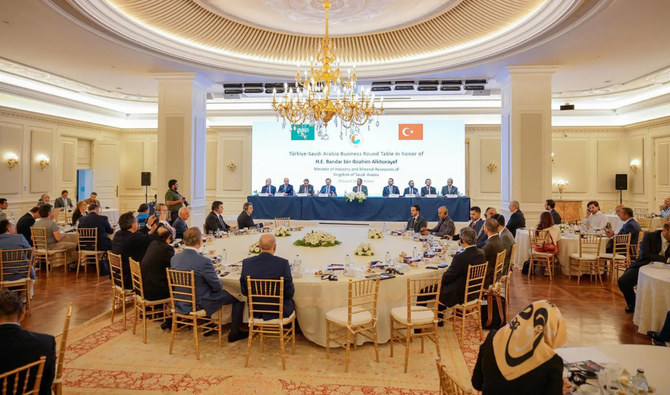
Al-Khorayef participated in a roundtable meeting hosted by the Turkish Union of Chambers and Commodity Exchanges of Turkey. (SPA)
4 / 4
Al-Khorayef participated in a roundtable meeting hosted by the Turkish Union of Chambers and Commodity Exchanges of Turkey. (SPA)
Short Url
Updated 29 August 2023
Follow

Saudi and Turkish authorities sign agreement for cooperation in mining sector

  • The deal aims to enhance collaboration through exchange of knowledge and expertise in mineral exploration services, supply chains, labs, drilling techniques and geological services
  • It was signed by the Kingdom’s minister of industry and mineral resources, Bandar Al-Khorayef, and his Turkish counterpart, Alparslan Bayraktar, during the former’s official visit to Turkiye

RIYADH: Saudi Arabia and Turkiye have signed an agreement for cooperation in the mining sector.

The memorandum of understanding was signed by the Kingdom’s minister of industry and mineral resources, Bandar Al-Khorayef, and his Turkish counterpart, Alparslan Bayraktar, during the former’s current official visit to Turkiye.

The deal aims to enhance collaboration through the transfer of knowledge and exchange of expertise in mineral exploration services, supply chains, laboratories, drilling techniques, and geological services, the Saudi Press Agency reported on Monday.

Other goals include fostering greater cooperation in research and development, clean mining technologies, resource efficiency and substitution, and other related technologies, and encouraging support for private-sector organizations in Saudi Arabia and Turkiye to invest in the sector.

During his visit to Turkiye, Al-Khorayef met a number of ministers and other officials from the Turkish government, and held two meetings with investors, one in Ankara and the other in Istanbul.

In addition to signing the mining cooperation agreement, Al-Khorayef and Bayraktar discussed other issues of mutual interest and concern, with a particular focus on the industrial and mining sectors, and ways in which cooperation between their countries might be enhanced.

In a separate meeting, Al-Khorayef and Omer Bolat, the Turkish minister of trade, discussed opportunities for Saudi Arabia and Turkiye to enhance their economic partnership to help achieve their joint aspirations.

Earlier, Al-Khorayef participated in a roundtable meeting hosted by the Turkish Union of Chambers and Commodity Exchanges of Turkey.

He said the Kingdom will be an important destination for Turkish investors due to its economic position, especially after the launch of Saudi Vision 2030, which aims to change the reality of the Saudi economy and reduce its dependence on oil, and benefit from the Kingdom’s distinguished geographical location to be an economic center for the region.

The minister reiterated that the Kingdom is interested in developing the infrastructure that adopts modern technologies, as the national strategy for industry focuses on technology, including artificial intelligence and 3D printing, in addition to creating globally competitive industrial investments in the long term.


MEA to see $3tn real estate, infrastructure pipeline by 2030, JLL says 

Updated 5 sec ago
Follow

MEA to see $3tn real estate, infrastructure pipeline by 2030, JLL says 

RIYADH: The Middle East and Africa region is set to see a $3 trillion pipeline of real estate and infrastructure projects between 2026 and 2030, driven by tight occupancy levels and strong investor demand, an analysis showed. 

In its latest report, professional services firm JLL said low vacancy and strong absorption rates are among the key drivers accelerating the sector’s transformation in the region, easing supply constraints and supporting rental and sales growth. 

The steady momentum in the region’s real estate and infrastructure sectors underscores the ongoing economic diversification efforts pursued by countries across the region.

In July, real estate consultancy Knight Frank said the Kingdom’s construction output value is expected to reach $191 billion by 2029, representing a 29.05 percent increase from 2024, driven by residential development, ongoing giga-projects and rising demand for office space. 

James Allan, CEO, UAE, Egypt and Africa at JLL, said: “Strong market fundamentals boosted the Middle East and Africa real estate market in 2025, setting the momentum for sustained performance across asset classes in 2026.” 

He added: “We saw record residential transactions, double-digit growth in industrial and logistics rents, and an exceptionally tight 1 percent office vacancy rate in 2025, driven by professional talent migration, substantial private investment, and strategic infrastructure development.” 

According to the report, the delivery of key infrastructure projects in the region will further catalyze new real estate developments and attract increased private sector participation. 

In the evolving capital landscape, cross-border capital and alternative financing mechanisms are projected to play an increasingly central role, particularly in greenfield developments where investment stock remains limited. 

The report added that improved market transparency across the region, driven by regulatory changes, is also expected to bolster investor confidence in the Middle East and Africa markets. 

JLL said the UAE remains central to this growth trajectory, with projected project cash flows of $795 billion from 2026 to 2030, including $470 billion allocated to real estate development. 

In November, CBRE echoed similar views on the region’s real estate sector, saying Saudi Arabia’s ongoing economic diversification push is energizing its property market, with office rents in Riyadh climbing 15 percent year on year and occupancy reaching 98 percent by the end of the third quarter of 2025. 

CBRE added that the strong performance in Saudi Arabia’s office sector is buoyed by the Kingdom’s non-oil economic expansion and an influx of multinational companies relocating regional headquarters to Riyadh.