Biden says action needed against ‘hate-fueled violence’ after racist shooting in Florida

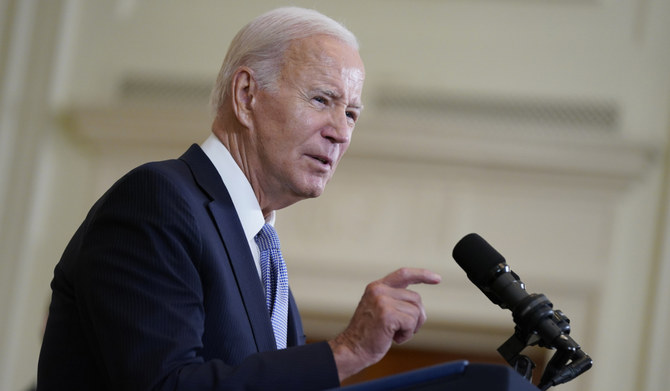
President Joe Biden speaks on the anniversary of the Inflation Reduction Act during an event in the East Room of the White House, Aug. 16, 2023, in Washington. (AP)
Short Url
Updated 28 August 2023
Follow

Biden says action needed against ‘hate-fueled violence’ after racist shooting in Florida

  • “We must refuse to live in a country where Black families going to the store or Black students going to school live in fear of being gunned down because of the color of their skin,” Biden wrote

WASHINGTON: President Joe Biden and Vice President Kamala Harris met with the Rev. Martin Luther King Jr.’s family to mark Monday’s 60th anniversary of the March on Washington, where King delivered his famous “I Have a Dream” speech at the Lincoln Memorial.
The White House invited a broad group of civil rights leaders to the meeting, including Martin Luther King III, his wife, Arndrea Waters King, his sister Bernice King and the Rev. Al Sharpton, along with representatives from organizations representing Jews, Hispanics and Asian Americans, according to Sharpton’s National Action Network.
The Democratic president was taking a page out of history by opening the White House to King’s family. On Aug. 28, 1963, the day of the March on Washington for Jobs and Freedom, President John F. Kennedy welcomed King and other key organizers of the march to the Oval Office for a meeting.
The White House initially said Biden’s meeting would be closed to press coverage, but reversed course midday on Monday and said journalists would be allowed in for the top of the meeting. It comes two days after Saturday’s racist attack at a Jacksonville, Florida store in which three Black people were shot to death by a white man wearing a mask and firing a weapon emblazoned with a swastika. The shooter, who had also posted racist writings, killed himself.
Biden also was to address a reception Monday evening to mark the 60th anniversary of the Lawyers’ Committee for Civil Rights Under Law, a nonpartisan, nonprofit legal organization that was established at Kennedy’s request to help advocate for racial justice.
In an opinion piece written for the Washington Post, Biden said the administration is working to advance King’s dream of a society in which people don’t judge others by their skin color.
Biden said his policies have led to a drop in Black unemployment, more small businesses being opened by Black entrepreneurs and more Black families covered by health insurance.
He’s given some $7 billion to the network of historically Black colleges and universities and has emphasized appointing Black people to his Cabinet and White House staff, throughout the federal judiciary and to independent agencies like the Federal Reserve.
“For generations, Black Americans haven’t always been fully included in our democracy or our economy, but by pure courage and heart, they have never given up pursuing the American Dream,” Biden wrote.
He also referenced Saturday’s racist attack in Jacksonville, Florida.
“We must refuse to live in a country where Black families going to the store or Black students going to school live in fear of being gunned down because of the color of their skin,” Biden wrote.
He called on the country to “reject the cramped view that America is a zero-sum game that holds that for one to succeed, another must fail,” adding: “Let us remember America is big enough for everyone to do well and reach their God-given potential.”
Biden’s meeting with King’s family and his remarks at the reception will give the president, who is running for reelection, an opportunity to appeal to Black voters by talking about what he and the broader administration have done to help make their lives better.
But Biden has also struggled to fulfill key promises to Black voters, perhaps the most loyal group in his political base. He kept a promise to put a Black woman — the first to serve — on the Supreme Court, but has been unable to follow through on pledges to shore up voting rights or enact changes to policing to help stop violence against people of color by law enforcement. Legislation on both issues has stalled in a divided Congress.
Harris, the first Black person elected vice president, said in a statement Monday that the march, though historic, “was neither the beginning nor the end of the movement for civil rights.”
“Today, sixty years after that historic day, let us rededicate ourselves to the fight for equity, opportunity, and justice,” she said. “And let us continue to work to secure our most foundational freedoms: the freedom to vote, the freedom of women to make decisions about their own bodies, and the freedom to live free from hate and violence.”
The 1963 March on Washington is still considered one of the greatest and most consequential racial justice demonstrations in US history.
The nonviolent protest attracted as many as 250,000 people to the Lincoln Memorial and provided momentum for Congress to pass landmark civil rights and voting rights legislation in the following years. King was assassinated in April 1968 in Memphis, Tennessee.
On Saturday, the same day as the shooting in Florida, thousands converged on the National Mall for a 60th anniversary commemoration. Speakers and others said a country still riven by racial inequality has yet to fulfill King’s dream of a colorblind society in which his four children “will not be judged by the color of their skin but by the content of their character.”


Trump warns Maduro against playing ‘tough’ as US escalates pressure campaign on Venezuela

Updated 23 December 2025
Follow

Trump warns Maduro against playing ‘tough’ as US escalates pressure campaign on Venezuela

  • Venezuelan President Nicolas Maduro on Monday fired back at Donald Trump, who has ordered US naval forces to blockade the South American country's oil wealth, saying the US president would be "better off" focusing on domestic issues rather than threatenin
  • The Defense Department, under Trump’s orders, continues its campaign of attacks on smaller vessels in the Caribbean and eastern Pacific Ocean that it alleges are carrying drugs to the United States and beyond

WEST PALM BEACH, Florida: President Donald Trump on Monday delivered a new warning to Venezuelan President Nicolás Maduro as the US Coast Guard steps up efforts to interdict oil tankers in the Caribbean Sea as part of the Republican administration’s escalating pressure campaign on the government in Caracas.
Trump was surrounded by his top national security aides, Secretary of State Marco Rubio and Defense Secretary Pete Hegseth, as he suggested that he remains ready to further escalate his four-month pressure campaign on the Maduro government, which began with the stated purpose of stemming the flow of illegal drugs from the South American nation but has developed into something more amorphous.
“If he wants to do something, if he plays tough, it’ll be the last time he’ll ever be able to play tough,” Trump said of Maduro as he took a break from his Florida holiday vacation to announce plans for the Navy to build a new, large warship.
Trump levied his latest threat as the US Coast Guard on Monday continued for a second day to chase a sanctioned oil tanker that the Trump administration describes as part of a “dark fleet” Venezuela is using to evade US sanctions. The tanker, according to the White House, is flying under a false flag and is under a US judicial seizure order.
“It’s moving along and we’ll end up getting it,” Trump said.
It is the third tanker pursued by the Coast Guard, which on Saturday seized a Panama-flagged vessel called Centuries that US officials said was part of the Venezuelan shadow fleet.
The Coast Guard, with assistance from the Navy, seized a sanctioned tanker called Skipper on Dec. 10, also part of the shadow fleet of tankers that the US says operates on the fringes of the law to move sanctioned cargo. That ship was registered in Panama.
Trump, after that first seizure, said the US would carry out a “blockade” of Venezuela. Trump has repeatedly said that Maduro’s days in power are numbered.
Last week, Trump demanded that Venezuela return assets that it seized from US oil companies years ago, justifying anew his announcement of a blockade against sanctioned oil tankers traveling to or from the South American country.
Homeland Security Secretary Kristi Noem, whose agency oversees the Coast Guard, said in a Monday appearance on “Fox & Friends” that the targeting of tankers is intended to send “a message around the world that the illegal activity that Maduro is participating in cannot stand, he needs to be gone, and that we will stand up for our people.”
Russian diplomats evacuate families from Caracas
Meanwhile, Russia’s Foreign Ministry started evacuating the families of diplomats from Venezuela, according to a European intelligence official speaking on condition of anonymity to discuss sensitive information.
The official told The Associated Press the evacuations include women and children and began on Friday, adding that Russian Foreign Ministry officials are assessing the situation in Venezuela in “very grim tones.” The ministry said in an X posting that it was not evacuating the embassy but did not address queries about whether it was evacuating the families of diplomats.
Venezuela’s Foreign Minister Yván Gil on Monday said he spoke by phone with his Russian counterpart, Sergey Lavrov, who he said expressed Russia’s support for Venezuela against Trump’s declared blockade of sanctioned oil tankers.
“We reviewed the aggressions and flagrant violations of international law that have been committed in the Caribbean: attacks against vessels and extrajudicial executions, and the unlawful acts of piracy carried out by the United States government,” Gil said in a statement.
The scene on a Venezuelan beach near a refinery
While US forces targeted the vessels in international waters over the weekend, a tanker that’s considered part of the shadow fleet was spotted moving between Venezuelan refineries, including one about three hours west of the capital, Caracas.
The tanker remained at the refinery in El Palito through Sunday, when families went to the town’s beach to relax with children now on break from school.
Music played on loudspeakers as people swam and surfed with the tanker in the background. Families and groups of teenagers enjoyed themselves, but Manuel Salazar, who has parked cars at the beach for more than three decades, noticed differences from years past, when the country’s oil-dependent economy was in better shape and the energy industry produced at least double the current 1 million barrels per day.
“Up to nine or 10 tankers would wait out there in the bay. One would leave, another would come in,” Salazar, 68, said. “Now, look, one.”
The tanker in El Palito has been identified by Transparencia Venezuela, an independent watchdog promoting government accountability, to be part of the shadow fleet.
Area residents on Sunday recalled when tankers would sound their horns at midnight New Year’s Eve, while some would even send up fireworks to celebrate the holiday.
“Before, during vacations, they’d have barbecues; now all you see is bread with bologna,” Salazar said of Venezuelan families spending the holiday at the beach next to the refinery. “Things are expensive. Food prices keep going up and up every day.”
Venezuela’s ruling party-controlled National Assembly on Monday gave initial approval to a measure that would criminalize a broad range of activities that could be linked to the seizure of oil tankers.
Lawmaker Giuseppe Alessandrello, who introduced the bill, said people could be fined and imprisoned for up to 20 years for promoting, requesting, supporting, financing or participating in “acts of piracy, blockades or other international illegal acts against” commercial entities operating with the South American country.
The Defense Department, under Trump’s orders, continues its campaign of attacks on smaller vessels in the Caribbean and eastern Pacific Ocean that it alleges are carrying drugs to the United States and beyond.
At least 104 people have been killed in 28 known strikes since early September. The strikes have faced scrutiny from US lawmakers and human rights activists, who say the administration has offered scant evidence that its targets are indeed drug smugglers and that the fatal strikes amount to extrajudicial killings.