

Roberto Mancini arrives in Riyadh to take over as manager of Saudi national team

1 / 4
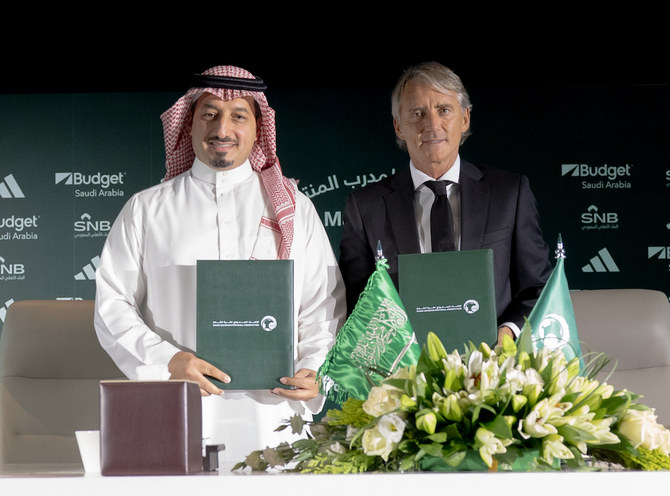
Roberto Mancini was officially unveiled as the manager of the Saudi national team at a ceremony in Riyadh on Monday. (Supplied/SAFF)
2 / 4
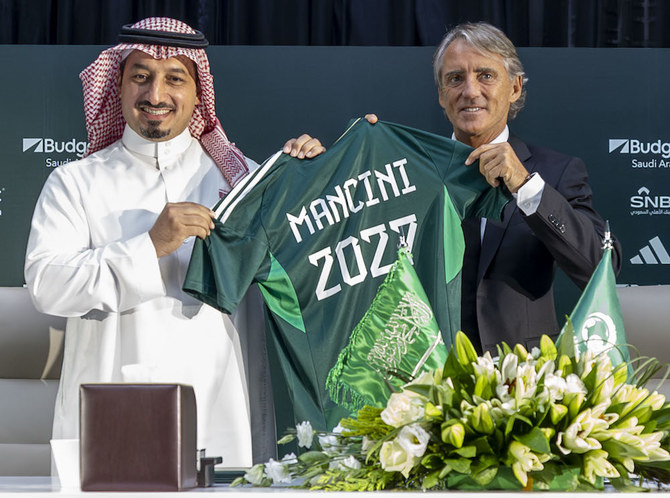
Roberto Mancini was officially unveiled as the manager of the Saudi national team at a ceremony in Riyadh on Monday. (Supplied/SAFF)
3 / 4
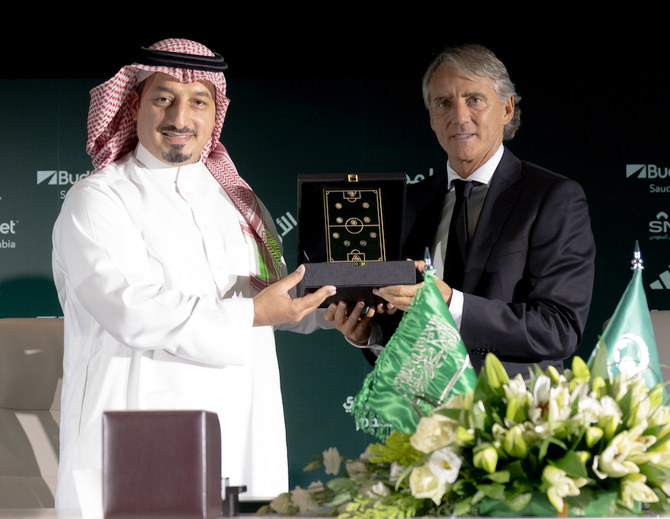
Roberto Mancini was officially unveiled as the manager of the Saudi national team at a ceremony in Riyadh on Monday. (Supplied/SAFF)
4 / 4
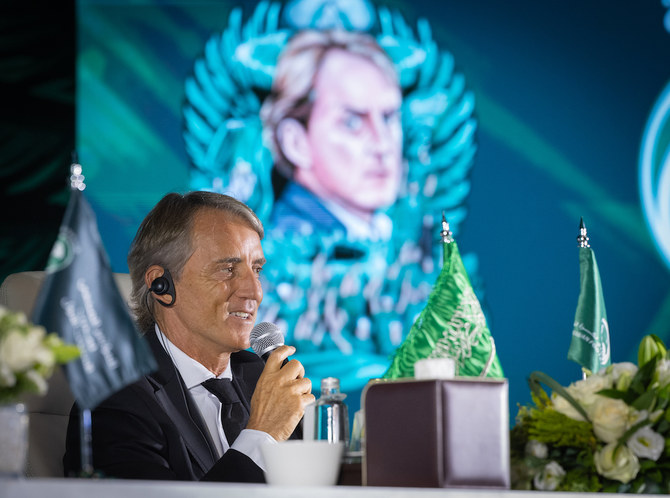
Roberto Mancini was officially unveiled as the manager of the Saudi national team at a ceremony in Riyadh on Monday. (Supplied/SAFF)
Short Url
Updated 28 August 2023
Follow

Roberto Mancini arrives in Riyadh to take over as manager of Saudi national team

  • The Italian was officially unveiled during a ceremony in Riyadh on Monday, a day after his appointment was announced
  • ‘We have good players, the previous coach did a great job, and in the coming period we need to translate our words into reality on the field,’ Mancini said

RIYADH: Roberto Mancini was officially unveiled as the new manager of the Saudi national team during a ceremony in Riyadh on Monday, a day after his appointment was announced.

During the event, Yasser Al-Misehal, the president of the Saudi Arabian Football Federation, expressed his excitement at securing the services of an internationally acclaimed coach to lead the Green Falcons, as he highlighted the Italian’s exceptional achievements and passion for the sport.

“There was some time in finalizing the deal for the Saudi national team manager and everyone knows the importance and sensitivity of this matter,” he said.

“Therefore, it deserved sufficient time to be settled in a distinguished manner. We are proud of our success in attracting a global coach, a coach who has achieved significant accomplishments and still possesses great passion for the game.

“We are fortunate that we have great support from our leadership and we have a significant responsibility to keep up with this support. Saudi Arabia has become attractive to all global names.”

Mancini discussed his initial plans and aspirations for the team. Not surprisingly, the first priority is getting to know the players and identifying key members of his squad.

“The next 10 days are important to see the players, and also in the past 10 days we have watched lots of videos on the teams and players,” he said.

“We have four friendly matches before the 2026 World Cup qualifiers, and we have enough time.”

He acknowledged the existing talent within the national team but added: “I am not a magician; we have exceptional talents and we can achieve our goals through continuous work.

“We have good players, the previous coach did a great job, and in the coming period we need to translate our words into reality on the field. Like I said before, we have good talent but we can achieve our goals by working hard.

“Our target is to win the Asian Cup after 27 years. Our target before that is we have four friendlies, we have two World Cup qualifiers, and after that we have a 20-day camp to prepare for the Asian Cup.”

Asked about the current football landscape in Saudi Arabia, with the arrival in recent months of several international stars to play in the Pro League, Mancini drew parallels with his home country.

“The same thing happened in Italy many years ago,” he said. “Lots of big foreign players came to Italy and we improved a lot. It’s good for the Saudi players and we have enough time to choose our players and we are prepared for that.”

Mancini takes over as manager from Frenchman Herve Renard, who stepped down in March after leading Saudi Arabia to the World Cup in Qatar. They were knocked out in the group stage but along the way shocked eventual tournament winners Argentina by defeating them 2-1 in their opening group game.


Morocco banish any doubts about ability to host World Cup 2030

Updated 19 January 2026
Follow

Morocco banish any doubts about ability to host World Cup 2030

  • Impressive stadiums, easy transportation links and a well-established tourism infrastructure ensured the 24-team tournament went off without any major hitch and will assuage any doubters about the World Cup in four years’ time

RABAT: Morocco’s successful staging of the Africa Cup of Nations means there should be no skepticism about its ability to co-host the World Cup with Portugal and Spain in 2030, even if Sunday’s final was clouded by a walk-off and defeat for the home team.

Impressive stadiums, easy transportation links and a well-established tourism infrastructure ensured the

24-team tournament went off without any major hitch and will assuage any doubters about the World Cup in four years’ time.

Morocco plans to use six venues in 2030 and five of them were used for the Cup of Nations, providing world-class playing surfaces and a spectacular backdrop.

The Grande Stade in Tangier with a 75,000 capacity is an impressive facility in the northern coastal city, less than an hour’s ferry ride from Spain.

Meanwhile, FIFA President Gianni Infantino condemned "some Senegal players" for the "unacceptable scenes" which overshadowed their victory in the final when they left the pitch in protest at a penalty awarded to Morocco.

African football's showpiece event was marred by most of the Senegal team walking off when, deep into injury time of normal play and with the match locked at 0-0, Morocco were awarded a spot-kick following a VAR check by referee Jean-Jacques Ndala for a challenge on Brahim Diaz.

security personnel at the other end of the stadium, Senegal's players eventually returned to the pitch to see Diaz shoot a soft penalty into the arms of their goalkeeper Edouard Mendy.

The match was played at the Stade Moulay Abdellah in the capital Rabat, which has a capacity of 69,500. The attendance for the final was 66,526.

Stadiums in Agadir, Fes and Marrakech were also more than adequate and will now be renovated over the next few years.

But the crowning glory is the proposed 115,000-capacity Stade Hassan II on ⁠the outskirts of Casablanca which Morocco hope will be chosen to host the final over Madrid’s Santiago Bernabeu Stadium.

In all, Morocco will spend $1.4 billion on the six stadiums. Also planned is extensive investment in airports, with some 10 Moroccan cities already running direct air links to Europe and many budget airlines offering flights to the country.

An extension of Africa’s only high-speed rail service, which already provides a comfortable three-hour ride from Tangier to Casablanca, further south to Agadir and Marrakech is also planned. Morocco hopes all of this will modernize its cities and boost the economy.

On the field, Morocco will hope to launch a credible challenge for a first African World Cup success, although on Sunday they continued their poor return in the Cup of Nations, where their only triumph came 50 years ago.

They surprised with a thrilling run to the last four at the Qatar 2022 World Cup as the first African nation to get that far and will hope for a similar impact at this year’s finals in North America. They are in Group C with Brazil, Scotland and Haiti.