

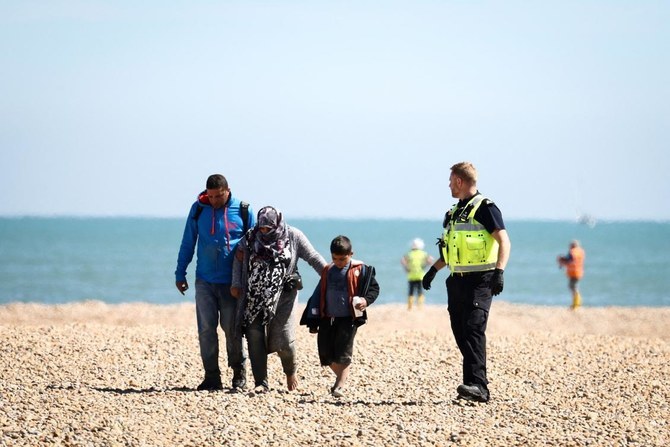

LONDON: Vulnerable children who arrive in the United Kingdom by small boat are being held in HMP Elmley, an adult prison with significant numbers of sex offenders.
The Observer cited a growing number of cases where unaccompanied children, many of whom appear to be trafficked, have been sent to Elmley, where foreign nationals are held. According to the latest inspection, the prison also houses sex offenders.
One of the 14 unaccompanied minors identified by the charity Humans for Rights Network as being sent to an adult prison was reportedly 14 when they spent seven months at Elmley.
The majority of cases involve children from Sudan or South Sudan who traveled to the UK through Libya, with most believed to have been trafficked or to have suffered some form of exploitation.
“Children are locked down in their cells, not knowing who to call for help, prevented from adequately accessing legal advice and from challenging the arbitrary decision made about their ages by immigration officials on arrival in the UK,” Maddie Harris, of Human for Rights Network, told the newspaper.
“These are children looking for safety who instead find themselves in an adult prison, denied protection and exposed to great harm,” she said.
Anita Hurrell, head of the migrant children’s project at the charity Coram, said: “It is wrong to criminalize these children and dangerous to send them to adult men’s prisons.”
The children have been charged with immigration offenses under the Nationality and Borders Act, which was enacted last year and includes harsher penalties to deter unlawful entry into the UK.
Lawyers warn that the practice of placing unaccompanied minors in adult prisons appears to be on the rise.
The Home Office judged that those sent to Elmley were adults after officials conducted what some experts describe as a “cursory and arbitrary” age assessment. Checks are often carried out within hours of individuals arriving in Britain by small boat.
Several Home Office decisions that led to children being sent to an adult prison have been overturned after detailed assessments by independent or local authority specialists.
Based on data from numerous councils, it has been revealed that over half of unaccompanied asylum-seeking children who undergo age assessments by the Home Office are later proven to be minors.
Syd Bolton, co-director of Equal Justice for Migrant Children, said that he considered the practice to be a “deliberate barrier to accessing asylum protection and denying young asylum-seekers access to children’s services. It is a major tool of the Home Office in discrediting an asylum claim.”
Elmley’s most recent inspection revealed that one out of every four inmates surveyed expressed feeling unsafe within the prison. Despite the fact that the prison is no longer designated to hold prisoners convicted of sexual offenses, 70 such inmates remained.
One inmate at Elmley had been convicted of 14 sex offenses and found guilty of abusing two children, the newspaper claimed.
“The children are always deeply harmed by the time they have spent in prison in the UK, expressing clearly how they are unable to sleep, do not understand why they were held there and struggle to speak about their time there,” Harris added.
Critics claim that the imprisoning of minors is an extension of the UK’s broken asylum system.
On Thursday, the backlog of asylum cases reached a record high of more than 175,000, a 44 percent increase on the previous year’s figure. This surge occurred despite the government almost doubling expenditure on asylum-related matters.
A government spokesperson said: “Assessing age is a challenging but vital process to identify genuine children and stop abuse of the system. We must prevent adults claiming to be children, or children being wrongly treated as adults — both present serious safeguarding risks.
“To further protect children, we are strengthening the age-verification process by using scientific measures, such as X-rays.”


