

'Happy moment' as first cargo arrives in Pakistan under new road trade deal with China 

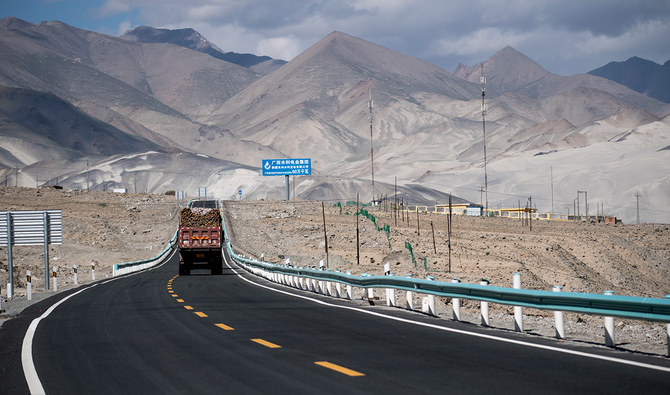
This picture taken on June 27, 2017 shows a truck driving along the China-Pakistan Friendship Highway before the Karakorum mountain range near Tashkurgan in China's western Xinjiang province. (AFP/File)
Short Url
Updated 27 August 2023
Follow

'Happy moment' as first cargo arrives in Pakistan under new road trade deal with China 

  • Development comes days after Pakistan, China launched an international road transport (TIR) route between Kashgar and Islamabad 
  • This is the first inaugural TIR trade route between China and Pakistan that highlights a fresh mode of cross-border transport for Xinjiang 

KHAPLU: A first-ever cargo carrying trade goods entered Pakistan on Sunday under a new road trade deal with China, a Pakistani customs official said, with local traders describing it as a “happy moment” for the northern Gilgit-Baltistan region. 

The development comes days after the two countries opened an international road transport (TIR) route between China’s inland city of Kashgar and the Pakistani capital of Islamabad, aiming to enhance cross-border trade. 

This is the first inaugural TIR trade route between China and Pakistan that highlights a fresh mode of cross-border transport for Xinjiang and potentially setting a precedent for future trade routes within the China-Pakistan Economic Corridor (CPEC). 

“Two consignments, bound for Afghanistan, have reached the Sost Dry Port under the TIR agreement,” Imtiaz Hussain, an assistant collector at Pakistan’s Silk Route Dry Port (SRDP) Sost, told Arab News. 

“The cargo will be cleared on Monday before leaving for Afghanistan.” 

Longtime ally Beijing has pledged over $65 billion in building CPEC infrastructure projects in Pakistan as part of China’s Belt and Road Initiative (BRI). The corridor includes a network of roads, railways, pipelines, and ports in Pakistan that will connect China to the Arabian Sea and help Islamabad expand and modernize its economy. 

Currently, the total volume of trade between China and Pakistan is above $12.06 billion, up nearly 19 percent as compared with 2021 when it stood at $10.14 billion due to COVID-19 pandemic. 

Speaking to Arab News, Imran Ali, president of the Gilgit-Baltistan Chamber of Commerce said the new trade route would bring prosperity to the region. 

“This is a happy moment for us. It will bring prosperity to the region and open the door for different kinds of business opportunities in Pakistan,” he told Arab News. 

“With the opening of this route, prices of commodities will also be slashed in the future.” 

Ali said this would be a “very feasible and shortest way” for Central Asian countries to connect with China. “The opening of this route is a good omen for Pakistani traders,” he added. 


ADB, Pakistan sign over $300 million agreements to undertake climate resilience initiatives

Updated 30 December 2025
Follow

ADB, Pakistan sign over $300 million agreements to undertake climate resilience initiatives

  • Pakistan ranks among nations most vulnerable to climate change and has seen erratic changes in weather patterns
  • The projects in Sindh and Punjab will restore nature-based coastal defenses and enhance agricultural productivity

ISLAMABAD: The Pakistani government and the Asian Development Bank (ADB) have signed more than $300 million agreements to undertake two major climate resilience initiatives, Pakistan’s Press Information Department (PID) said on Tuesday.

The projects include the Sindh Coastal Resilience Sector Project (SCRP), valued at Rs50.5 billion ($180.5 million), and the Punjab Climate-Resilient and Low-Carbon Agriculture Mechanization Project (PCRLCAMP), totaling Rs34.7 billion ($124 million).

Pakistan ranks among nations most vulnerable to climate change and has seen erratic changes in its weather patterns. In 2022, monsoon floods killed over 1,700 people, displaced another 33 million and caused over $30 billion losses, while another 1,037 people were killed in floods this year.

The South Asian country is ramping up climate resilience efforts, with support from the ADB and World Bank, and investing in climate-resilient infrastructure, particularly in vulnerable areas.

“Both sides expressed their commitment to effectively utilize the financing for successful and timely completion of the two initiatives,” the PID said in a statement.

The Sindh Coastal Resilience Project (SCRP) will promote integrated water resources and flood risk management, restore nature-based coastal defenses, and strengthen institutional and community capacity for strategic action planning, directly benefiting over 3.8 million people in Thatta, Sujawal, and Badin districts, according to ADB.

The Punjab project will enhance agricultural productivity and climate resilience across 30 districts, improving small farmers’ access to climate-smart machinery, introducing circular agriculture practices to reduce residue burning, establishing testing and training facilities, and empowering 15,000 women through skills development and livelihood diversification.

Earlier this month, the ADB also approved $381 million in financing for Pakistan’s Punjab province to modernize agriculture and strengthen education and health services, including concessional loans and grants for farm mechanization, Science, Technology, Engineering and Mathematics (STEM) education, and nursing sector reforms.