
RIYADH: In the face of worldwide economic uncertainty, Saudi Arabia stands out for its robust diversification efforts driven by Vision 2030 strategies, resulting in a surge of business activities despite prevailing concerns over inflation and geopolitical tensions.
The International Monetary Fund’s latest World Economic Outlook report forecasts a deceleration in global economic growth, dropping from 3.4 percent the previous year to 2.8 percent in 2023, with an expected rise of 3 percent next year.
The dire global economic forecast stems from a combination of factors, including the necessity for stringent policy measures to combat inflation, the ongoing conflict in Ukraine, the rise of geoeconomic fragmentation, and vulnerabilities within the nonbank financial sector.
Yet, across several Gulf Cooperation Council nations, most notably in Saudi Arabia, the gloomy global outlook has given way to optimism and enthusiastic economic growth.
Economic Diversification Index
Despite market volatility, Nasser Saidi & Associates — an economic and business advisory consultancy led by a Lebanese politician and economist who held roles as minister of economy and industry and vice governor for the Lebanese central bank— reveals that from 2000 to 2019, notable improvements in Economic Diversification Index scores are seen in countries such as China, the US, Saudi Arabia, Germany, and Oman.
Additionally, GCC nations, excluding Bahrain, rank among the top 20 countries that have advanced their EDI scores during this timeframe.
HIGHLIGHT
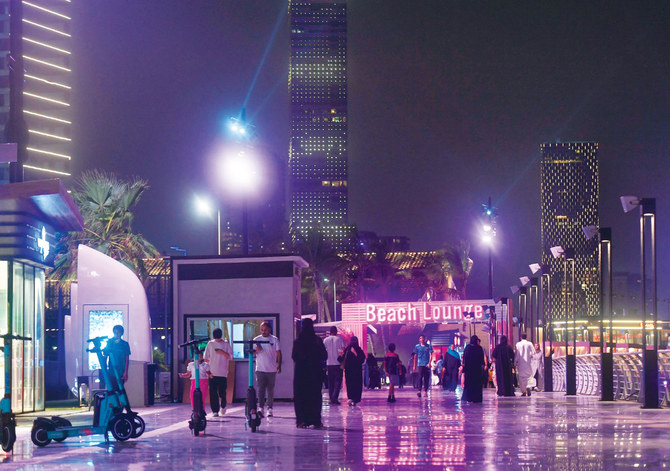
As Saudi Arabia continues its diversification journey, the tangible outcomes are evident on the output side. New sectors have opened in the realm of tourism, media, hospitality, entertainment, mining, metals, finance, and the digital sphere, including advancements in fintech, AI, and clean energy.
While Saudi Arabia ranks among the nations experiencing rapid EDI growth, it’s important to note that its journey started from a relatively modest base, notes Saidi.
The Kingdom’s earlier limited level of diversification implies that its pace would outstrip that of already highly diversified economies, he explains.
“There is a process of convergence toward highly diversified economies. We can expect this trend to continue.”
Similarly, the IMF highlights the surge in Saudi Arabia’s non-oil gross domestic product, which reached 4.8 percent of GDP in 2022, driven by robust private consumption and non-oil private investment, including giga projects. It forecasts that non-oil growth in the Kingdom will surpass 5 percent for the initial half of 2023.
While countries heavily reliant on oil exports have long found it difficult to diversify their economy, Saudi Arabia, thanks to its steadfast political commitment and Vision 2030 policies implemented at rapid speed, is now witnessing signs of success for its economic diversification plans.
“The Kingdom’s success can be attributed to the presence of a unified, whole-of-government approach, guided by the ambitious 2030 agenda,” Hussein Abul-Enin, head of Middle East, Access Partnership, tells Arab News.
Since Vision 2030 was launched in 2016 by Crown Prince and Prime Minister Mohammed bin Salman, the government has been implementing a number of economic and social reforms including reducing restrictions on women’s employment, developing new economic sectors, and reducing energy subsidies.
Saidi emphasizes that the improvement of Saudi’s EDI score is not surprising, given the conscious effort to expand the non-oil private sector’s contribution to the GDP — a pivotal component of the diversification strategy supported by economic policies.
“On the output side, diversification away from oil has benefitted from the size of the country as well as having relatively closed sectors although with relatively low levels of tariffs,” he says.
Emerging sectors
With the implementation of Vision 2030, Saidi says the nation is becoming more open, and new upcoming sectors, including digital economy, travel, tourism, logistics, recreation and culture, will add to the diversification efforts.
Abul-Enin further notes how the Kingdom’s economic diversification efforts have been largely successful owing to the government’s increasing investment in “digital transformation.”
“From accelerating the adoption of cloud for public sector services, to encouraging the use of emerging technologies (generative AI, robotics and distributed ledger technologies), Saudi Arabia has been able to achieve significant progress on achieving its economic diversification goals,” he tells Arab News.

Hussein Abul-Enin, head of Middle East, Access Partnership. (Supplied)
As Saudi Arabia continues its diversification journey, the tangible outcomes are evident on the output side. New sectors have opened in the realm of tourism, media, hospitality, entertainment, mining, metals, finance, and the digital sphere, including advancements in fintech, AI, and clean energy.
Abul-Enin stresses the country’s growth in the digital sector to overcome hurdles and challenges on the road to increased economic diversification.
“Saudi Arabia must continue to invest in advanced training modules and digital talent to overcome this hurdle,” he tells Arab News.
As Saudi Arabia approaches the realization of its Vision 2030, Abul-Enin expects the Kingdom to evolve into a regional economic and technology hub, with an increasingly significant role in global markets.
Sustaining growth
While Saudi Arabia’s economic diversification model is reaping notable benefits and success, oil still remains a dominant source of Saudi export and fiscal revenue, directly accounting for over 40 percent of its GDP, according to a report by the IMF in 2022.
“With respect to trade, oil is still the prominent commodity the Kingdom trades, however, being an international commodity, it is traded with a large, diversified set of nations (offering some buffer in case a few of the major trade partners' growth/ demand weakens),” explains Saidi.
However, as we look forward, the question arises: how can Saudi Arabia’s economic diversification model sustain its fruitful trajectory?
According to Saidi, Saudi investments in sectors like mining and metals, along with hospitality and tourism, including religious, cultural, and historical, “seem most likely to reap benefits.”
Additionally, there has also been the introduction of revenue-enhancing measures. These include measures such as value added tax at a comparatively higher rate of 15 percent compared to other GCC nations, along with excise and legislated taxes on specific goods and services at purchase.
These additions, explains Saidi, “have enabled the country to move away from the procyclical nature of government revenue that was evident in the past, tracking oil’s boom-bust cycles and leading to pro-cyclical fiscal policies.”
Saidi emphasizes that for Saudi Arabia, the continuation of fiscal consolidation efforts is vital, which includes implementing revenue-enhancing measures. As the country strives to attract regional headquarters to relocate to Riyadh, he says it would be interesting to see how the corporate taxation efforts are molded.
Further expansion of economic diversification opportunities can stem from the clean energy sector, particularly as the Kingdom advances its initiatives toward achieving net-zero emissions by 2060.
“The clean energy sector has much potential for growth — the nation could even export electricity generated from solar power via an interconnected grid all the way to Europe and/ or South Asia,” he states.
“In my view Saudi will emerge as a new energy powerhouse during this decade, building on its comparative advantage in solar power and exporting ‘green electricity’ and hydrogen,” Saidi concludes.