Philippines to pursue migrant workers’ welfare at ASEAN-GCC Summit

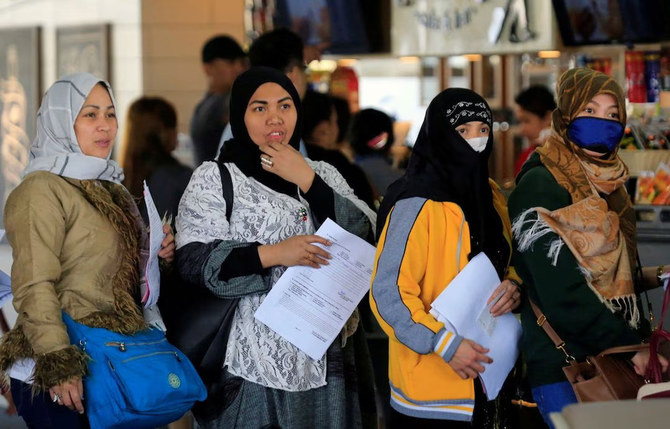
For Southeast Asian countries like the Philippines, migrant workers are key drivers of the local economy. (Reuters)
Short Url
Updated 19 October 2023
Follow

Philippines to pursue migrant workers’ welfare at ASEAN-GCC Summit

  • Around half of overseas Filipino workers are in Gulf countries
  • Inaugural ASEAN-GCC leaders’ summit scheduled for October

MANILA: The Philippine government is going to pursue the welfare of migrant workers at the upcoming Association of Southeast Asian Nations and Gulf Cooperation Council Summit, the Department of Foreign Affairs has said, as preparations are underway for the inaugural meeting in Riyadh.

Around half of some 1.8 million overseas Filipinos live and work in Gulf countries, according to the latest survey by the Philippine Statistics Authority.

Manila wants their welfare and protection to be discussed when leaders of the ASEAN — of which the Philippines is a founding member — convene with the GCC in the Saudi capital in October.

Daniel Espiritu, assistant secretary for ASEAN affairs at the Department of Foreign Affairs, told Arab News this week that while the summit’s agenda is expected to be finalized next month, the Philippines “will push” for the issue of migrant workers’ welfare to be included.

“The president will bring up the issue of migrant workers’ protection. That will be on top,” he said. The protection of migrant workers has long been a priority in ASEAN, as each year the region sends millions of them abroad. A declaration on their protection, especially in emergency situations like conflict, was adopted by ASEAN members during the ASEAN Summit in Indonesia in May.

For Southeast Asian countries like the Philippines, migrant workers are key drivers of the local economy. Remittances from overseas Filipino workers have in the past decade contributed an average of nearly 10 percent of the country’s gross domestic product.

“Migrant workers’ protection is a priority program of our government,” Arnold Mamaclay, president of the Philippine Employment Agencies and Associates for Corporate Employers in the Middle East, told Arab News.

“Pushing this in the summit will acknowledge their rights, ensure fair treatment, and foster cooperation between countries.”

According to Lito Soriano, former head of the Philippine Association of Service Exporters, discussing labor migration at the summit would help align Philippine policies with those of the receiving countries and make them mutually beneficial.

“This meeting of minds between ASEAN and GCC is a much-needed activity,” he said. “It helps the social and economic improvement of both the sending and receiving countries.”



Rubio says technical talks with Denmark, Greenland officials over Arctic security have begun

Updated 4 sec ago
Follow

Rubio says technical talks with Denmark, Greenland officials over Arctic security have begun

  • US Secretary of State on Wednesday appeared eager to downplay Trump’s rift with Europe over Greenland

WASHINGTON: Technical talks between the US, Denmark and Greenland over hatching an Arctic security deal are now underway, Secretary of State Marco Rubio said on Wednesday.
The foreign ministers of Denmark and Greenland agreed to create a working group aimed at addressing differences with the US during a Washington meeting earlier this month with Vice President JD Vance and Rubio.
The group was created after President Donald Trump’s repeated calls for the US to take over Greenland, a Danish territory, in the name of countering threats from Russia and China — calls that Greenland, Denmark and European allies forcefully rejected.
“It begins today and it will be a regular process,” Rubio said of the working group, as he testified before the Senate Foreign Relations Committee. “We’re going to try to do it in a way that isn’t like a media circus every time these conversations happen, because we think that creates more flexibility on both sides to arrive at a positive outcome.”
The Danish Foreign Ministry said Wednesday’s talks focused on “how we can address US concerns about security in the Arctic while respecting the red lines of the Kingdom.” Red lines refers to the sovereignty of Greenland.
Trump’s renewed threats in recent weeks to annex Greenland, which is a semiautonomous territory of a NATO ally, has roiled US-European relations.
Trump this month announced he would slap new tariffs on Denmark and seven other European countries that opposed his takeover calls, only to abruptly drop his threats after a “framework” for a deal over access to the mineral-rich island was reached, with NATO Secretary-General Mark Rutte’s help. Few details of the agreement have emerged.
After stiff pushback from European allies to his Greenland rhetoric, Trump also announced at the World Economic Forum in Davos, Switzerland, last week that he would take off the table the possibility of using American military force to acquire Greenland.
The president backed off his tariff threats and softened his language after Wall Street suffered its biggest losses in months over concerns that Trump’s Greenland ambitions could spur a trade war and fundamentally rupture NATO, a 32-member transatlantic military alliance that’s been a linchpin of post-World War II security.
Rubio on Wednesday appeared eager to downplay Trump’s rift with Europe over Greenland.
“We’ve got a little bit of work to do, but I think we’re going to wind up in a good place, and I think you’ll hear the same from our colleagues in Europe very shortly,” Rubio said.
Rubio during Wednesday’s hearing also had a pointed exchange with Sen. Tim Kaine, D-Virginia, about Trump repeatedly referring to Greenland as Iceland while at Davos.
“Yeah, he meant to say Greenland, but I think we’re all familiar with presidents that have verbal stumbles,” Rubio said in responding to Kaine’s questions about Trump’s flub — taking a veiled dig at former President Joe Biden. “We’ve had presidents like that before. Some made a lot more than this one.”