

US envoy meets family of Iranian-German imprisoned in Iran

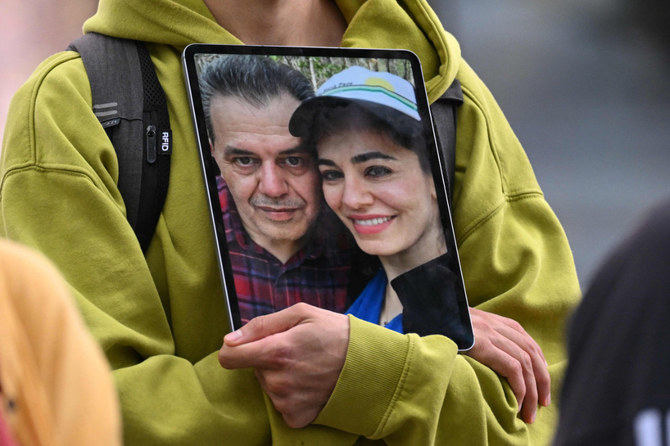
A demonstrator holds a picture of Iranian-German Jamshid Sharmahd (L), who has been sentenced to death in Iran, with his daughter Gazelle Sharmahd during a demonstration for his release in front of the German Foreign Ministry in Berlin on July 31, 2023. (AFP)
Short Url
Updated 26 August 2023
Follow

US envoy meets family of Iranian-German imprisoned in Iran

  • Jamshid Sharmahd is being held on charges of being a ringleader of the "terrorist Tondar group" backed by the US
  • Gazelle Sharmahd asks that father be part of whatever is agreed to free US nationals

WASHINGTON: A US envoy for Iran met on Friday with the family of Iranian-German national Jamshid Sharmahd, who was sentenced to death in February in Iran after being convicted of heading a pro-monarchist group accused of a deadly 2008 bombing.
Deputy Special Envoy Abram Paley posted a picture of himself with Sharmahd’s son Shayan and daughter Gazelle on the social media site X, formerly known as Twitter.
“I welcomed the opportunity to meet with Jamshid Sharmahd’s family today. He should have never been detained in Iran, and we hope to see the day he is reunited with his loved ones,” Paley wrote.
Responding to the post, Gazelle Sharmahd said she had told Paley she needed “actions” and that her father must be part of whatever is agreed to free US nationals.
“We will continue to urge the Biden Administration to work with stakeholders to #LeaveNoOneBehind or stop negotiations with my dad’s kidnappers,” Sharmahd said on X.
Jamshid Sharmahd, who also has US residency, was arrested in 2020. Iran’s intelligence ministry at the time described him as “the ringleader of the terrorist Tondar group, who directed armed and terrorist acts in Iran from America.”
Based in Los Angeles, the little-known Kingdom Assembly of Iran, or Tondar, says it seeks to restore the Iranian monarchy that was overthrown by the 1979 Islamic revolution. It runs pro-Iranian opposition radio and television stations abroad.


US Catholic cardinals urge Trump administration to embrace a moral compass in foreign policy

(From L): Cardinal Blase Cupich, cardinal Robert McElroy and cardinal Joseph Tobin. (AP file photo)
Updated 6 sec ago
Follow

US Catholic cardinals urge Trump administration to embrace a moral compass in foreign policy

  • The three cardinals, who are prominent figures in the more progressive wing of the US church, took as a starting point a major foreign policy address that Pope Leo XIV delivered Jan. 9 to ambassadors accredited to the Holy See

ROME: Three US Catholic cardinals urged the Trump administration on Monday to use a moral compass in pursuing its foreign policy, saying US military action in Venezuela, threats of acquiring Greenland and cuts in foreign aid risk bringing vast suffering instead of promoting peace.
In a joint statement, Cardinals Blase Cupich of Chicago, Robert McElroy of Washington and Joseph Tobin of Newark, N.J., warned that without a moral vision, the current debate over Washington’s foreign policy was mired in “polarization, partisanship, and narrow economic and social interests.”
“Most of the United States and the world are adrift morally in terms of foreign policy,” McElroy told The Associated Press. “I still believe the United States has a tremendous impact upon the world.”
The statement was unusual and marked the second time in as many months that members of the US Catholic hierarchy have asserted their voice against a Trump administration many believe isn’t upholding the basic tenets of human dignity. In November, the entire US conference of Catholic bishops condemned the administration’s mass deportation of migrants and “vilification” of them in the public discourse.
The three cardinals, who are prominent figures in the more progressive wing of the US church, took as a starting point a major foreign policy address that Pope Leo XIV delivered Jan. 9 to ambassadors accredited to the Holy See.
The speech, delivered almost entirely in English, amounted to Leo’s most substantial critique of US foreign policy. History’s first US-born pope denounced how nations were using force to assert their dominion worldwide, “completely undermining” peace and the post-World War II international legal order.
Leo didn’t name individual countries, but his speech came against the backdrop of the then-recent US military operation in Venezuela to remove Nicolás Maduro from power, US threats to take Greenland as well as Russia’s ongoing war in Ukraine.
The US Conference of Catholic Bishops was consulted on the statement, and its president, Archbishop Paul Coakley, “supports the emphasis placed by the cardinals on Pope Leo’s teaching in these times,” said spokesperson Chieko Noguchi.
The White House didn’t immediately respond to the AP’s request for comment on Monday.
Cardinals question the use of force
The three cardinals cited Venezuela, Greenland and Ukraine in their statement — saying they “raised basic questions about the use of military force and the meaning of peace” — as well as the cuts to foreign aid that US President Donald Trump’s administration initiated last year.
“Our country’s moral role in confronting evil around the world, sustaining the right to life and human dignity, and supporting religious liberty are all under examination,” they warned.
“We renounce war as an instrument for narrow national interests and proclaim that military action must be seen only as a last resort in extreme situations, not a normal instrument of national policy,” they wrote. “We seek a foreign policy that respects and advances the right to human life, religious liberty, and the enhancement of human dignity throughout the world, especially through economic assistance.”
Tobin described the moral compass the cardinals wish the US would use globally.
“It can’t be that my prosperity is predicated on inhuman treatment of others,” he told the AP. “The real argument isn’t just my right or individual rights, but what is the common good.”
Cardinals expand on their statement in interviews with AP
In interviews, Cupich and McElroy said the signatories were inspired to issue a statement after hearing from several fellow cardinals during a Jan. 7-8 meeting at the Vatican. These other cardinals expressed alarm about the US action in Venezuela, its cuts in foreign aid and its threats to acquire Greenland, Cupich said.
A day later, Leo’s nearly 45-minute-long speech to the diplomatic corps gave the Americans the language they needed, allowing them to “piggyback on” the pope’s words, Cupich said.
Cupich acknowledged that Maduro’s prosecution could be seen positively, but not the way it was done via a US military incursion into a sovereign country.
“When we go ahead and do it in such a way that is portrayed as saying, ‘Because we can do it, we’re going to do it, that might makes right’ — that’s a troublesome development,” he said. “There’s the rule of law that should be followed.”
Trump has insisted that capturing Maduro was legal. On Greenland, Trump has argued repeatedly that the US needs control of the resource-rich island, a semiautonomous region of NATO ally Denmark. for its national security.
The Trump administration last year significantly gutted the US Agency for International Development, saying its projects advance a liberal agenda and were a waste of money.
Tobin, who ministered in more than 70 countries as a Redemptorist priest and the order’s superior general, lamented the retreat in USAID assistance, saying US philanthropy makes a big difference in everything from hunger to health.
The three cardinals said their key aim wasn’t to criticize the administration, but rather to encourage the US to regain is moral standing in the world by pursuing a foreign policy that is ethically guided and seeks the common good.
“We’re not endorsing a political party or a political movement,” Tobin said. The faithful in the pews and all people of good will have a role to play, he said.
“They can make an argument of basic human decency,” he said.