

Canada thrash France as Basketball World Cup tips off

1 / 2
Canada guard Shai Gilgeous-Alexander shoots against France forward Nicolas Batum (5) during the Basketball World Cup Group H match between France and Canada at the Indonesia Arena stadium in Jakarta on Friday. (AP)
2 / 2
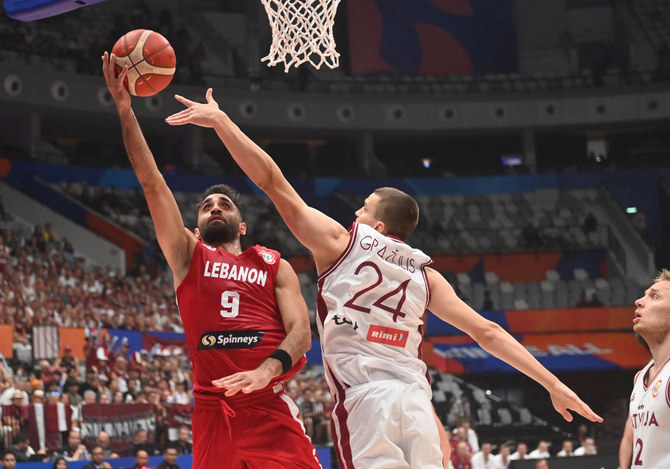
Lebanon's Sergio El Darwich scores during the FIBA Basketball World Cup Group H match between Latvia and Lebanon at Indonesia Arena in Jakarta on Friday. (AFP)
Short Url
Updated 26 August 2023
Follow

Canada thrash France as Basketball World Cup tips off

  • Canadians blew their opponents away, stepping on the gas in the second half to run away with a 95-65 victory
  • Philippines roared on by over 38,000 fans drop an 87-81 decision against Dominican Republic at  Philippine Arena

JAKARTA: Canada opened the Basketball World Cup with a statement win over France on Friday, while cohosts the Philippines fell short of a memorable victory in front of their raucous fans.

There were also wins for Italy, Australia, Montenegro, Latvia, the Dominican Republic, Lithuania and Germany as the tournament tipped off in the Philippines, Japan and Indonesia.

Canada came into the tournament with a squad packed with NBA talent but they faced a stiff test against France, who won silver at the Tokyo Olympics two years ago.

In the event the Canadians blew their opponents away, stepping on the gas in the second half to run away with a 95-65 victory.

Canada outscored the French 25-8 in the third quarter and Shai Gilgeous-Alexander finished as the game’s top scorer with 27 points, despite failing to get on the scoresheet in the first quarter.

“It’s always good to be rewarded when you’ve been working so hard, so I give these guys all the credit in the world,” said head coach Jordi Fernandez.

“The most important game of your life is your next game, and if we think differently, we’re wrong.”

Canada lost key guard Jamal Murray on the eve of the tournament, when he withdrew saying his body needed more time to recover after winning the NBA title with the Denver Nuggets last season.

“We have a lot of guys on this team that are hungry, talented, and ultimately just want to win,” said Gilgeous-Alexander.

“When you have those three things, you can do anything.”

Evan Fournier scored 21 points for France, who now take on Latvia on Sunday with their tournament hanging in the balance.

Fournier said his team “got our ass kicked.”

“As a team, they forced us to do things that we don’t want to do,” said the New York Knicks small forward.

“At first we were able to score every now and then, our defense was solid, but as the game went on they kept applying pressure and it just got the best of us.”

Elsewhere in Group H, tournament debutants Latvia beat Lebanon 109-70.

In Group A, the Philippines were roared on by over 38,000 fans as they took on the Dominican Republic at Philippine Arena in Bocaue, Bulacan outside Metro Manila.

They gave as good as they got against a Dominican side featuring three-time NBA All Star Karl-Anthony Towns.



Philippines' Jordan Clarkson shoots over Dominican Republic's Gelvis Solano during the FIBA Basketball World Cup Group A match between Philippines and Dominican Republic at Philippine Arena on Friday. (AFP)

But the home team came unstuck when star player Jordan Clarkson fouled out late in the fourth quarter, and went on to lose 87-81.

Head coach Chot Reyes was not impressed with the referee’s decision to call the final foul on Utah Jazz shooting guard Clarkson.

“I might get fined and we are a PG-13 audience here,” he said.

In the day’s other Group A game, Italy beat Angola 81-67.

In Group E, Australia made a slow start before eventually running out comfortable 98-72 winners over Finland on the southern Japanese island of Okinawa.

Josh Giddey flirted with a triple-double, claiming 14 points, nine rebounds and eight assists, while Patty Mills scored 25 points.

But 20-year-old Oklahoma City Thunder star Giddey warned that the Boomers must improve when they play Germany in their second game on Sunday.

“It’s hard in FIBA because it’s a shorter game — slow starts can cost you a ballgame,” said Giddey, whose team trailed after the first quarter.

“We were lucky tonight, we were switched on from the second quarter onwards.”

Elsewhere in Group E, Germany beat cohosts Japan 81-63, with 25 points from forward Moritz Wagner.

In Group D, Lithuania beat Egypt 93-67 and Montenegro beat Mexico 91-71.


Will Afghanistan’s pledge against cross-border attacks ease tensions with Pakistan?

Updated 8 sec ago
Follow

Will Afghanistan’s pledge against cross-border attacks ease tensions with Pakistan?

  • Afghan clerics’ decree banned use of Afghan soil for cross-border attacks on Wednesday
  • Latest heavy firing between Afghanistan, Pakistan killed at least 5 people 

KABUL: As tensions flare up again between Afghanistan and Pakistan, the Afghan leadership has moved to reaffirm its commitment against cross-border militancy this week in what is seen as Kabul’s attempt to move the needle on peace negotiations, after multiple rounds of talks failed to produce a lasting truce. 

The neighboring countries have struggled to maintain a fragile ceasefire after border clashes killed dozens in October, the worst fighting since the Taliban took control of Afghanistan in 2021.

While subsequent talks toward a permanent ceasefire yielded little progress, the temporary truce brokered by Qatar and Turkiye collapsed last Friday, with heavy firing along the Spin Boldak-Chaman border that killed at least five people. 

Over the years Pakistan has put much of the blame for the border clashes on the government in Kabul allowing Tehreek-e-Taliban Pakistan — an outlawed armed group, which is separate from the Afghan Taliban — to use Afghan territory for cross-border attacks — a claim that Afghanistan has repeatedly denied.

Afghanistan again pledged to prevent its territory from being used to harm other countries on Thursday, with Taliban Foreign Minister Amir Khan Muttaqi highlighting it as a religious duty, as endorsed just a day earlier by around 1,000 Afghan clerics in a fatwa, or religious decree.

“The fatwa was more political than religious,” Kabul University lecturer Abdullah Awwab told Arab News on Friday. 

“I think it was a smooth way out of the pressure put on them by Pakistan and mediators, who were asking for a fatwa against the TTP. The emirate couldn’t issue that, so instead they had scholars issue a fatwa for ordinary Afghans, banning them from jihad abroad.

“The fatwa shows Pakistan that the Taliban can use a fatwa to stop Afghans from joining the war. It demonstrates Kabul’s power and control over its own soil and people — and, at the same time, it shows Pakistan’s weakness in needing to ask Kabul for a religious fatwa.”

Addressing new graduates at a ceremony in Kabul, Muttaqi said the Taliban had not “permitted anyone to carry out military activities in other countries” and that the government had the right to take action against anyone who violated the directive. 

“The leaders and elders of this Islamic emirate have pledged that Afghan soil will not be used to harm anyone. All the scholars and religious leaders affirmed that obeying this commitment is necessary for all Muslims,” he said. 

“Just as this nation has historically acted upon the fatwas and advice of its scholars, so too will (it) act upon them now. This is our shared duty.” 

Asif Durrani, Pakistan’s former special envoy to Afghanistan, said the decree was a “very significant” development.

“Hopefully, the TTP, which owes allegiance to the Taliban’s Supreme Leader Mullah Hibatullah Akhundzada, will now submit to the collective wisdom of the Afghan Taliban ulema and surrender arms,” he wrote on X. 

Though the decree answers one of Pakistan’s demands, Afghan political analyst Wasi Baheer said it had “no direct impact” in the conflict.

“Pakistan’s harsh words and threats to Kabul don’t mean much, because the real issue is inside Pakistan,” he told Arab News.

“They cannot simply force changes in Kabul. The main reason talks collapsed in Qatar, Istanbul, and Saudi Arabia is that Pakistan demanded the Taliban act harshly against the TTP — which makes no sense, because it is an internal Pakistani problem. Using force here in Afghanistan will not bring any relief to Pakistan’s security.”