

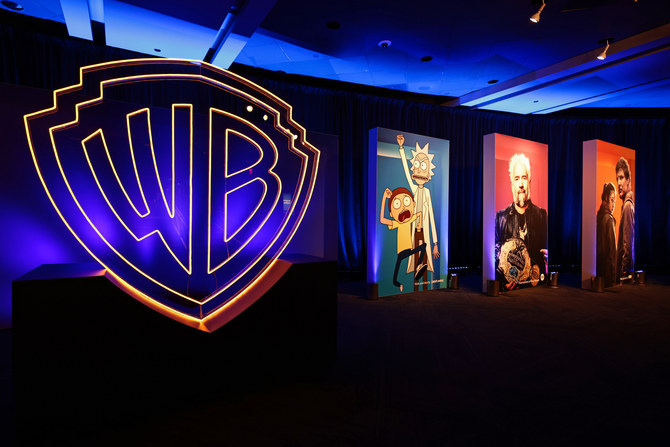

DUBAI: Warner Bros. Discovery celebrated its 100th anniversary this year, and as part of its centennial campaigns plans to further expand its presence in the Middle East.
The company has only recently started investing in the Middle East. This includes the theme park Warner Bros. World Abu Dhabi that was launched in 2018, original content, and partnerships with local brands.
“We are dedicated to expanding our presence and offerings in the region,” Francesco Perta, vice president of business development and distribution, Warner Bros. Discovery, MENAT, told Arab News recently. He said the region is “home to immense diversity, and our equally diverse content portfolio aims to continue elevating entertainment experiences for all audiences.”
The company is focused on two key initiatives with regard to content, he added, which is investing in content localization through dubbing and subtitling, and original local productions.
He said local partnerships are crucial “in ensuring the authenticity of our storytelling while reaffirming our dedication to supporting Arab entertainment.” This was reflected in the positive reception of shows including “Khaymat Ramadan,” “Dare to Take Risks,” and “Escape Kitchen,” said Perta.
The regional adaptation of the popular reality show “Say Yes to the Dress” became one of the most streamed Discovery+ shows after its launch early last year, he added.
Warner Bros. Discovery is set to launch another local production in September, “Dr. Implant Master,” which will feature dentist Dr. Barbara Sobczak performing procedures on patients with different problems.
The series, which is filmed entirely in Dubai, will introduce a new patient in every episode “allowing audiences to witness some of Dubai’s residents’ lives transformed one smile at a time,” said Perta.
However, “great stories are nowhere without effective platforms,” and so, “we have adopted a unique distribution strategy in the Middle East” that is designed to reach audiences across various channels including linear TV, streaming and cinemas, he explained.
“I’ve always believed that standing out does not mean standing alone,” Perta said, referring to the company’s partnerships with streaming platforms OSN+, STARZPLAY, Shahid, TOD and STC TV; traditional networks and broadcasters OSN and beIN; and cable providers du, Etisalat, Ooredoo and stc.
Partnering with such homegrown platforms has allowed the company “to get a grasp of invaluable consumer insights in record time and establish instant brand awareness,” he said.
Perta said the company is committed to its partnership model and does not plan to launch any independent streaming platform.
Although “creative alignment, quality control, language barriers, and regulatory compliance are some of the aspects that need to be effectively managed between partners,” the model “has posed more pros to us than cons,” he said.
Since the onset of COVID-19, the entertainment industry has undergone massive shifts with companies focusing “on attracting and retaining subscribers by investing heavily in original content to stay competitive,” said Perta.
Warner Bros. Discovery’s approach to the competition was to “strategically leverage” its content libraries by combining Warner Bros.’ films and TV shows with Discovery’s reality content, he added.
As the “streaming revolution continues,” the company is mindful of not neglecting traditional or linear TV, which Perta believes “will persist, especially for news and sports.”
To this end, last year, Warner Bros. Discovery partnered with Saudi Research and Media Group, or SRMG, to launch a new free-to-air Arabic channel Asharq Discovery.
“This innovative channel is an authentic gateway, bridging Middle East and global viewers by offering compelling content, enriching experiences, and unforgettable stories from the Arab region,” said Perta.
The media behemoth is aware of the changing landscape “where consumers no longer passively watch content,” he added.
It is, therefore, taking “proactive measures to immerse viewers in the magic of our stories” not just globally but in the Middle East as well through initiatives like the theme park in Abu Dhabi and candlelight concerts in 100 cities around the world including Dubai.
“As we look to the future, our unwavering commitment to consumers and the Middle East remains at the heart of our strategy,” said Perta.
Inspired by the fast-paced growth of the region, Warner Bros. Discovery is dedicated to supporting local government initiatives such as the Saudi Vision 2030 plan, he added.
It has partnered with development company Saudi Entertainment Ventures or SEVEN, part of Saudi Arabia’s Public Investment Fund, to “bring purpose-built indoor adventure centers to the Kingdom, with the aim to contribute to its tourism goals,” Perta explained.
The attraction, which will first open in Riyadh, will feature Discovery content, marking a global first for the company.
Perta said: “By staying attuned to regional audience’s preferences and evolving tastes, we will continuously expand our diverse offerings that not only enthrall with world-class storytelling but also champion the Middle East’s entertainment industry.”


