


India’s lunar rover goes down a ramp to the moon’s surface and takes a walk

1 / 6
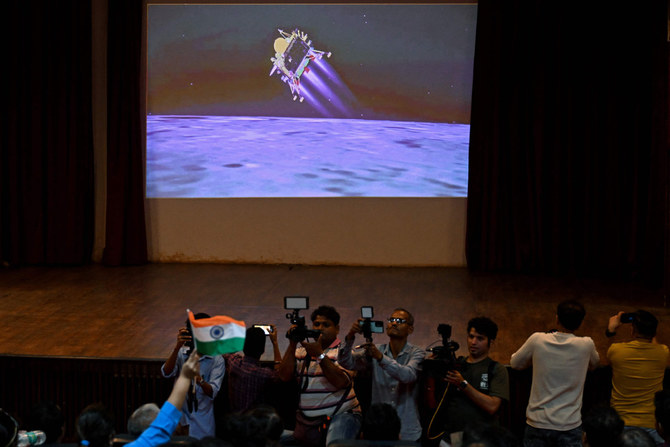
People watch a live stream aired by Indian Space Research Organization (ISRO) website at the Nehru Science Centre in Mumbai on August 23, 2023, minutes before the successful lunar landing of Chandrayaan-3 spacecraft on the south pole of the Moon. (AFP)
2 / 6
Indians celebrate on the streets of Ahmedabad on August 24, 2023, the successful lunar landing of Chandrayaan-3 spacecraft on the south pole of the moon. (AFP)
3 / 6
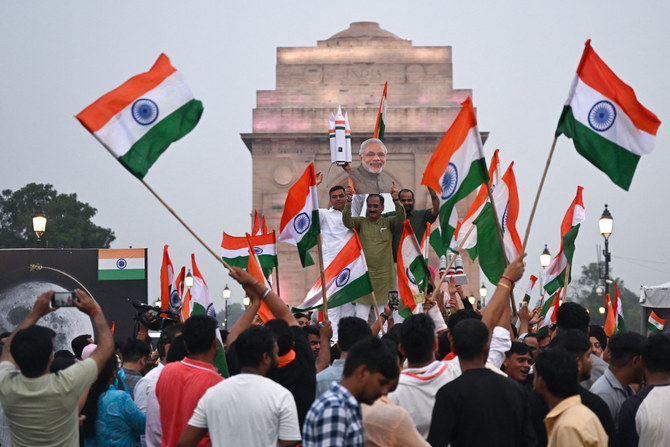
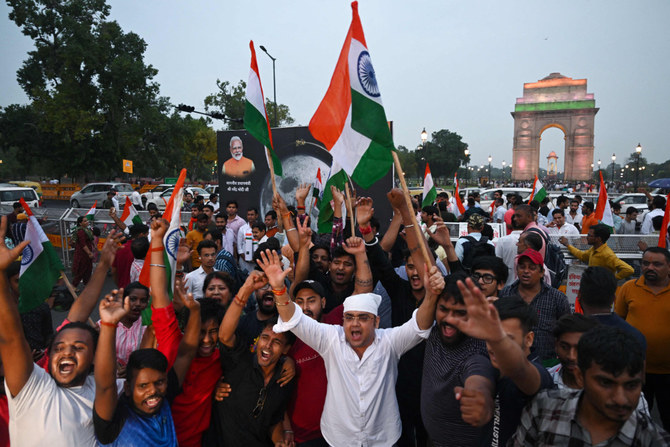
Indians wave national flags in New Delhi on August 23, 2023, as they celebrate the successful lunar landing of Chandrayaan-3 spacecraft on the south pole of the moon. (AFP)
4 / 6
Indians wave national flags in New Delhi on August 23, 2023, as they celebrate the successful lunar landing of Chandrayaan-3 spacecraft on the south pole of the moon. (AFP)
5 / 6
Indians distribute sweets on the streets of Mumbai on August 24, 2023, the successful lunar landing of Chandrayaan-3 spacecraft on the south pole of the moon. (AFP)
6 / 6
Indians wave national flags as they celebrate on the streets of Mumbai on August 24, 2023, the successful lunar landing of Chandrayaan-3 spacecraft on the south pole of the moon. (AFP)
Short Url
Updated 25 August 2023
Follow

India’s lunar rover goes down a ramp to the moon’s surface and takes a walk

  • The Chandrayan-3 Rover would conduct experiments over 14 days, says state-run Indian Space Research Organization
  • Residents of the world’s most populous country erupt into jubilation. "The moon is Indian," the Indian Express newspaper screams

NEW DELHI: A lunar rover slid down a ramp from the lander of India’s spacecraft within hours of its historic touch-down near the moon’s south pole, Indian space officials said Thursday, as the country celebrated its new scientific accomplishment.
“India took a walk on the moon,” the state-run Indian Space Research Organization said, adding that the Chandrayan-3 Rover would conduct experiments over 14 days, including an analysis of the mineral composition of the lunar surface.
Residents of the world’s most populous country had crowded around televisions in offices, shops, and restaurants on Wednesday and erupted into clapping, dancing, and exchanging of sweets when they saw the lander’s smooth touchdown. It landed on uncharted territory that scientists believe could hold vital reserves of frozen water.
“India Goes Where No Nation’s Gone Before,’’ read Thursday’s headline in The Times of India daily, while the Indian Express newspaper exclaimed, “The moon is Indian.”

Ajay Bhargava, a New Delhi-based architect, said it was a great experience watching broadcasts of the landing, and that he felt it was the culmination of hard work by India’s scientists over the years.
“Prime Minister Narendra Modi or any other politician should not take credit for this achievement,” Bhargava said in a telephone interview.

Indian Space Research Organization Chairman S. Somnath said the lander had touched down close to the center of the 4.5-kilometer-wide (2.8-mile-wide) area that had been targeted for the landing. “It landed within 300 meters (985 feet) of that point,” the Press Trust of India cited him as saying.
The rover was on the move, and working "very well,” Somnath said.
Somnath said there are two scientific instruments in the rover and three instruments on board the lander, and all of them have been switched on sequentially.
“They will study basically the mineral composition of the moon, as well as the atmosphere of the moon and the seismic activities there,” he added.
After a failed attempt to land on the moon in 2019, India on Wednesday joined the United States, the Soviet Union and China as only the fourth country to achieve this milestone.

The successful mission showcases India’s rising standing as a technology and space powerhouse and dovetails with the image that Modi is trying to project: an ascendant country asserting its place among the global elite.
The mission began more than a month ago at an estimated cost of $75 million. Somnath said that India would next attempt a manned lunar mission.
Many countries and private companies are interested in the South Pole region because its permanently shadowed craters may hold frozen water that could help future astronaut missions, as a potential source of drinking water or to make rocket fuel.
India’s success comes just days after Russia’s Luna-25, which was aiming for the same lunar region, spun into an uncontrolled orbit and crashed. It would have been the first successful Russian lunar landing after a gap of 47 years. Russia’s head of the state-controlled space corporation Roscosmos attributed the failure to the lack of expertise due to the long break in lunar research that followed the last Soviet mission to the moon in 1976.
Active since the 1960s, India has launched satellites for itself and other countries, and successfully put one in orbit around Mars in 2014. India is planning its first mission to the International Space Station next year, in collaboration with the United States.


Bangladesh’s religio-political party open to unity govt

Updated 01 January 2026
Follow

Bangladesh’s religio-political party open to unity govt

  • Opinion polls suggest that Jamaat-e-Islami will finish a close second to the Bangladesh Nationalist Party in the first election it has contested in nearly 17 years

DHAKA: A once-banned Bangladeshi religio-political party, poised for its strongest electoral showing in February’s parliamentary vote, is open to joining a unity government and has held talks with several parties, its chief said.

Opinion polls suggest that Jamaat-e-Islami will finish a close second to the Bangladesh Nationalist Party in the first election it has contested in nearly 17 years as it marks a return to mainstream politics in the predominantly Muslim nation of 175 million.

Jamaat last held power between 2001 and 2006 as a junior coalition partner with the BNP and is open to working with it again.

“We want to see a stable nation for at least five years. If the parties come together, we’ll run the government together,” Jamaat chief Shafiqur Rahman said in an interview at his office in a residential area in Dhaka, ‌days after the ‌party created a buzz by securing a tie-up with a Gen-Z party.

Rahman said anti-corruption must be a shared agenda for any unity government.

The prime minister will come from the party winning the most seats in the Feb. 12 election, he added. If Jamaat wins the most seats, the party will decide whether he himself would be a candidate, Rahman said.

The party’s resurgence follows the ousting of long-time Prime Minister Sheikh Hasina in a youth-led uprising in August 2024. 

Rahman said Hasina’s continued stay in India after fleeing Dhaka was a concern, as ties between the two countries have hit their lowest point in decades since her downfall.

Asked about Jamaat’s historical closeness to Pakistan, Rahman said: “We maintain relations in a balanced way with all.”

He said any government that includes Jamaat would “not feel comfortable” with President Mohammed Shahabuddin, who was elected unopposed with the Awami League’s backing in 2023.