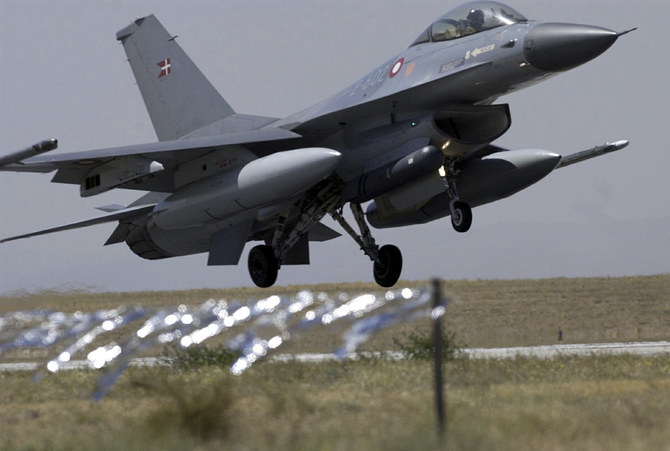
WASHINGTON: The US will start training Ukrainian pilots to fly US-made F-16 fighter jets, beginning at an Air National Guard base in October, the Pentagon said Thursday.
The training is part of a US and European effort to get the advanced fighter jets to Ukraine for its defense against invading Russian forces.
The announcement came as President Joe Biden spoke with Ukrainian President Volodymyr Zelensky to commemorate Ukraine’s Independence Day and to reiterate support for the effort to fight back Russian troops.
The two discussed the F-16 training, and Biden assured Zelensky of an expedited approval for other nations to transfer their F-16s to Ukraine once training is completed, the White House said in a statement.
Zelensky thanked Biden, Congress and “all Americans” in a post on X, the platform formerly known as Twitter. “The US took the lead in rallying global support for Ukraine. This crucial leadership enabled our struggle and bent the arc of history toward good.”
US military officials stress it takes years of training to be able to field F-16 squadrons, limiting the impact the aircraft will have on Ukraine’s defense for the near future.
“This is about the long-term support to Ukraine,” the Pentagon spokesman, Brig. Gen. Pat Ryder, told reporters in Washington. “This is not about the counteroffensive that they’re conducting right now.”
The training will take place at Morris Air National Guard base in Tucson, Arizona. The pilots will first undergo English instruction at Lackland Air Force Base in San Antonio, Texas, to bring their fluency up to the level needed to operate the aircraft, starting next month, Ryder said.
Ukraine has long pressed for the American fighter jets to help defend its cities and forces from Russian artillery and aviation. Denmark, the Netherlands and Norway announced in recent days they would supply the aircraft to Ukraine.
Ryder said the US decided to join European allies in the training to avoid bottlenecks in bringing Ukrainian pilots up to speed.
The US training would accommodate “several” Ukrainian fighter pilots and dozens of maintenance people for the jets, he said.
For experienced pilots, training can range around five months, Ryder said. He sketched out courses covering the basics. In addition to flying the advanced craft, they include formation flying, operating weapons, air combat and suppressing air defense systems, on top of centrifuge training on the ground to help pilots withstand the g-forces of an F-16 cockpit.


![]()
![]()


US will start training Ukrainian pilots on F-16s at air base in Arizona

Short Url
https://arab.news/vzrat
US will start training Ukrainian pilots on F-16s at air base in Arizona
- The training is part of a US and European effort to get the advanced fighter jets to Ukraine for its defense against invading Russian forces
- Several Ukrainian fighter pilots and dozens of maintenance people for the jets will be trained, says Pentagon spokesman


Rubio to visit eastern Europe, bolster ties with pro-Trump leaders
- Energy cooperation and NATO commitments will be discussed
- Trump’s hard-right supporters view Hungary’s Orban as a model
MUNICH: US Secretary of State Marco Rubio is set to begin a two-day trip on Sunday, to bolster ties with Slovakia and Hungary, whose conservative leaders, often at odds with other European Union countries, have warm ties with President Donald Trump.
Rubio will use the trip to discuss energy cooperation and bilateral issues, including NATO commitments, the State Department said in an announcement last week.
“These are countries that are very strong with us, very cooperative with the United States, work very closely with us, and it’s a good opportunity to go see them and two countries I’ve never been in,” Rubio told reporters before departing for Europe on Thursday.
Rubio, who in his dual role also serves as Trump’s national security adviser, will meet in Bratislava on Sunday with Slovak Prime Minister Robert Fico, who visited Trump in Florida last month. The US diplomat’s trip follows his participation in the Munich Security Conference over the last few days.
WILL MEET VIKTOR ORBAN ON MONDAY
On Monday, Rubio is expected to meet with Hungarian leader Viktor Orban, who is trailing in most polls ahead of an election in April when he could be voted out of power.
“The President said he’s very supportive of him, and so are we,” Rubio said. “But obviously we were going to do that visit as a bilateral visit.”
Orban, one of Trump’s closest allies in Europe, is considered by many on the American hard-right as a model for the US president’s tough policies on immigration and support for families and Christian conservatism. Budapest has repeatedly hosted Conservative Political Action Conference events, which bring together conservative activists and leaders, with another due in March.
TIES WITH MOSCOW AND CLASHES WITH THE EU
Both Fico and Orban have clashed with EU institutions over probes into backsliding on democratic rules.
They have also maintained ties with Moscow, criticized and at times delayed the imposition of EU sanctions on Russia and opposed sending military aid to Ukraine.
Even as other European Union countries have secured alternative energy supplies after Moscow invaded Ukraine in 2022, including by buying US natural gas, Slovakia and Hungary have also continued to buy Russian gas and oil, a practice the United States has criticized.
Rubio said this would be discussed during his brief tour, but did not give any details.
Fico, who has described the European Union as an institution that is in “deep crisis”, has showered Trump with praise saying he would bring peace back to Europe.
But Fico criticized the US capture of Venezuelan President Nicolas Maduro in early January.
Hungary and Slovakia have also so far diverged from Trump on NATO spending.
They have raised defense spending to NATO’s minimum threshold of 2 percent of GDP.
Fico has, however, refused to raise expenditure above that level for now, even though Trump has repeatedly asked all NATO members to increase their military spending to 5 percent. Hungary has also planned for 2 percent defense spending in this year’s budget.
On nuclear cooperation, Slovakia signed an agreement with the United States last month and Fico has said US-based Westinghouse was likely to build a new nuclear power plant.
He also said after meeting the chief of France’s nuclear engineering company Framatome during the week he would welcome more companies taking part in the project.
Rubio will use the trip to discuss energy cooperation and bilateral issues, including NATO commitments, the State Department said in an announcement last week.
“These are countries that are very strong with us, very cooperative with the United States, work very closely with us, and it’s a good opportunity to go see them and two countries I’ve never been in,” Rubio told reporters before departing for Europe on Thursday.
Rubio, who in his dual role also serves as Trump’s national security adviser, will meet in Bratislava on Sunday with Slovak Prime Minister Robert Fico, who visited Trump in Florida last month. The US diplomat’s trip follows his participation in the Munich Security Conference over the last few days.
WILL MEET VIKTOR ORBAN ON MONDAY
On Monday, Rubio is expected to meet with Hungarian leader Viktor Orban, who is trailing in most polls ahead of an election in April when he could be voted out of power.
“The President said he’s very supportive of him, and so are we,” Rubio said. “But obviously we were going to do that visit as a bilateral visit.”
Orban, one of Trump’s closest allies in Europe, is considered by many on the American hard-right as a model for the US president’s tough policies on immigration and support for families and Christian conservatism. Budapest has repeatedly hosted Conservative Political Action Conference events, which bring together conservative activists and leaders, with another due in March.
TIES WITH MOSCOW AND CLASHES WITH THE EU
Both Fico and Orban have clashed with EU institutions over probes into backsliding on democratic rules.
They have also maintained ties with Moscow, criticized and at times delayed the imposition of EU sanctions on Russia and opposed sending military aid to Ukraine.
Even as other European Union countries have secured alternative energy supplies after Moscow invaded Ukraine in 2022, including by buying US natural gas, Slovakia and Hungary have also continued to buy Russian gas and oil, a practice the United States has criticized.
Rubio said this would be discussed during his brief tour, but did not give any details.
Fico, who has described the European Union as an institution that is in “deep crisis”, has showered Trump with praise saying he would bring peace back to Europe.
But Fico criticized the US capture of Venezuelan President Nicolas Maduro in early January.
Hungary and Slovakia have also so far diverged from Trump on NATO spending.
They have raised defense spending to NATO’s minimum threshold of 2 percent of GDP.
Fico has, however, refused to raise expenditure above that level for now, even though Trump has repeatedly asked all NATO members to increase their military spending to 5 percent. Hungary has also planned for 2 percent defense spending in this year’s budget.
On nuclear cooperation, Slovakia signed an agreement with the United States last month and Fico has said US-based Westinghouse was likely to build a new nuclear power plant.
He also said after meeting the chief of France’s nuclear engineering company Framatome during the week he would welcome more companies taking part in the project.
Latest updates


Recommended



© 2026 SAUDI RESEARCH & PUBLISHING COMPANY, All Rights Reserved And subject to Terms of Use Agreement.