

At least 90 Yemenis die in lightning strikes in 2 months

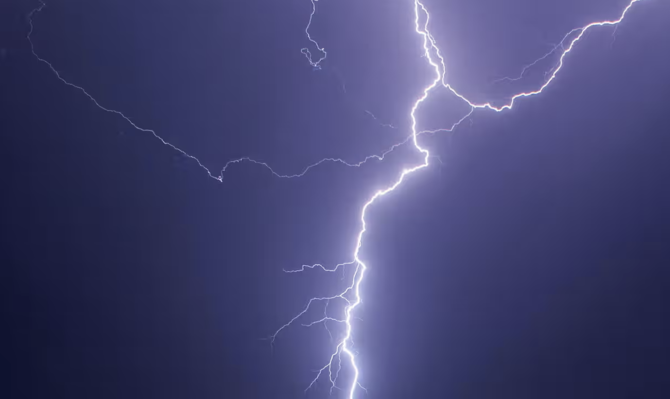
Lightning strikes killed 45 people in Yemen in July, the UN Food and Agriculture Organization said, while local media reported almost the same number of lightning-related deaths this month. (Reuters/File Photo)
Short Url
Updated 24 August 2023
Follow

At least 90 Yemenis die in lightning strikes in 2 months

  • Red Crescent urges ‘simple’ precautions, such as turning off mobiles and landlines, and unplugging electrical devices

AL-MUKALLA: Lightning strikes killed 45 people in Yemen in July, the UN Food and Agriculture Organization said, while local media reported almost the same number of lightning-related deaths this month.

In a routine agrometeorological alert issued on Wednesday, the FAO reported that intense lightning activity and thunderstorms last month killed 45 people and large numbers of livestock, mainly in Yemen’s highland provinces.

“Overall, field reports indicate that 45 people and several herds of livestock were confirmed dead across Yemen. As the kharif rainy season continues, there is a high likelihood of sustained lightning activities across much of Yemen. Lightning remains an active threat to pastoral farming across much of Yemen,” it said.

The report coincided with claims by local media and testimonies from individuals indicating that at least 45 Yemenis have been killed by lightning strikes since the start of August. 

Two children died last week when lightning struck their home in the Bajel district of Hodeidah, a province in western Yemen, according to locals.

A young man in the same property escaped unhurt. 

Most lightning-related fatalities were recorded in mountainous provinces, such as Amran, Mahweet, Sanaa, and Hajjah.

This month, lightning struck Mohammed Hassan Al-Hajj’s home in the Hufash district of Al-Mahweet region, killing him while he slept.

Numerous Yemenis shared on social media the image of Qusay Ghawth, a young man who was struck and killed by lightning in Aflah Al-Sham in the Hajjah district. 

In the Khamir district of Amran’s highland province, a shepherd and more than 40 of her animals were killed by a lightning strike while they huddled near a cliff.

Yemen’s Red Crescent estimates there have been 150 lightning-related deaths and injuries since the beginning of the year.

It has urged Yemenis to take “simple” precautions, including turning off mobiles and landlines, disconnecting the internet, unplugging chargers and solar power panels, avoiding sheltering under trees, and staying indoors during thunderstorms.

Meanwhile, two civilians were killed in the province of Hodeidah after tampering with unexploded ordnance, Yemeni Landmine Records, an organization that monitors civilian land mine fatalities in the country, reported on Wednesday.

Ahmed Fetaini, 18, and Majed Yahiya, 30, were collecting trash in Hodeidah’s Ad Durayhimi district when blast occurred.

The same organization said that a deminer in the central province of Marib’s Raghwan region was injured when a land mine he was attempting to defuse detonated.

The Hodeidah city-based UN Mission to Support the Hodeidah Agreement said on Monday that explosions caused by land mines and other munitions killed five civilians and injured four others in Hodeidah’s Al-Hali, Al-Hawak, Ad Durayhimi, Bayt Al-Faqih and At Tuhayta districts in July.

The numbers represent a 13 percent increase on the previous month, but a 57 percent decrease on the same month last year.

Hodeidah is believed to have the highest concentration of land mines in Yemen. The Houthis planted thousands of explosive devices in the province to prevent Yemeni government forces from capturing territory. 


Syrian military tells civilians to evacuate contested area east of Aleppo amid rising tensions

Updated 50 min 32 sec ago
Follow

Syrian military tells civilians to evacuate contested area east of Aleppo amid rising tensions

  • Syria’s military has announced it will open a “humanitarian corridor” for civilians to evacuate from an area in Aleppo province
  • This follows several days of intense clashes between government forces and the Kurdish-led Syrian Democratic Forces

DAMASCUS: Syria’s military said it would open a corridor Thursday for civilians to evacuate an area of Aleppo province that has seen a military buildup following intense clashes between government and Kurdish-led forces in Aleppo city.
The army’s announcement late Wednesday — which said civilians would be able to evacuate through the “humanitarian corridor” from 9 a.m. to 5 p.m. Thursday — appeared to signal plans for an offensive in the towns of Deir Hafer and Maskana and surrounding areas, about 60 kilometers (40 miles) east of Aleppo city.
The military called on the Kurdish-led Syrian Democratic Forces and other armed groups to withdraw to the other side of the the Euphrates River, to the east of the contested zone.
Syrian government troops have already sent troop reinforcements to the area after accusing the SDF of building up its own forces there, which the SDF denied. There have been limited exchanges of fire between the two sides, and the SDF has said that Turkish drones carried out strikes there.
The government has accused the SDF of launching drone strikes in Aleppo city, including one that hit the Aleppo governorate building on Saturday shortly after two Cabinet ministers and a local official held a news conference there.
The tensions in the Deir Hafer area come after several days of intense clashes last week in Aleppo city that ended with the evacuation of Kurdish fighters and government forces taking control of three contested neighborhoods. The fighting killed at least 23 people, wounded dozens more, and displaced tens of thousands.
The fighting broke out as negotiations have stalled between Damascus and the SDF, which controls large swaths of northeast Syria, over an agreement to integrate their forces and for the central government to take control of institutions including border crossings and oil fields in the northeast.
Some of the factions that make up the new Syrian army, which was formed after the fall of former President Bashar Assad in a rebel offensive in December 2024, were previously Turkiye-backed insurgent groups that have a long history of clashing with Kurdish forces.
The SDF for years has been the main US partner in Syria in fighting against the Daesh group, but Turkiye considers the SDF a terrorist organization because of its association with the Kurdistan Workers’ Party, or PKK, which has waged a long-running insurgency in Turkiye. A peace process is now underway.
Despite the long-running US support for the SDF, the Trump administration has also developed close ties with the government of interim Syrian President Ahmad Al-Sharaa and has pushed the Kurds to implement the integration deal. Washington has so far avoided publicly taking sides in the clashes in Aleppo.
The SDF in a statement warned of “dangerous repercussions on civilians, infrastructure, and vital facilities” in case of a further escalation and said Damascus bears “full responsibility for this escalation and all ensuing humanitarian and security repercussions in the region.”
Adm. Brad Cooper, commander of US Central Command, said in a statement Tuesday that the US is “closely monitoring” the situation and called for “all parties to exercise maximum restraint, avoid actions that could further escalate tensions, and prioritize the protection of civilians and critical infrastructure.” He called on the parties to “return to the negotiating table in good faith.”
Al-Sharaa blasts the SDF
In a televised interview aired Wednesday, Al-Sharaa praised the “courage of the Kurds” and said he would guarantee their rights and wants them to be part of the Syrian army, but he lashed out at the SDF.
He accused the group of not abiding by an agreement reached last year under which their forces were supposed to withdraw from neighborhoods they controlled in Aleppo city and of forcibly preventing civilians from leaving when the army opened a corridor for them to evacuate amid the recent clashes.
Al-Sharaa claimed that the SDF refused attempts by France and the US to mediate a ceasefire and withdrawal of Kurdish forces during the clashes due to an order from the PKK.
The interview was initially intended to air Tuesday on Shams TV, a broadcaster based in Irbil — the seat of northern Iraq’s semi-autonomous Kurdish region — but was canceled for what the station initially said were technical reasons.
Later the station’s manager said that the interview had been spiked out of fear of further inflaming tensions because of the hard line Al-Sharaa took against the SDF.
Syria’s state TV station instead aired clips from the interview on Wednesday. There was no immediate response from the SDF to Al-Sharaa’s comments.