

Pakistan’s drug regulatory authority fixes maximum retail price for 25 life-saving medicines

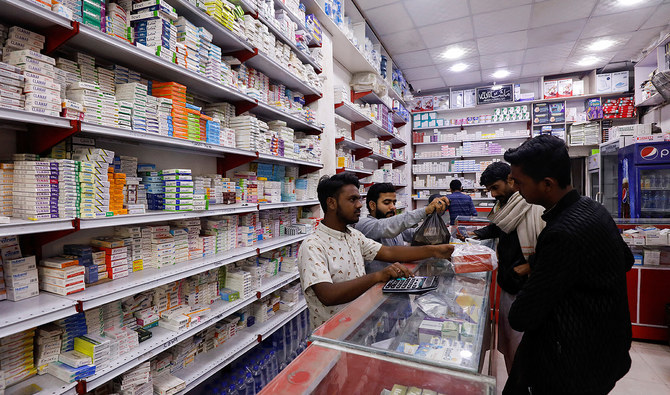
This photo, taken on February 9, 2023, customers buy medicine from a medical supply store in Karachi, Pakistan. (REUTERS/File)
Short Url
Updated 24 August 2023
Follow

Pakistan’s drug regulatory authority fixes maximum retail price for 25 life-saving medicines

  • The cost of 30 tablets of a drug used to cure lung cancer among adults has been fixed at Rs846,857
  • Pakistan’s financial challenges have taken medicine prices much higher than other countries in the region

ISLAMABAD: The Drug Regulatory Authority of Pakistan (DRAP) notified the maximum retail prices of 25 life-saving drugs this week, fixing the cost of 30 tablets of Lorviqua, which is used to treat adults with non-small cell lung cancer, at Rs846,857.

DRAP suggested raw material import for medicines from China earlier this year, pointing to the fact that the government could make payments in the Chinese currency after agreeing on a mechanism with the authorities in Beijing.

The proposal was floated after months of restrictions imposed by the country on the import of luxury and essential items due to Pakistan’s depleting foreign exchange reserves.

Local pharmaceutical manufacturers also noted the cost of raw material for medicines had significantly increased amid an acute shortage following the imposition of 17 percent general sales tax.

“In exercise of the powers conferred by clause (a) of section 7 of the Drug Regulatory Authority of Pakistan Act, 2012 (XXI of 2012) read with section 12 of the Drugs Act, 1976 (XXXI of 1976), the Drug Regulatory Authority of Pakistan with the approval of the Federal Government is pleased to fix maximum retail prices [of 25 medicines],” a notification issued on Tuesday said on top of a table specifying the revised prices.

Among the life-saving drugs mentioned in the notification, the maximum retail price of 10 tablets of paracetamol has been fixed at Rs192.

It said that 10 tablets of Zerbaxa, which helps treat urinary tract and intra-abdominal infections, would have a maximum cost of Rs153,566.

The prices of medicines in Pakistan are much higher compared to other countries in the region since most of them are imported from abroad.

Additionally, Pakistan’s national currency has rapidly lost its value against the United States dollar in recent years, which has also affected its trade and market prices of various products.


Pakistani stocks breach 176,000 points barrier as investors expect further rate cuts

Updated 01 January 2026
Follow

Pakistani stocks breach 176,000 points barrier as investors expect further rate cuts

  • Pakistani financial analyst attributes surge to falling inflation, investors expecting further policy rate cuts
  • Pakistan’s finance ministry said Thursday that inflation had slowed to 5.6 percent year-on-year in December 

KARACHI: Pakistani stocks continued their bullish run on Thursday, breaching the 176,000 points barrier for the first time after trading ended, with analysts attributing the surge to investors expecting further cuts in the policy rate. 

The KSE-100 benchmark gained 2,301.17 points at close of business on Thursday, marking an increase of 1.32 percent to settle at 176,355.49 points. 

Pakistan’s central bank cut its key policy rate by 50 basis points to 10.5 percent last ‌month, breaking a four-meeting ‌hold in a move ‌that ⁠surprised ​markets. Pakistan’s consumer price inflation slowed to 5.6 percent year-on-year in December, while prices fell on a monthly basis as per data from the finance ministry. 

“Upbeat data for consumer price index (CPI) inflation at 5.6pc in December 2025 [with] investors expecting a further State Bank of Pakistan rate cuts on falling inflation data,” Ahsan Mehanti, CEO of Arif Habib Commodities Ltd., told Arab News. 

The stock market witnessed a trading volume of 1,402.650 million shares, with a traded value of Rs48.424 billion ($173 million), compared with 957.239 million shares valued at Rs44.231 billion ($158 million) during the previous session.

Topline Securities, a leading brokerage firm in Pakistan, credited the surge to strong buying at the first session.

“This positivity can be accredited to buying by local institutions on the start of the new calendar year,” it said. 

Pakistan’s Finance Adviser Khurram Schehzad highlighted that the bullish trend at the stock market reflected “strong investor confidence.”

“With lower inflation, affordable fuel, stronger reserves, rising digitization and a buoyant capital market, Pakistan’s economic outlook is clearly improving--supporting greater confidence, better investment sentiment and more positive momentum for 2026,” he said on social media platform X.