

Wagner mercenary leader, Russian mutineer, ‘Putin’s chef’: The many sides of Yevgeny Prigozhin

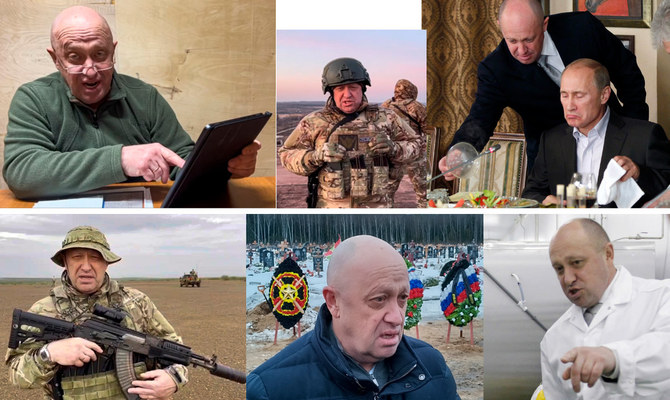
Billionaire Yevgeny Prigozhin was a man of many faces. He was an ex-convict, a crook, a mercenary, a killer, a warlord and had the reputation as "chef" for Russian President Vladimir Putin. (AP photos)
Short Url
Updated 24 August 2023
Follow

Wagner mercenary leader, Russian mutineer, ‘Putin’s chef’: The many sides of Yevgeny Prigozhin

Yevgeny Prigozhin’s fate has been entwined with the Kremlin for decades — as a trusted government contractor, and the head of the Wagner mercenary army that fought in Ukraine and has been blamed for doing Russia’s dirty work in Syria and Africa.
But when he turned his men toward Moscow two months ago, many inside Russia and beyond started wondering just how long he could last after drawing the fury of Russian President Vladimir Putin.
Prigozhin cut a deal with Putin and the leader of Belarus for a safe haven for himself and the men involved in the rebellion. He was reported to pop up periodically in Russia, and appeared in a recruitment video earlier this week.
But then on Wednesday Russia’s civil aviation agency said he was aboard a plane that crashed north of Moscow, killing all 10 people on board.
Prigozhin's background
Prigozhin was convicted of robbery and assault in 1981, and sentenced to 12 years in prison. When he got out, he opened a restaurant business in St. Petersburg in the 1990s. Putin was the city’s deputy mayor at the time.
Prigozhin used that connection to develop a catering business and won lucrative Russian government contracts that earned him the nickname “Putin’s chef.” He later expanded into other areas, including media and an infamous Internet “troll factory” that led to his indictment in the US for meddling in the 2016 presidential election.
Wagner was first seen in action in eastern Ukraine soon after a separatist conflict erupted there in April 2014, in the weeks following Russia’s annexation of Ukraine’s Crimean Peninsula. At the time, Russia denied sending its own weapons and troops despite ample evidence to the contrary. The private Wagner army gave Moscow a degree of deniability.
Wagner personnel also deployed to Syria, where Russia supported President Bashar Assad’s government in a civil war. In Libya, they fought alongside forces of commander Khalifa Haftar. The group has also operated in the Central African Republic and Mali.
But it wasn’t until September 2022 that Prigozhin acknowledged founding, leading and financing Wagner. By then, his mercenaries — including men he’d recruited in Russian prisons — were fighting and dying by scores in Ukraine, especially in the shattered town of Bakhmut.
Reputation for truthfulness

Prigozhin fostered Wagner’s reputation for ruthlessness, and the mercenaries have been accused by Western countries and UN experts of human rights abuses throughout Africa, including in Central African Republic, Libya and Mali.
A 2017 online video showed a group of armed people, reportedly Wagner contractors, torturing a Syrian and beating him to death with a sledgehammer before mutilating and burning his body.
In 2022, another video showed a former Wagner contractor beaten to death with a sledgehammer after he allegedly fled to the Ukrainian side and was repatriated.
Despite public outrage and demands for investigations, the Kremlin repeatedly turned a blind eye.
Wagner’s role in Ukraine
Wagner took an increasingly visible role in the Ukraine war as regular Russian troops suffered heavy attrition and lost territory in humiliating setbacks.
Prigozhin toured Russian prisons to recruit fighters, promising pardons if they survived a half-year tour of front line duty with Wagner.
In the interview in May, he claimed to have recruited 50,000 convicts, with about 35,000 men on the front lines at all times. He has also said he had lost more than 20,000 men — half of them convicts — in the battle for Bakhmut.
The US has estimated Wagner had about 50,000 personnel fighting in Ukraine, including 10,000 contractors and 40,000 convicts.
Poking the bear
Prigozhin claimed full credit in January for capturing the Donetsk region salt mining town of Soledar in Ukraine, and he accused the Russian Defense Ministry of trying to steal Wagner’s glory. He repeatedly complained the Russian military failed to supply Wagner with sufficient ammunition to capture Bakhmut and threatened to pull out his men.
After the capture of Soledar, Prigozhin increasingly raised his public profile, for months boasting almost daily about Wagner’s purported victories, sardonically mocking his enemies and complaining in profanity-laced diatribes about the military brass.
On June 23, he called for an armed uprising against the defense minister and headed from Ukraine toward Moscow with his mercenaries. His forces took control of the military headquarters in Rostov-on-Don, the city in southern Russia near the border with Ukraine, and continued their “march of justice,” until stopping a mere 200 kilometers (120 miles) from the Russian capital.
Putin branded Prigozhin a traitor as the revolt unfolded. But the criminal case against the mercenary chief on rebellion charges was later dropped. Unusually, the Kremlin said Putin had a three-hour meeting with Prigozhin and Wagner Group commanders days after the rebellion.
Some number of Wagner mercenaries headed to Belarus, but the fate of both Prigozhin and his force remained unclear.
US President Joe Biden recently suggested Prigozhin was a marked man.
“If I were he, I’d be careful what I ate. I’d keep my eye on my menu,” Biden said last month.
But the man who made his first fortune as a caterer was undaunted in his latest appearance on Monday, telling would-be Wagner recruits his organization was “making Russia even greater on all continents.”


After accepting US deportees, South Sudan wanted sanctions relief for top official, documents show

Updated 57 min 57 sec ago
Follow

After accepting US deportees, South Sudan wanted sanctions relief for top official, documents show

  • In July, South Sudan became the first African country to receive third-country deportees from the US

JUBA: After agreeing to accept deportees from the United States last year, South Sudan sent a list of requests to Washington that included American support for the prosecution of an opposition leader and sanctions relief for a senior official accused of diverting over a billion dollars in public funds.
The requests, contained in a pair of diplomatic communications made public by the State Department this month, offer a glimpse into the kind of benefits that some governments may have sought as they negotiated with the US over the matter of receiving deportees.
In the documents, the US expresses “appreciation” to South Sudan for accepting the deportees and details the names, nationalities and crimes for which each individual was convicted.
In July, South Sudan became the first African country to receive third-country deportees from the US, Rwanda, Eswatini, Ghana and Equatorial Guinea have since received deportees.
The eight deportees to South Sudan included nationals of Mexico, Cuba, Vietnam, Laos, Myanmar and South Sudan itself.
Contentious deportations
They arrived in the South Sudanese capital of Juba after spending weeks on a US military base in Djibouti, where they were held after a US court temporarily blocked their deportation. Six of the eight men remain at a residential facility in Juba under the supervision of security personnel.
South Sudanese national Dian Peter Domach was later freed, according to the Ministry of Foreign Affairs, while Jesus Munoz-Gutierrez, a Mexican, was repatriated in September.
South Sudanese officials have not publicly said what long-term plan is in place for those still in custody. The third-country deportations were highly contentious, criticized by rights groups and others who expressed concern South Sudan would become a dumping ground.
Details of the deal between the US and South Sudan remain murky. It is still unclear what, if anything, South Sudan may have actually received or been promised. The documents only offer a glimpse into what the South Sudanese government hoped to get in return.
In other cases, Human Rights Watch said it saw documents showing the US agreed to pay Rwanda’s government around $7.5 million to take up to 250 deportees. The US will give Eswatini $5.1 million to take up to 160 deportees, according to the group.
For South Sudan, in one communication dated May 12 and marked confidential, South Sudan’s Ministry of Foreign Affairs raised eight “matters of concern which the Government of South Sudan believes merit consideration.” These ranged from the easing of visa restrictions for South Sudanese nationals to the construction of a rehabilitation center and “support in addressing the problem of armed civilians.”
Request to lift sanctions
But an eye-catching ask was for the lifting of US sanctions against former Vice President Benjamin Bol Mel as well as Washington’s support for the prosecution of opposition leader Riek Machar, the now-suspended first vice president of South Sudan who faces treason, murder and other criminal charges in a controversial case.
The allegations against Machar stem from a violent incident in March, when an armed militia with historical ties to him attacked a garrison of government troops. Machar’s supporters and some activists describe the charges as politically motivated.
Bol Mel is accused of diverting more than a billion dollars earmarked for infrastructure projects into companies he owns or controls, according to a UN report. He wielded vast influence in the government and was touted by some as Kiir’s likely successor in the presidency until he was dismissed and placed under house arrest in November.
Bol Mel was also viewed as a key figure behind the prosecution of Machar, one of the historical leaders of South Sudan’s ultimately successful quest for independence from Sudan in 2011.
Machar was Kiir’s deputy when they fell out in 2013, provoking the start of civil war as government troops loyal to Kiir fought forces loyal to Machar.
A 2018 peace agreement brought Machar back into government as the most senior of five vice presidents. His prosecution has been widely criticized as a violation of that agreement, and has coincided with a spike in violence that the UN says killed more than 1,800 people between January and September 2025.
The UN has also warned that a resurgence of fighting has brought the country “back to the edge of a relapse into civil war.” Machar is under house arrest in Juba while his criminal trial proceeds slowly.
In its communications with the US, South Sudan also asked for sanctions to be lifted over South Sudanese oil companies “to encourage direct foreign investments,” and for the US to consider investing in other sectors including fossil fuels, minerals and agriculture.
When asked if the US government had provided or promised South Sudan anything in return for accepting the deportees, a State Department official said, “In keeping with standard diplomatic practice, we do not disclose the details of private discussions.”
A spokesman for South Sudan’s Ministry of Foreign Affairs, Thomas Kenneth Elisapana, declined to comment.
US aid cuts
Despite accepting the US request to admit deportees, relations between the two governments have been strained in recent months.
In December, the US threatened to reduce aid contributions to the country, accusing the government of imposing fees on aid groups and obstructing their operations.
The US has historically been one of the largest donors to South Sudan, providing roughly $9.5 billion in aid since 2011. Over the years, South Sudan’s government has struggled to deliver many of the basic services of a state, and years of conflict have left the country heavily reliant on foreign aid.