

Pakistan’s disaster management body issues flood warning in Sutlej River

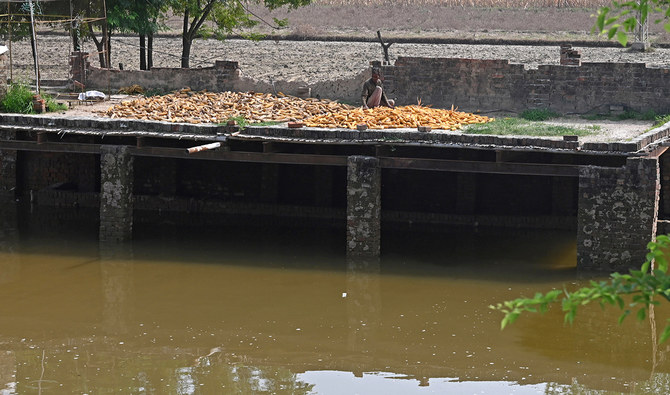
A flood-affected man dries his corns on a rooftop near the flooded area of Sutlej river on the outskirts of Kasur on July 18, 2023. (AFP/File)
Short Url
Updated 22 August 2023
Follow

Pakistan’s disaster management body issues flood warning in Sutlej River

  • The authority says due to the flood, low-lying areas of Sulemanki village will be most vulnerable on Aug. 22
  • Jhelum River is also expected to experience a peak in flow from Aug. 23 to 25, which may affect Mangla dam levels

ISLAMABAD: Pakistan’s National Disaster Management Authority (NDMA) has warned relevant authorities to ensure prompt evacuation of people residing in low-lying regions of eastern Sulemanki village, adding that the Sutlej River was expected to reach the “highest flood level” in the area on Tuesday.

The river, traversing both northern India and eastern Pakistan, has undergone a significant surge following New Delhi’s release of excess water from reservoirs due to the ongoing monsoon season.

“The Sulemanki headworks will achieve a very high flood level by 22 August,” the NDMA stated on Monday while citing its flood forecasting division’s latest report.

The statement also highlighted that a peak in the flow of the Jhelum River was projected to occur from August 23 to 25, which would impact the levels of Mangla dam.


In view of the situation, the NDMA chairman, Lieutenant General Inam Haider Malik, provided clear directives to all the relevant departments to take appropriate measures, added the statement.

His instructions encompass timely clearance of settlements and encroachments near the riverbeds, vigilant monitoring of evolving situation, conducting flood damage assessments, and gleaning accurate data.

With several Pakistani rivers experiencing persistent flooding, approximately 238,202 individuals from vulnerable areas have been successfully evacuated to safer locations, according to the NDMA. The agency said it also mobilized 203 boats and 795 rescue personnel on the ground to assist in its efforts.

In 2022, torrential monsoon rains and glacial melt triggered devastating floods across various regions of Pakistan. The aftermath resulted in the loss of 1,700 lives, millions displaced, extensive agricultural land destruction, and an estimated $30 billion worth of damages as per government assessments.


UK says Pakistan regulatory overhaul to yield £1 billion a year as Islamabad launches reform drive

Updated 13 December 2025
Follow

UK says Pakistan regulatory overhaul to yield £1 billion a year as Islamabad launches reform drive

  • Britain says it worked with Pakistan on 472 proposed reforms to streamline business rules across key sectors
  • PM Shehbaz Sharif says Pakistan has stabilized economy and now aims to attract investment by cutting red tape

ISLAMABAD: Britain’s development minister Jenny Chapman said on Saturday Pakistan’s sweeping new regulatory overhaul could generate economic gains of nearly £1 billion a year, as Islamabad formally launched the reform package aimed at cutting red tape and attracting foreign investment.

The initiative, driven by Prime Minister Shehbaz Sharif’s government and the Board of Investment, aims to introduce legislative changes and procedural reforms designed to streamline approvals, digitize documentation and remove outdated business regulations.

Chapman said the UK had worked with Pakistan on 472 reform proposals as part of its support to help the country shift from economic stabilization to sustained growth.

“These reforms will break down barriers to investment, eliminate more than 600,000 paper documents, and save over 23,000 hours of labor every year for commercial approvals,” Chapman said at the launch ceremony in the presence of Sharif and his team. “The first two packages alone could have an economic impact of up to 300 billion Pakistani rupees annually — nearly one billion pounds — with more benefits to come.”

Addressing the ceremony, the prime minister said the reforms were central to Pakistan’s effort to rebuild investor confidence after the country narrowly avoided financial default in recent years.

“Our economy was in a very difficult situation when we took office,” he said. “But we did not lose hope, and today Pakistan is economically out of the woods. Now we are focused on growing our economy and attracting foreign investment.”

He described the new regulatory framework as a “quantum jump” that would reduce corruption, speed up approvals and remove longstanding procedural hurdles that have discouraged businesses.

Chapman told the audience that more than 200 British companies operate in Pakistan, with the largest six contributing around one percent of Pakistan’s GDP.

She said the UK saw Pakistan as a partner rather than a recipient of aid.

“Modern partners work together not as donors but as investors, bringing all our strengths to the table,” she said, adding that the reforms would make Pakistani exports more competitive and encourage UK firms to expand their footprint.

Sharif highlighted the role of the British Pakistani diaspora and said Pakistan hoped to unlock more private capital by engaging diaspora entrepreneurs and financial institutions in the UK.