

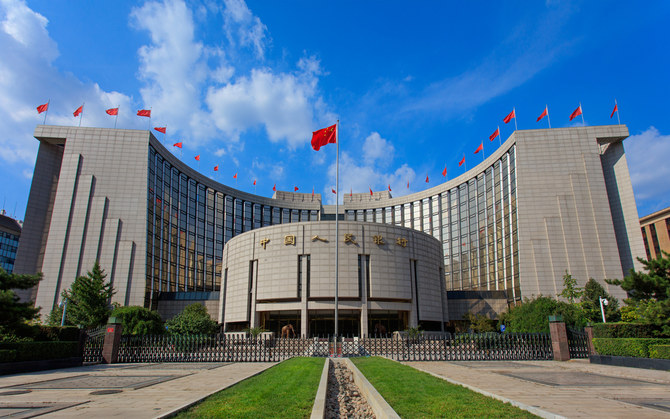

BEIJING: China’s central bank on Monday cut a key interest rate in an attempt to counter the post-Covid growth slowdown in the world’s second-largest economy.
Activity has been dragged down recently by uncertainty in the labor market and global economic sluggishness, weakening demand for Chinese goods.
Financial troubles in the real estate sector, with several leading developers on the verge of bankruptcy and struggling to complete projects, also pose a major obstacle to growth.
The People’s Bank of China said on Monday cut the one-year loan prime rate, which serves as a benchmark for corporate loans, from 3.55 percent to 3.45 percent.
However, the five-year LPR, which is used to price mortgages, was held at 4.2 percent.
Closely followed by the markets, the two rates are now at historic lows, after previous reductions in June.
The decision is intended to encourage commercial banks to grant more loans and at more advantageous rates.
Monday’s measures — which run counter to rising interest rates around the world as other major economies work to curb inflation — aim to indirectly support economic activity as growth flags.
The long-awaited post-Covid recovery following the lifting of health restrictions at the end of 2022 has run out of steam in recent months.
In another sign that the recovery is faltering, loans to households fell last month to their lowest level since 2009.
To reinvigorate the economy, the central bank reduced the rate for its medium-term lending facility to financial institutions last Tuesday.
And financial regulators agreed Friday on the need for “financial support,” while avoiding “risks and hidden dangers,” state media reported.
Analysts polled by Bloomberg expected a bigger cut to the LPR following the Friday meeting.
In a note following the Monday announcement, Goldman Sachs economist Maggie Wei described the LPR cut as “disappointing,” adding that it “would not help with building confidence” as Chinese authorities pursue an economic recovery.
The move “can even backfire if market participants interpret these easing measures as policymakers' unwillingness to deliver even moderate policy stimulus,” wrote Wei.
Traders appeared unimpressed with the move, with Hong Kong stocks down 1.4 percent and Shanghai off 0.6 percent.
The central bank’s decision comes as a crisis at property giant Country Garden, long deemed financially sound and now ultra-indebted, raises fears of a bankruptcy that could have dire consequences for the domestic financial system.
Country Garden’s problems are building just two years after a crisis erupted at major rival Evergrande, which is struggling with huge debt.
In addition to the real estate woes, growth is also hampered by sluggish consumption amid uncertainty in the labor market and a global economic slowdown.
That is weighing on demand for Chinese goods, slowing the activity of thousands of factories.
China suspended the monthly publication of its detailed youth unemployment figures last Tuesday, after it hit a record high of 21.3 percent in June, according to official data.
The unemployment rate is calculated for urban areas and therefore provides only a partial picture of the situation.
The series of gloomy figures in recent weeks has ramped up pressure on officials to introduce a vast economic recovery plan, but debt-averse policymakers in Beijing are reluctant.
Authorities have instead announced various steps to boost the private sector, which was hit particularly hard during the pandemic, and consumption, though they have yet to take effect.
The economic slowdown threatens a growth target set by authorities at around five percent for this year.
If achieved, that would already be one of China’s lowest annual growth rates in decades, outside of the Covid period.
Beijing last Wednesday acknowledged economic “difficulties” but castigated the pessimism of Western commentators who doubt its continued ability to support global growth.
“Eventually, they will for sure be proven wrong,” said Wang Wenbin, a spokesman for the Chinese Ministry of Foreign Affairs.


