

New find throws light on life of slaves in Ancient Rome’s Pompeii

1 / 3
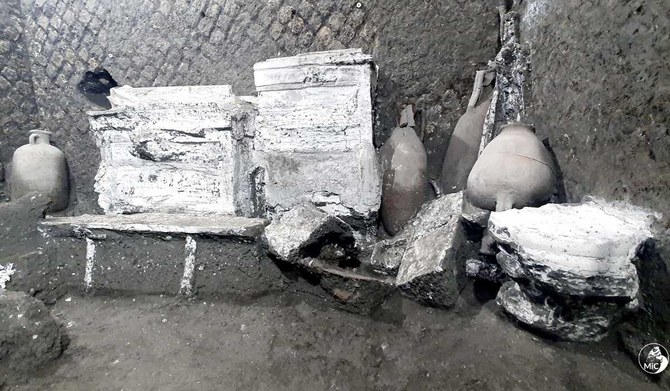
A small bedroom, that was almost certainly used by slaves, is pictured after it was discovered by archaeologists in a Roman villa near Pompeii, in this undated picture, Italy. (REUTERS)
2 / 3
A small bedroom, that was almost certainly used by slaves, is pictured after it was discovered by archaeologists in a Roman villa near Pompeii, in this undated picture, Italy. (REUTERS)
3 / 3
A small bedroom, that was almost certainly used by slaves, is pictured after it was discovered by archaeologists in a Roman villa near Pompeii, in this undated picture, Italy. (REUTERS)
Short Url
Updated 21 August 2023
Follow

New find throws light on life of slaves in Ancient Rome’s Pompeii

  • Archaeologists said part of one of the beds had been destroyed by a tunnel used by robbers to access another part of the villa

ROME: Archaeologists have discovered a small bedroom in a Roman villa near Pompeii that was almost certainly used by slaves, throwing light on their lowly status in the ancient world, the culture ministry said on Sunday.
The room was found at the Civita Giuliana villa, some 600 meters (2,000 ft) north of the walls of Pompeii, which was wiped out by a volcanic eruption of Mount Vesuvius nearly 2,000 years ago.
It contained two beds, only one of which had a mattress, two small cabinets and a series of urns and ceramic containers, in which the remains of two mice and a rat were found.
“These details once again underline the conditions of precarity and poor hygiene in which the lower echelons of society lived during that time,” the culture ministry said in its statement.
Materials such as furniture and fabric, covered by the devastating blast of rock fragments, gas, and ash from Vesuvius, decomposed over the years, leaving a void in the debris.
When filled with plaster, this void reveals the original shape and contours of the long gone material, including the outline of a crumpled blanket left on the bed netting.
“It looks like a photograph ... However, this is an image from almost 2000 years ago,” the ministry said.
No traces were found of grates, locks, or chains to restrain the room’s inhabitants.
“It seems that control was primarily exerted through the internal organization of servitude, rather than physical barriers and restraints,” said Gabriel Zuchtriegel, the director of the Archaeological Park of Pompeii.
Excavations at the Civita Giuliana villa were carried out in 1907-1908, and then again from 2017, when police realized the site was being plundered by illegal diggers.
Archaeologists said part of one of the beds had been destroyed by a tunnel used by robbers to access another part of the villa.
Pompeii and the surrounding countryside was submerged by volcanic ash when Mount Vesuvius exploded in AD 79, killing thousands of Romans who had no idea they were living beneath one of Europe’s biggest volcanoes.
The eruption buried the city in a thick layer of ash, preserving many of its residents and buildings.
The site has seen a burst of recent archaeological activity aimed at halting years of decay and neglect, largely thanks to a recently concluded 105-million-euro ($115.58 million) EU-funded project.
Culture Minister Gennaro Sangiuliano said on Sunday that conservation and research efforts would continue.
“What we are learning about the material conditions and social organization of that era opens up new horizons for historical and archaeological studies,” he said.


Essex man takes on charity endurance challenge for children in Gaza

Updated 03 January 2026
Follow

Essex man takes on charity endurance challenge for children in Gaza

  • Mark Watson, 63, is undertaking a “virtual Sumud” journey from his Essex home town in Harlow to Gaza, covering 2,287 miles

LONDON: A man in England has launched a demanding charity challenge to raise funds for children affected by the war in Gaza.

Mark Watson, 63, is undertaking a “virtual Sumud” journey from his Essex home town in Harlow to Gaza, covering 2,287 miles through running, walking, swimming, cycling and rowing.

He is raising money for Medical Aid for Palestinians, a UK-based humanitarian organization providing healthcare to Palestinians in Gaza and the occupied territories.

“I have felt helpless day after day seeing images of countless children in Gaza with broken bodies and missing limbs and witnessing their unbearable suffering,” Watson said on his JustGiving page.

“I have been inspired by the courage of those who took part in the global Sumud flotilla and all of the activists who have put their lives and freedom at risk supporting the Palestinian people and so I am raising funds for Medical Aid for Palestinians.

“My challenge is to complete a virtual Sumud from Harlow, where I live, to Gaza. Running, walking, swimming, cycling and rowing I will cover the 2,287 miles as quickly as I can.

“I am an unfit, overweight 63-year-old, so I’m not going to break any records, but the Arabic word Sumud means steadfastness and perseverance and I will give it my all.

Watson added: “I hope to be joined by people I love and admire along the way, so please support my fundraiser. Every donation, however small, will help save the lives of Palestinians.”

As of January 3, his fundraiser had reached 12 per cent of its £5,000 target.

The war in Gaza began after the October 7, 2023, attack by Hamas on southern Israel, in which around 1,200 people were killed and more than 200 taken hostage, according to Israeli authorities.

Israel responded with a large-scale military campaign in Gaza, which local health authorities say has resulted in the deaths of more than 71,000 Palestinians, widespread destruction of civilian infrastructure and a severe humanitarian crisis.

International aid agencies have repeatedly warned that children have been among the most affected, facing injury, displacement, malnutrition and limited access to medical care.

Watson said he was inspired by activists and humanitarian efforts supporting Palestinians and hopes his challenge can make a small contribution toward saving lives.