

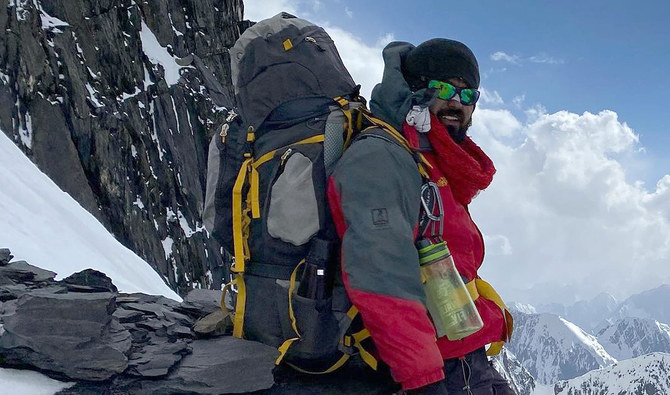

KHAPLU: Ali Akbar Sakhi dreamed of setting a record for Afghanistan by becoming the first climber from the landlocked nation to summit the 8,611-meter K2 in 2022. While the 36-year-old rendered his life in pursuit of the goal during a 2022 expedition, Pakistani rescuers did etch his name in history by bringing his body, the first out of more than a hundred, from a height above 7,000 meters on the snow-capped ‘Savage Mountain,’ setting a new record in human history.
Sakhi attempted to summit K2, the second highest mountain in the world, along with a dozen Pakistani and international climbers in the summer last year. He reportedly died of cardiac arrest some 350 meters short of Camp 3 (7,550 meters) on July 21, 2022.
Famously called the ‘Savage Mountain,’ K2 straddles the Pakistan-China border and is widely considered the world’s toughest and most dangerous climb because of its challenging terrain and treacherous weather.
The tracks leading up to the summit are strewn with bodies of more than a hundred climbers who have died since the first K2 summit in 1954, but the mortal remains are buried several feet below the giant masses of snow, making it difficult for anyone to spot them, let alone locate the bodies.
However, a 10-member team of Pakistani mountaineers, led by Abid Sadpara, turned the impossible into possible and successfully brought down in late July Sakhi’s body from an altitude of 7,200 meters after more than a year.
“This is a new record. There is no example of such [ground] rescue operation. From the base camp to these 7,200 meters, we completed the rescue mission in only six days,” Sadpara said.
Arif Sadpara, a member of the rescue team, said if they got sponsorship and approval from relatives, they could bring back bodies of famed Pakistani climber Muhammad Ali Sadpara and other mountaineers. Muhammad Ali, Iceland’s John Snorri and Chile’s Juan Pablo Mohr went missing while attempting to scale K2 in the winter of 2021.
“There are a lot of dead bodies at different camps of K2,” Arif said. “There are dead bodies at camps 1, 2, 3, 4 and higher sites. But not a single body has ever been brought back from such heights.”
Prior to attempting the K2 summit, Sakhi had scaled 5,050-meter Shah Foladi, the highest peak in the Koh-e-Baba mountains of Afghanistan’s Bamiyan province, and the 7,492-meter Nowshak peak, the second highest mountain in the Hindu Kush range after the 7,708-meter Tirich Mir.
Sakhi’s wife this year contacted authorities in Pakistan to help locate his body, after which the Pakistan Army helped set-up the recovery team. Six of the team members left for the spot where Sakhi had gone missing last year, while the rest stayed back for communication and as back-up support.
His body was brought down to the K2 base camp on July 29, according to the rescuers. It was moved to Afghanistan on August 1 and he was laid to rest on a hiking trail near the Afghan capital of Kabul two days later.
“He used to climb the hiking trail every Friday with his friends and I wanted him to be there as he was a man of the mountains,” Karima Sakhi, the widow of the Afghani climber, told Arab News over the phone from Canada.
She applauded the Pakistani mountaineers for bringing her husband’s body down from such height: “They are the heroes and mountaineers with heart and humanity who want to rescue people at the cost of their lives and I am so grateful for what they did for me and I am sure they will make Pakistan proud.”
Ghulam Muhammad, the tourism minister of Pakistan’s northern Gilgit-Baltistan region that is home to five out of 14 world peaks above 8,000 meters, appreciated the Pakistani team for their effort to retrieve the body of the Afghan climber.
“I appreciate the efforts of the rescue team in recovering the body of the Afghan climber,” Muhammad told Arab News. “A proud moment. I will write and recommend for proper appreciation by the GB government.”
However, Karima voiced her dissatisfaction with the response of the tour company, the Karakorum Expeditions, regarding what had happened to her husband during the ascent.
“The tour company didn’t let me know what exactly happened. All they said was anything can happen on the mountain,” she said.
“He (Sakhi) never had any heart issues. He died because of the negligence of the tour company, he was left near camp 3 overnight in freezing weather, and he had hypothermia. He survived all night, and he died in the morning.”
Speaking to Arab News, Mirza Ali, the founder of Karakorum Expeditions, denied the allegation.
“He [the deceased] used to complain of heart issues during the expedition. He collapsed [below camp-3] all of a sudden last year. So most probably he died because of a heart issue, because he repeatedly told our guides about the heart issue,” Ali said.
“Two of our guides were with him and tried to save him. But this is mountain and anything can happen.”


