

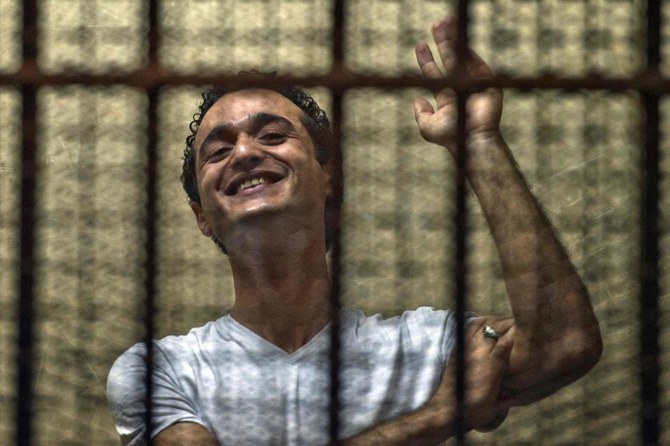

CAIRO: Egyptian activist Ahmed Douma, a leading figure of the country’s 2011 uprising who has spent the last decade behind bars, has been granted a presidential pardon, lawyers said Saturday.
“President Abdel Fattah El-Sisi... has used his constitutional powers” to pardon several prisoners including Douma, said lawyer Tarek Elawady, a member of the presidential pardons committee.
Prominent rights lawyer Khaled Ali meanwhile said on social media he was waiting outside Badr prison on Cairo’s outskirts for the activist’s release.
A court in 2019 had sentenced Douma to 15 years in prison on charges of clashing with security forces in the capital two years earlier, commuting a previous 25-year sentence handed down in 2015.
Egypt’s top appeals court later in 2019 upheld the 15-year sentence, which also included a fine of six million Egyptian pounds ($372,000 at the time).
Douma, now 37, was a leading activist in the 2011 uprising that toppled former president Hosni Mubarak.
The activist published in 2021 a collection of poems titled “Curly,” written while he was held in solitary confinement.
The collection was displayed at that year’s Cairo International Book Fair but was quickly pulled for “security reasons.”
In one of his poems from prison, Douma writes: “There’s no time for depression, no opportunity for sadness, the flood is raging.”
He was arrested in a crackdown following the 2013 military ouster of Mubarak’s successor, Islamist Muhammad Mursi.
El-Sisi, a former army chief who spearheaded Mursi’s ouster, has been accused of leading a relentless crackdown on both pro-democracy campaigners and Islamists.
Key activists from the revolution remain behind bars, including British-Egyptian pro-democracy blogger Alaa Abdel Fattah, who has spent the better part of the past decade behind bars.
While rights defender Hossam Bahgat welcomed the news of Douma’s imminent release, he said the decision was made “without any transparency or understanding of why some people were selected and others were ignored.”
The president has pardoned numerous prominent figures over the past year, but critics have charged that more people have been arrested in the meantime.
Since April last year, authorities have released 1,000 political prisoners amid much fanfare, but detained almost 3,000 more, according to Egyptian rights monitors.
El-Sisi in July pardoned researcher Patrick Zaki a day after he received a three-year sentence, as well as rights lawyer Mohamed Al-Baqer who was arrested in 2019 while attending an interrogation of Abdel Fattah, his client at the time.
According to Bahgat, founder of the Egyptian Initiative for Personal Rights, the authorities have “become well aware of rising frustration both domestically and internationally.”
But “the regime is showing no indication of moving toward ending the crisis of political prisoners in Egypt,” Bahgat said.
The pardons come as Egypt conducts a so-called “national dialogue” meant to bring in an opposition that has been decimated throughout a decade of repression since El-Sisi came to power.
The president announced on Wednesday he had received the first recommendations of this “dialogue,” saying he had “passed them on to the competent authorities so that they can be applied within the framework granted by the legal and constitutional provisions.”
The pardon also comes months ahead of Egypt’s presidential election scheduled for 2024.
Though no candidates have formally been announced, the incumbent is widely expected to sit in the upcoming polls.



