

EU chief warns of ‘grave consequences’ if Niger president’s health suffers

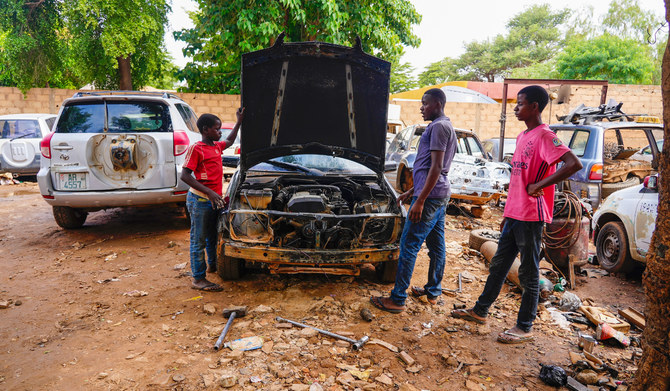
Mechanics work on a car on Friday in Niamey, Niger. Before last month’s coup, Europe and the US had poured millions of dollars into propping up Niger’s military. (AP)
Short Url
Updated 18 August 2023
Follow

EU chief warns of ‘grave consequences’ if Niger president’s health suffers

  • ECOWAS will maintain their sanctions despite the economic impact these have on some of the countries from the region

BRUSSELS: EU chief Charles Michel warned there will be “grave consequences” if Niger’s military regime allows ousted President Mohammed Bazoum’s health to worsen under house arrest, a European official said on Friday.

In a call to President Bola Tinubu of Nigeria, chair of the ECOWAS regional bloc which opposes the Niger coup, Michel said “President Bazoum’s detention conditions are deteriorating.”
Bazoum, 63, was detained on July 26 by members of his presidential guard, in the fifth coup to hit Niger since independence from France in 1960. He and his family are detained in the presidential palace.
“The Nigerian president stressed the determination and political will of ECOWAS to act together. ECOWAS will maintain their sanctions despite the economic impact these have on some of the countries from the region,” the official said.
Michel “reiterated the EU’s full support and backing of ECOWAS’ decisions, as well as firm condemnation of the unacceptable coup de force in Niger.
“The EU will not recognize the authorities resulting from the putsch in Niger. President Bazoum, democratically elected, remains the legitimate head of state of Niger,” she said.
“President Bazoum’s detention conditions are deteriorating. Any further deterioration to his well-being status will have grave consequences.”
Sources said on Friday that violence erupted this week in a string of villages in remote southwest Niger leaving at least 28 civilians dead,
“For now we have recorded at least 28 dead, but the toll could go up,” said a senior official in the Tillaberi region close to Mali.
Some of the bodies had been “carried off” by the Niger River, he added.
The violence started at sunset on Tuesday and ended midday on Wednesday, the official said.
In Ayorou, one of four departments affected, four people were killed and 26 injured by bullets and knives, according to a local source.
The military authorities who overthrew the president did not confirm the killings.
One security source said “about 100 civilians” had died in the latest violence near the borders with Burkina Faso and Mali where terorists regularly strike.
A figure in the region’s civil society said the violence was due to a “cycle of reprisals” between Peul herders and settled Djerma people who both populate the area.
“There was an attack against the herders so armed herder youths carried out reprisals ... and that was repeated in other villages,” the civil society member said.
The two groups clashed at the end of April and in early May in villages and hamlets along the river leaving dozens dead and wounded. Thousands were temporarily displaced.
A local radio journalist said that the April-May clashes followed “several murders” of villagers by suspected jihadists who steal cattle and levy taxes.
Under president Bazoum the authorities have regularly run awareness campaigns warning people of attempts by jihadists to inflame communal tensions.


Australia holds day of reflection to honor victims of Bondi Beach attack

Updated 9 sec ago
Follow

Australia holds day of reflection to honor victims of Bondi Beach attack

  • The gun attack, Australia’s worst in nearly 30 years, is being investigated as an act of terrorism targeting Jews

SYDNEY: Australia held a day of reflection on Sunday to honor those killed and wounded in a mass ​shooting that targeted a seaside Hanukkah celebration at Sydney’s Bondi Beach a week ago.
The gun attack, Australia’s worst in nearly 30 years, is being investigated as an act of terrorism targeting Jews. Authorities have ramped up patrols and policing across the country to prevent further antisemitic violence.
Australian flags were flown at half-mast on Sunday on federal and New South Wales state government buildings, with an official minute of silence to ‌be held ‌at 6:47 p.m. local time.
Authorities also invited ‌Australians ⁠to ​light ‌a candle on Sunday night “as a quiet act of remembrance with family, friends or loved ones” of the 15 people killed and dozens wounded in the attack, allegedly carried out by a father and son.
“At 6:47 p.m., you can light a candle in your window to remember the victims of the antisemitic terrorist attack in Bondi and support those who are grieving,” Prime ⁠Minister Anthony Albanese said on social media platform X late on Saturday.
Albanese, under pressure from critics ‌who say his center-left government has not done ‍enough to curb a surge in antisemitism ‍since Israel launched its war in Gaza, has vowed to strengthen ‍hate laws in the wake of the massacre.
On Saturday, the government of New South Wales, which includes Sydney, pledged to introduce a bill on Monday to ban the display of symbols and flags of “terrorist organizations,” including those of Al-Qaeda, Al ​Shabab, Boko Haram, Hamas, Hezbollah and Daesh.
Around 1,000 surf lifesavers returned to duty at Bondi Beach on Saturday, restarting ⁠patrols after a halt sparked by the shooting on the first evening of the Jewish festival.
A day earlier, Australia’s Jewish community gathered at Bondi Beach for prayers, while hundreds of swimmers and surfers formed a huge circle in the waters off the beach to honor victims.
Alleged gunman Sajid Akram, 50, was shot dead by police at the scene. His 24-year-old son Naveed Akram, who was also shot by police and emerged from a coma on Tuesday afternoon, has been charged with 59 offenses, including murder and terrorism, according to police. He remained in custody in hospital.
Authorities believe the pair ‌was inspired by militant Sunni Muslim group Daesh, with flags of the group allegedly found in the car the two took to Bondi.