

China blasts US-Japan-South Korea summit, warns of ‘contradictions and increasing tensions’

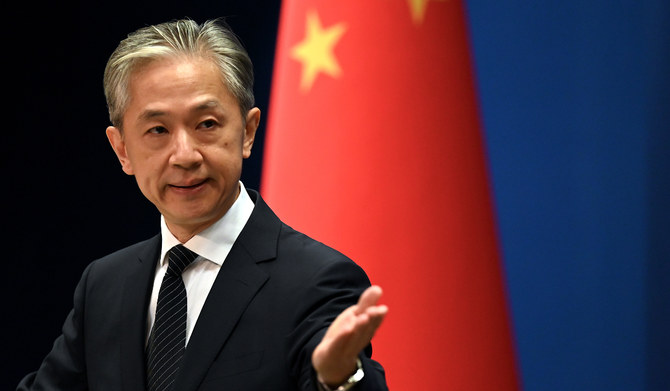
Chinese Foreign Ministry spokesman Wang Wenbin gestures during a press conference at the Ministry of Foreign Affairs in Beijing on August 8, 2022. (AFP)
Short Url
Updated 18 August 2023
Follow

China blasts US-Japan-South Korea summit, warns of ‘contradictions and increasing tensions’

BEIJING: China is renewing its criticism of this weekend’s summit among the leaders of the US, Japan and South Korea, saying no country should “seek its own security at the expense of the security interests of others and of regional peace and stability.”
“The international community has its own judgment as to who is creating contradictions and increasing tensions,” Foreign Ministry spokesperson Wang Wenbin told reporters at a daily briefing Friday.
“Attempts to form various exclusive groups and cliques and to bring bloc confrontation into the Asia-Pacific region are unpopular and will definitely spark vigilance and opposition in the countries of the region,” Wang said.
The summit at the the rustic Camp David presidential retreat seeks to further tighten security and economic ties between Japan and South Korea, two nations whose historically frosty relations have rapidly thawed over the last year as they share concerns about China’s assertiveness in the Pacific and North Korea’s persistent nuclear threats.

FASTFACT

The summit at the the rustic Camp David presidential retreat seeks to further tighten security and economic ties between Japan and South Korea.

China is extremely sensitive to any moves it perceives as seeking to contain its rise to dominance in Asia and has traditionally counted on the historical enmity between Tokyo and Seoul to keep its rivals divided and weaken the US system of regional alliances.
Beijing has made clear the current rapprochement between the two was something it very much did not want to see and its top diplomat, Wang Yi, last month made a clumsy and much-criticized appeal to racial-cultural similarities between Chinese, Japanese and Koreans as an alternative to partnering with the West.
“No matter how yellow you dye your hair, or how sharp you make your nose, you’ll never turn into a European or American, you’ll never turn into a Westerner,” said Wang, a former foreign minister who now heads the ruling Communist Party’s foreign affairs commission.
“One needs to know where one’s roots are,” Wang added.
President Joe Biden is looking to use the summit to urge South Korean President Yoon Suk Yeol and Japanese Prime Minister Fumio Kishida to firmly turn the page on their countries’ difficult shared history.
The Japan-South Korea relationship is a delicate one because of differing views of World War II history and Japan’s colonial rule over the Korean Peninsula. Past efforts to tighten security cooperation between Seoul and Tokyo have progressed by fits and starts.
Expected major announcements include plans to expand military cooperation on ballistic missile defenses and making the summit an annual event.
In the face of deteriorating ties with Washington, Seoul and Tokyo, China has grown closer to Russia, with whom it declared a “no-limits” partnership just prior to President Vladimir Putin’s full-on invasion of Ukraine last year.
Japan’s Defense Ministry on Friday said it scrambled fighter jets after spotting two Russian IL-38 reconnaissance aircraft flying back and forth over the Tsushima Strait in southwestern Japan.
A day earlier, the ministry said Japan spotted a fleet of 11 Chinese and Russian navy ships crossing waters between the southern Japanese islands of Okinawa and Miyako.
The fleet comprised six Chinese and five Russian warships, many of which had taken part in what they called a joint patrol in July when they sailed through the Soya Strait between the northern main island of Hokkaido and Sakhalin, the Japanese Defense Ministry said Thursday. The ministry views the repeated joint military activities by the two countries around Japan as aimed at demonstrating their combined threat against Japan, and expressed concern to both China and Russia, Kyodo News reported.
Asked about the activities, Wang said, “It conforms to international law and international practice for the Chinese and Russian vessels to conduct normal patrols.”
China has also sought stronger relations with developing nations in Africa and Central and South America and President Xi Jinping will be attending next week’s summit in Johannesburg of the BRICS bloc linking Brazil, Russia, India, China and South Africa.


China foreign minister blasts Middle East war, urges US to manage ties

Updated 57 min 3 sec ago
Follow

China foreign minister blasts Middle East war, urges US to manage ties

  • Wang Yi: ‘A strong fist does not mean strong reason. The world cannot return to the law of the jungle’

BEIJING: China’s top diplomat condemned on Sunday the war in the Middle East and urged the United States to iron out its differences with Beijing.
Foreign Minister Wang Yi told a press conference in the Chinese capital that the war, which was sparked by US and Israeli strikes on Iran, “should never have happened.”
“A strong fist does not mean strong reason. The world cannot return to the law of the jungle,” he told reporters.
He was speaking during China’s annual political gathering, which began this week, known as the “Two Sessions.”
The parallel meetings of China’s parliament and political consultative body are closely watched for clues as to the priorities of top leaders, in the face of a precarious geopolitical landscape
Wang addressed a range of issues, including a trade war with the United States, regional tensions in the South China Sea, as well as wars in the Middle East and Ukraine.
“This year is indeed a big year for Sino-US relations,” Wang said.
‘Manage differences’
Ties between China and the United States have been strained since US President Donald Trump returned to the White House last year, followed by a trade war that saw the two countries impose tit-for-tat tariffs on each other’s products.
“We observe certain country erecting tariff barriers and pursuing decoupling and supply chain disruption,” Wang said on Sunday.
“These actions are akin to trying to extinguish a fire with fuel. Ultimately, they will backfire and harm itself.”
While China and the United States “cannot change each other,” he said, “we can change the way we interact with each other.”
Wang urged both sides to “create a suitable environment, manage existing differences, and eliminate unnecessary interference.”
But a wide range of disagreements remain.
Beijing has blasted US and Israeli military strikes on Iran, with which it has diplomatic and trade ties.
It has in particular condemned the killing of the country’s supreme leader Ayatollah Ali Khamenei.
Wang also maintained that China’s relations with Moscow, which have been criticized by Western countries for sustaining the war in Ukraine, remained “steadfast and unshakeable.”
China ‘gym’
China has sought to profit off Trump’s volatile foreign policies, positioning itself as a reliable alternative to once traditional US allies.
Leaders from France, Canada, Finland and the United Kingdom, among others, have flocked to Beijing, recoiling from Trump’s bid to seize Greenland and tariff threats against fellow NATO members.
Wang welcomed the visits on Sunday, saying “we have noticed that more and more insightful Europeans agree that China is not a competitor, but a global partner.”
“We welcome our European friends to step out of the ‘small attic’ of protectionism and come to the ‘gym’ of the Chinese market, where they can strengthen their muscles and enhance their competitiveness,” he said.
In the spirit of warming relations, China has doled out visa-free travel agreements to around 50 countries including France, Germany, and the United Kingdom.
Beijing has also agreed to reduced tariffs with Ottawa and London in their exports to China.
Wang also addressed relations between China and Japan, which have been locked in a spat after comments by Prime Minister Sanae Takaichi in November that Tokyo could intervene militarily in any attack on self-ruled Taiwan.
Takaichi’s comments enraged Beijing, which views Taiwan as its territory and has not ruled out taking by force.
Wang emphasized on Sunday that Beijing “will never allow anyone or any force to separate Taiwan … from China once again.”
He warned Japan against “repeating the same disastrous mistakes,” adding that China “will never allow anyone to stand up for colonialism,” in an apparent reference to Tokyo’s actions during World War II.
The issue of Taiwan, he insisted, is “at the heart of China’s core interests” and “a red line that must not be crossed or trampled on.”