

China blasts US-Japan-South Korea summit, warns of ‘contradictions and increasing tensions’

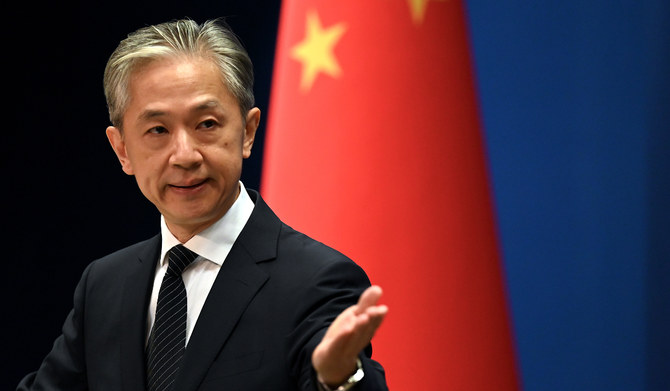
Chinese Foreign Ministry spokesman Wang Wenbin gestures during a press conference at the Ministry of Foreign Affairs in Beijing on August 8, 2022. (AFP)
Short Url
Updated 18 August 2023
Follow

China blasts US-Japan-South Korea summit, warns of ‘contradictions and increasing tensions’

BEIJING: China is renewing its criticism of this weekend’s summit among the leaders of the US, Japan and South Korea, saying no country should “seek its own security at the expense of the security interests of others and of regional peace and stability.”
“The international community has its own judgment as to who is creating contradictions and increasing tensions,” Foreign Ministry spokesperson Wang Wenbin told reporters at a daily briefing Friday.
“Attempts to form various exclusive groups and cliques and to bring bloc confrontation into the Asia-Pacific region are unpopular and will definitely spark vigilance and opposition in the countries of the region,” Wang said.
The summit at the the rustic Camp David presidential retreat seeks to further tighten security and economic ties between Japan and South Korea, two nations whose historically frosty relations have rapidly thawed over the last year as they share concerns about China’s assertiveness in the Pacific and North Korea’s persistent nuclear threats.

FASTFACT

The summit at the the rustic Camp David presidential retreat seeks to further tighten security and economic ties between Japan and South Korea.

China is extremely sensitive to any moves it perceives as seeking to contain its rise to dominance in Asia and has traditionally counted on the historical enmity between Tokyo and Seoul to keep its rivals divided and weaken the US system of regional alliances.
Beijing has made clear the current rapprochement between the two was something it very much did not want to see and its top diplomat, Wang Yi, last month made a clumsy and much-criticized appeal to racial-cultural similarities between Chinese, Japanese and Koreans as an alternative to partnering with the West.
“No matter how yellow you dye your hair, or how sharp you make your nose, you’ll never turn into a European or American, you’ll never turn into a Westerner,” said Wang, a former foreign minister who now heads the ruling Communist Party’s foreign affairs commission.
“One needs to know where one’s roots are,” Wang added.
President Joe Biden is looking to use the summit to urge South Korean President Yoon Suk Yeol and Japanese Prime Minister Fumio Kishida to firmly turn the page on their countries’ difficult shared history.
The Japan-South Korea relationship is a delicate one because of differing views of World War II history and Japan’s colonial rule over the Korean Peninsula. Past efforts to tighten security cooperation between Seoul and Tokyo have progressed by fits and starts.
Expected major announcements include plans to expand military cooperation on ballistic missile defenses and making the summit an annual event.
In the face of deteriorating ties with Washington, Seoul and Tokyo, China has grown closer to Russia, with whom it declared a “no-limits” partnership just prior to President Vladimir Putin’s full-on invasion of Ukraine last year.
Japan’s Defense Ministry on Friday said it scrambled fighter jets after spotting two Russian IL-38 reconnaissance aircraft flying back and forth over the Tsushima Strait in southwestern Japan.
A day earlier, the ministry said Japan spotted a fleet of 11 Chinese and Russian navy ships crossing waters between the southern Japanese islands of Okinawa and Miyako.
The fleet comprised six Chinese and five Russian warships, many of which had taken part in what they called a joint patrol in July when they sailed through the Soya Strait between the northern main island of Hokkaido and Sakhalin, the Japanese Defense Ministry said Thursday. The ministry views the repeated joint military activities by the two countries around Japan as aimed at demonstrating their combined threat against Japan, and expressed concern to both China and Russia, Kyodo News reported.
Asked about the activities, Wang said, “It conforms to international law and international practice for the Chinese and Russian vessels to conduct normal patrols.”
China has also sought stronger relations with developing nations in Africa and Central and South America and President Xi Jinping will be attending next week’s summit in Johannesburg of the BRICS bloc linking Brazil, Russia, India, China and South Africa.


Tarique Rahman takes oath as Bangladesh’s PM after landslide election win

Updated 5 sec ago
Follow

Tarique Rahman takes oath as Bangladesh’s PM after landslide election win

  • 49 members of new cabinet, including ministers and state ministers, have also been sworn in
  • Experts say restoring law and order will be the new government’s main immediate task

DHAKA: Bangladesh Nationalist Party Chairman Tarique Rahman took the oath as prime minister on Tuesday, days after his party secured more than a two-thirds majority in the first vote since a student-led uprising expelled former Premier Sheikh Hasina.

The son of former Prime Minister Khaleda Zia and former President Ziaur Rahman — the BNP’s founder — Rahman returned to Bangladesh in late December after nearly two decades of self-imposed exile.

He led his party to a landslide victory last week, winning an absolute majority with 209 seats in the 300-seat parliament, followed by the Jamaat-e-Islami party, which won 68 seats.

The swearing-in ceremony was held publicly for the first time, under the open sky at the south plaza of the national parliament building.

Rahman’s administration takes over from an interim government led by Nobel laureate Muhammad Yunus who during the 18 months after Hasina’s ouster in August 2024, prepared the country for reform and the next election.

One of the most immediate tasks expected of the new leadership of the country of 170 million is the restoration of law and order — an area in which the caretaker cabinet faced widespread criticism.

A crisis that swept through the police force, which was implicated in the deadly crackdown on the July to August 2024 protests, has left law enforcement significantly weakened and some of its tasks were taken over by the military.

“The law-and-order situation during the interim’s period became very volatile ... The government will have to immediately step in to stop mobocracy,” said Dr. Zahed Ur Rahman, a Dhaka-based political commentator.

“The government must think about withdrawing the military from the streets because they’ve been there for one and a half years, and the military chief repeatedly said that it is having some impact on their professionalism. The regular police should take charge fully.”

In the long-term, the new government will have to focus on reviving the economy.

Under the interim administration the country has recorded little foreign or domestic investment — a situation expected as an elected government will mean more stability to potential investors, Rahman said, warning that the process will also require better energy security.

“We do not have good energy security. Supplying energy at a cheap or affordable price will be tough because this sector suffered rampant corruption during Sheikh Hasina’s regime.

“When investment increases, energy consumption or demand increases. So, it will be a severe problem to manage the power supply,” he told Arab News.

As the BNP leader took the oath of office, he appointed 24 ministers and 25 state ministers, with former commerce minister Amir Khasru Mahmud Chowdhury taking the finance and planning portfolio, former attorney general Md. Asaduzzaman as law minister, and former state minister of power, Ikbal Hasan Mahmud Tuku, at the helm of the Ministry of Power, Energy and Mineral Resources.

The appointment of the foreign minister is still pending.

The new government’s foreign policy will have to address the influence of key players — the US, China, and India, a neighbor that was Bangladesh’s main partner during the 15-year rule of Hasina’s Awami League and with whom Dhaka has been at loggerheads since the former leader fled to New Delhi following her ouster.

Since 2024, India has suspended key transshipment access that allowed Bangladeshi exports to go via Indian ports and airports. It also put on hold most normal visa services for Bangladeshis, who were among its largest groups of medical tourists.

Bangladesh needs to revive the relationship as the “next priority” after restoring law and order, according to Mohiuddin Ahmad, a political historiographer.

“The revival of a good relationship with India will increase people-to-people contact, bilateral trade and commerce, and so on,” he said.

“The next priority should be the normalization of the relationship with India. We need such a relationship with India, which will promote all the elements of a good neighborhood.”