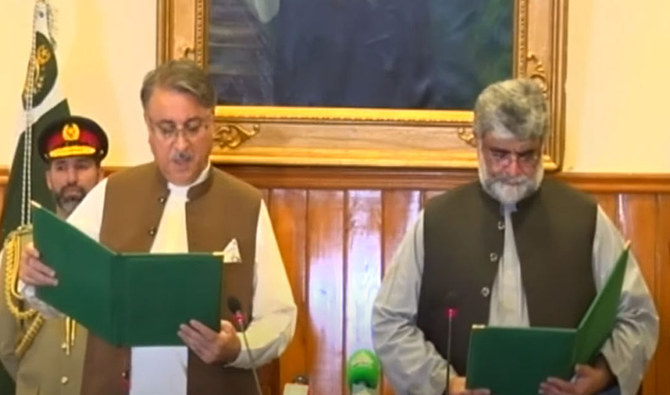

QUETTA: Pakistan’s volatile southwestern Balochistan province gained its caretaker chief minister on Friday, as Ali Mardan Khan Domki took the oath of office while expressing his resolve to ensure free and fair elections amid a peaceful security environment in the coming months.
Domki is the grandson of the late Nawab Akbar Khan Bugti, former governor of the province and tribal chieftain who was killed during a military operation under the Musharraf administration in August 2006.
His father, Mir Hazoor Baksh Khan Domki, served as a senator from 1975 to 1977. In 2013, his elder brother, Dostain Khan Domki, secured a seat in Pakistan’s national assembly and served as state minister for science and technology in the 2017 government of the Pakistan Muslim League-Nawaz (PML-N) party.
The investiture of Balochistan’s new caretaker chief minister was administered by Governor Malik Abdul Wali Khan Kakar. Previously, he held the position of district nazim for Sibi from 2005 to 2010, hailing from a prominent tribal family entrenched in the area’s history.
“Being a caretaker government, our first responsibility is to hold fair elections and maintain law and order in the province,” he said during a brief media interaction after taking oath in the provincial capital Quetta.
“Holding elections is the responsibility of the Election Commission of Pakistan,” he continued. “I am optimistic that elections will be held on time.”
Domki’s name was approved for the job by the governor of Balochistan earlier in the day after a parliamentary committee comprising his predecessor, Mir Abdul Quddus Bizenjo, and opposition members selected him as their consensus candidate after a political deadlock.
His selection for the post came only a day after Pakistan’s Caretaker Prime Minister Anwaar-ul-Haq Kakar unveiled his 23-member cabinet which took the oath at the Presidency in Islamabad Thursday evening.
Pakistan’s least developed Balochistan province borders Afghanistan to the north and Iran to the west. It also has a long coastline on the Arabian Sea.
The province is known for its vast gold and copper reserves, though it has also experienced separatist violence by the Baloch nationalist groups who accuse the country’s central government of exploiting their region’s natural resources without doing much to improve the lives of its people.
Prior to the announcement of his name as caretaker chief minister, Domki met with the PM Kakar earlier this month.
Speaking to Arab News, Irfan Saeed, a senior journalist from Balochistan, said the interim provincial administration would find it challenging to deal with the security deficit in the area.
“For the coming interim CM Ali Mardan Domki, the biggest challenge will be to hold peaceful elections, given the province’s history where political and security disturbances are not uncommon on such occasions,” he said.
However, he acknowledged that Balochistan had found a significant representation in the current interim setup wherein the prime minister and his three cabinet members belong to the same province.
“The deprived masses in the province need a strong voice at the federal level,” Saeed added. “The next elected government of the country should focus on Balochistan to end decades-long insurgency and sense of deprivation in the area.”