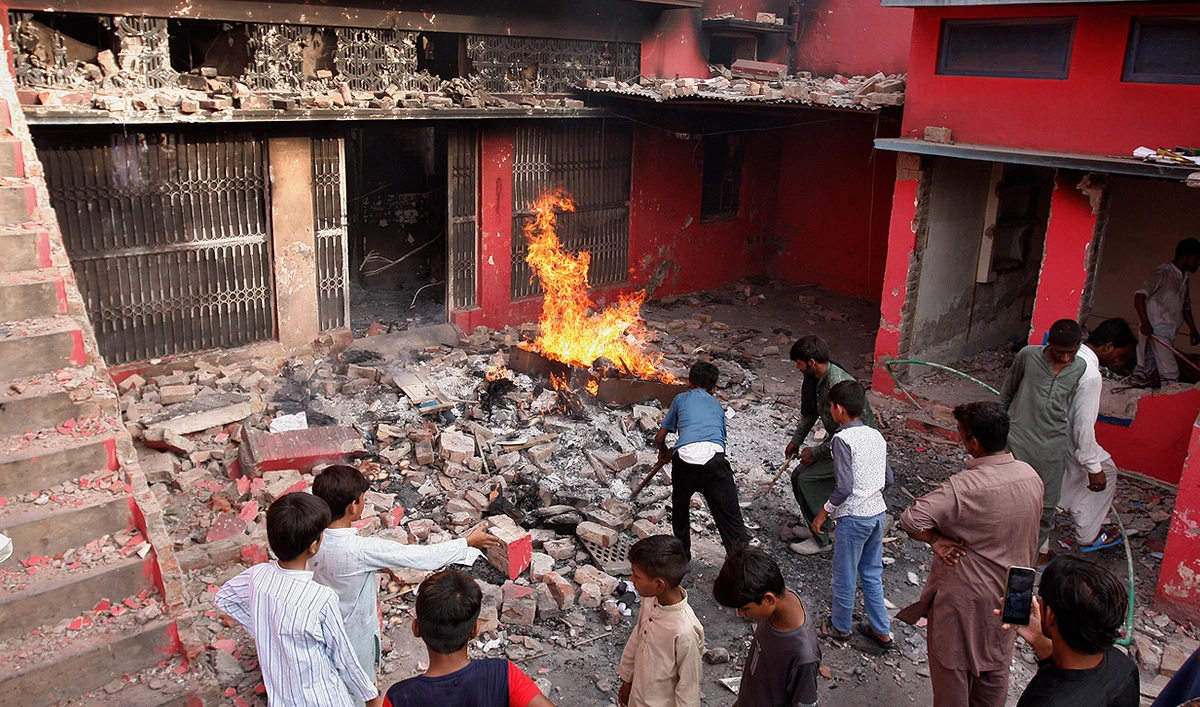
- The alleged desecration set off a violent rampage on Wednesday in Jaranwala, causing Christians to flee to safer places
- Authorities summoned soldiers to restore order, and Christian residents slowly returned home to see the destruction Thursday
JARANWALA: Police arrested 129 Muslims after a mob angered by an alleged Qur’an desecration attacked a dozen churches and nearly two dozen homes of minority Christians, officials said Thursday. Police also arrested two Christian men accused of defacing Islam’s holy book.
The alleged desecration set off a violent rampage Wednesday in Jaranwala, causing Christians to flee to safer places in the eastern city as the mob inflicted one of the country’s most destructive attacks on Christians.
The city police chief, Bilal Mehmood, said officers arrested Raja Amir and a friend who were accused by local Muslims of tearing pages from a Qur’an, writing insulting remarks on other pages and then throwing the book on the ground.
The regional police chief, Rizwan Khan, said 129 people had been arrested as suspected rioters and the situation was under control. Authorities summoned soldiers to restore order, and Christian residents slowly returned home to see the destruction Thursday.
“We were sitting at home when suddenly we heard that a mob is coming and it is burning homes and attacking churches,” Shazia Amjad said as she wept outside her charred home.
She said that the mob burned household items and furniture and that some of her possessions were stolen while she was staying with her family in a safer area.
Other Christians described similar ordeals and expressed bewilderment.
Azeem Masih wept as he sat outsisitting outside his home, which was one of several buildings burned on his street. He said some rioters brought in vehicles to haul away Christians’ household items after burning furniture and other belongings.
“Why did they do it to us? We had not done anything wrong,” he said.
Local priest Khalid Mukhtar said he believed most of Jaranwala’s 17 churches were attacked and his own home was damaged.
Government officials said all of the damaged churches and homes would be repaired within a week and those who suffered losses would be compensated.
The violence drew nationwide condemnation, and caretaker Prime Minister Anwaarul-ul-Haq Kakar ordered police to ensure rioters were arrested.
The regional police chief said the mob quickly gathered and began attacking churches and Christian homes. Rioters also assaulted the offices of a city administrator, but police intervened, shooting into the air and wielding batons to disperse the attackers with the help of Muslim clerics and elders.
Videos and photos posted on social media show a throng of angry people descending on a church, throwing pieces of bricks and setting it on fire. In another video, four other churches are attacked, their windows broken as attackers throw pieces of furniture outside and set them on fire.
In another video, a man is seen climbing to the roof of a church and removing a steel cross after repeatedly hitting it with a hammer as a crowd cheers him on.
The violence drew condemnation from domestic and international human rights groups.
Amnesty International called for the repeal of Pakistan’s blasphemy laws.
Under Pakistan’s blasphemy laws, anyone found guilty of insulting Islam or Islamic religious figures can be sentenced to death. While authorities have yet to carry out a death sentence for blasphemy, often just an accusation can incite mobs to violence, lynchings and killings.
Rights groups say blasphemy allegations have been used to intimidate religious minorities and settle personal scores.
Vedant Patel, a spokesperson for the US State Department, urged Pakistan to conduct a full investigation. “We support peaceful freedom of expression and the right to freedom of religion and belief for everybody,” he said in Washington on Wednesday.