British-led coalition to provide Ukraine with anti-drone systems

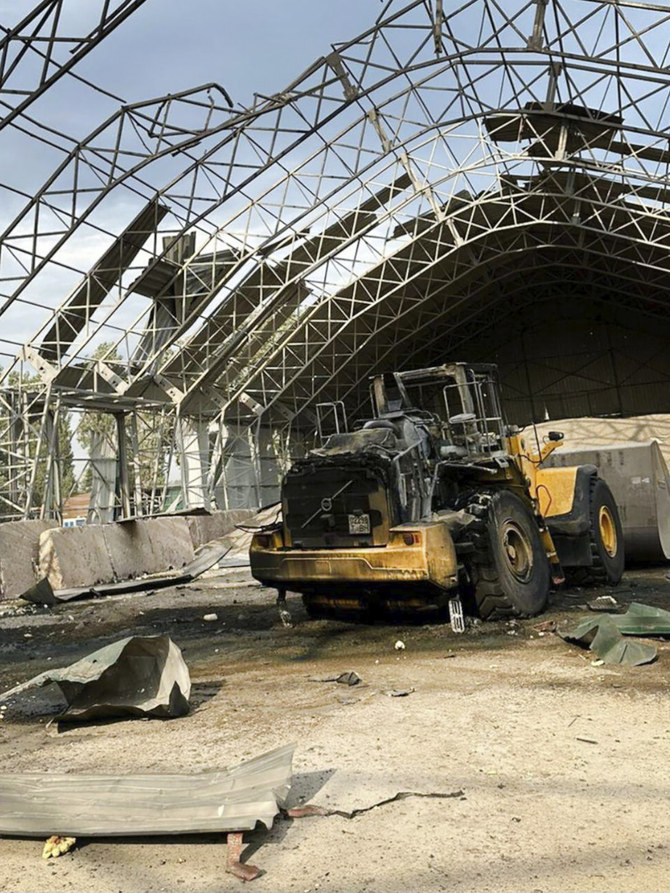
A granary destroyed in a Russian drone attack at night is seen in a Danube port near Odesa, Ukraine, on Aug. 16, 2023. (Odesa Regional Administration Press Office via AP)
Short Url
Updated 18 August 2023
Follow

British-led coalition to provide Ukraine with anti-drone systems

LONDON: A British-led group of European countries said on Friday it would provide about 90 million pounds ($115 million) of air defense equipment to help Ukraine defend itself against Russian attacks.

This includes a 56-million-pound contract with the Norwegian defense company Kongsberg to provide vehicle-mounted Cortex Typhon systems, which are used to detect and destroy drones.

“These air defense systems have the capability and flexibility to be rapidly deployed to either protect Ukraine’s civilian population and infrastructure, or be put to use on the frontline,” said Britain’s defense minister Ben Wallace.
The International Fund for Ukraine — a group of countries including Britain, Norway, the Netherlands, Denmark and Sweden — has also agreed two other contracts for air defense equipment, which will be revealed at a later date.
Both Ukraine and Russia have stepped up attacks on each other’s troops recently as Ukraine seeks to dislodge Russian forces that have dug in across southern and eastern Ukraine since their invasion last year.
Odesa, Ukraine’s largest port and naval base, has been repeatedly attacked with missiles and drones after Russia pulled out of an agreement allowing grain shipments from Ukraine’s ports in July.


Bangladesh’s religio-political party open to unity govt

Updated 01 January 2026
Follow

Bangladesh’s religio-political party open to unity govt

  • Opinion polls suggest that Jamaat-e-Islami will finish a close second to the Bangladesh Nationalist Party in the first election it has contested in nearly 17 years

DHAKA: A once-banned Bangladeshi religio-political party, poised for its strongest electoral showing in February’s parliamentary vote, is open to joining a unity government and has held talks with several parties, its chief said.

Opinion polls suggest that Jamaat-e-Islami will finish a close second to the Bangladesh Nationalist Party in the first election it has contested in nearly 17 years as it marks a return to mainstream politics in the predominantly Muslim nation of 175 million.

Jamaat last held power between 2001 and 2006 as a junior coalition partner with the BNP and is open to working with it again.

“We want to see a stable nation for at least five years. If the parties come together, we’ll run the government together,” Jamaat chief Shafiqur Rahman said in an interview at his office in a residential area in Dhaka, ‌days after the ‌party created a buzz by securing a tie-up with a Gen-Z party.

Rahman said anti-corruption must be a shared agenda for any unity government.

The prime minister will come from the party winning the most seats in the Feb. 12 election, he added. If Jamaat wins the most seats, the party will decide whether he himself would be a candidate, Rahman said.

The party’s resurgence follows the ousting of long-time Prime Minister Sheikh Hasina in a youth-led uprising in August 2024. 

Rahman said Hasina’s continued stay in India after fleeing Dhaka was a concern, as ties between the two countries have hit their lowest point in decades since her downfall.

Asked about Jamaat’s historical closeness to Pakistan, Rahman said: “We maintain relations in a balanced way with all.”

He said any government that includes Jamaat would “not feel comfortable” with President Mohammed Shahabuddin, who was elected unopposed with the Awami League’s backing in 2023.