

Heavy rain and landslides have killed at least 72 people this week in an Indian Himalayan state

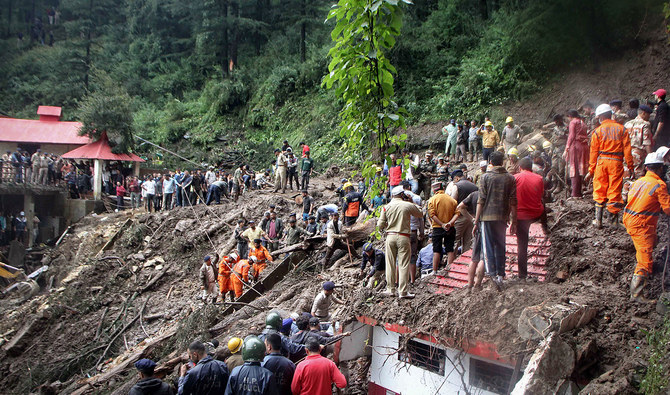
National Disaster Response Force (NDRF) personnel search for victims at the site of a landslide after a temple collapsed due to heavy rains in Shimla on August 14, 2023. (AFP)
Short Url
Updated 17 August 2023
Follow

Heavy rain and landslides have killed at least 72 people this week in an Indian Himalayan state

  • Rescuers in mountainous Himachal Pradesh state work through tough weather conditions
  • Last month, record monsoon showers killed over 100 people in two weeks in northern India

NEW DELHI: Days of relentless rain in India’s Himalayan region have killed at least 72 people this week, a government official said Thursday, as a heavy monsoon triggered landslides and flash floods that have submerged roads, washed away buildings and left residents scrambling for safety.

Rescuers in the mountainous Himachal Pradesh state have been working through challenging weather conditions to save people trapped under mud and debris from the rains that struck over the weekend. India’s weather department has put the state on high alert and expects the downpours to continue over the next few days.

Vikram Singh, an operator at the state’s emergency operation center, said on Thursday that the 72 deaths occurred over the previous five days and that rescue work was ongoing.

Hundreds of roads remain blocked and schools in the capital city of Shimla have been ordered shut as the Indian Air Force and disaster response teams help evacuate people from low-lying, vulnerable areas. The state’s chief minister, Sukhvinder Singh Sukhu, said over 2,000 people have been rescued using helicopters and motor boats and are now safe in relief camps.

Visuals on social media showed trees falling apart as homes, built atop the hills, collapsed in succession. In the background, people can be heard crying out in horror, as they shouted “get out from here” and “get back.”

In Shimla, a Hindu temple collapsed on Monday amid deadly landslides, and authorities feared that people are still buried under the debris. Authorities said the temple was crowded with devotees, raising fears that the death toll could rise as rescue work carries on.

Homes in some districts were also washed away after a cloudburst — a sudden, very heavy rain — Sunday night, leaving roads flooded and people stranded.

Cloudbursts are defined as when more than 10 centimeters (3.9 inches) of rainfall occurs within 10 square kilometers (3.8 square miles) within an hour. They are a common occurrence in Himalayan regions, where they have the potential to cause intense flooding and landslides affecting thousands of people.

Sukhu, the chief minister, told the Press Trust of India news agency that it will take a year to rebuild infrastructure destroyed by the rains of this monsoon, and claimed the estimated loss to be about 100 billion rupees ($1.2 billion). “It's a big challenge, a mountain-like challenge,” he said.

Last month, record monsoon showers killed more than 100 people over two weeks in parts of northern India, including in Himachal Pradesh, which was the worst hit.

Disasters caused by landslides and floods are common in India’s Himalayan north during the June-September monsoon season. Scientists say they are becoming more frequent as global warming increases.

However, local experts say the current disaster is likely due to unplanned construction in this vulnerable region. “It is poor planning and governance that has led to this much damage,” said Anand Sharma, a retired meteorologist with the Indian Meteorological Department, the country’s weather agency.

Sharma is from the Himalayan region and has closely observed weather patterns in this region for over three decades. He said the heavy and sometimes extreme rains is expected in the Himalayan foothills during the monsoon season.

“All the fallen buildings are those that were constructed recently, buildings built a 100 years ago have witnessed little to no damage," he said, adding that growing tourism to the region is another factor.

“They build anywhere they like and when heavy rains occur, such disasters inevitably follow," Sharma said.


Lawsuit challenges Trump administration’s ending of protections for Somalis

Updated 10 March 2026
Follow

Lawsuit challenges Trump administration’s ending of protections for Somalis

  • The lawsuit cites a series of statements Trump has made describing Somalis as “garbage” and “low IQ people” who “contribute nothing.”

BOSTON: Immigrant rights advocates filed a lawsuit on Monday seeking to stop US President Donald Trump’s administration from next ​week ending legal protections that allow nearly 1,100 Somalis to live and work in the United States. The lawsuit, brought by four Somalis and two advocacy groups, challenges the US Department of Homeland Security’s decision to end Temporary Protected Status for Somali immigrants, whom Trump has derided in public remarks. Outgoing Homeland Security Secretary Kristi Noem in January announced that TPS for Somalis would end on March 17, arguing that Somalia’s conditions had improved, despite fighting continuing between Somali forces and Al-Shabab militants. The plaintiffs, who ‌include the groups ‌African Communities Together and Partnership for the Advancement ​of ‌New ⁠Americans, in the ​lawsuit filed ⁠in Boston federal court argue the move was procedurally flawed and driven by a discriminatory, predetermined agenda.
The lawsuit cites a series of statements Trump has made describing Somalis as “garbage” and “low IQ people” who “contribute nothing.”
The plaintiffs said the administration is ending TPS for Somalia and other countries due to unconstitutional bias against non-white immigrants, not based on objective assessments of country conditions.
“The termination of TPS for Somalia is racism masking as immigration policy,” ⁠Omar Farah, executive director at the legal group Muslim Advocates, said ‌in a statement.
DHS did not respond to ‌a request for comment. It has previously said TPS ​was “never intended to be a de ‌facto amnesty program.”
TPS is a form of humanitarian immigration protection that shields eligible migrants ‌from deportation and allows them to work. Under Noem, DHS has moved to end TPS for a dozen countries, sparking legal challenges. The administration on Saturday announced plans to pursue an appeal at the US Supreme Court in order to end TPS for over 350,000 Haitians. It ‌also wants the high court to allow it to end TPS for about 6,000 Syrians.

SOMALI COMMUNITY TARGETED
Somalia was first designated ⁠for TPS in ⁠1991, with its latest extension in 2024. About 1,082 Somalis currently hold TPS, and 1,383 more have pending applications, according to DHS. Somalis in Minnesota in recent months had become a target of Trump’s immigration crackdown, with officials pointing to a fraud scandal in which many people charged come from the state’s large Somali community. The Trump administration cited those fraud allegations as a basis for a months-long immigration enforcement surge in Democratic-led Minnesota, during which about 3,000 immigration agents were deployed, spurring protests and leading to the killing of two US citizens by federal agents.
In November, Trump announced he would end TPS for Somalis in Minnesota, and a month later said ​he wanted them sent “back to where they ​came from.”
The US Department of State advises against traveling to Somalia, citing crime and civil unrest among numerous factors.