Fuel price protests erupt in Syrian Druze city

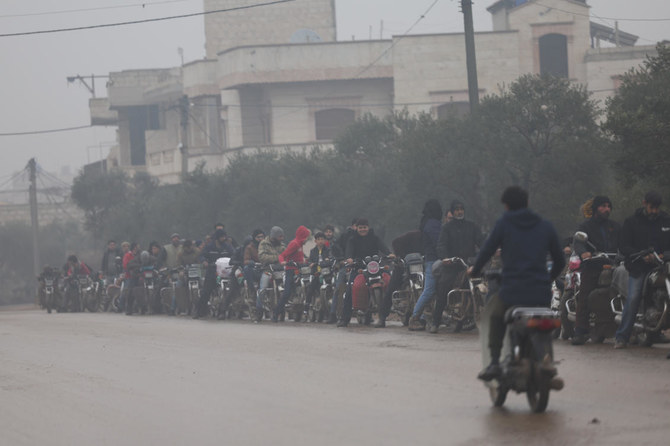
People queue up for gasoline in Syria. (File/AP)
Short Url
Updated 17 August 2023
Follow

Fuel price protests erupt in Syrian Druze city

  • Demonstrators complain of economic hardships
  • City of mainly ethnic Druze residents had been spared unrest
  • Currency hits new record low after latest price hikes

JEDDAH: Protests erupted on Thursday in the ethnic Druze city of Sweida in southwest Syria against economic collapse and a controversial increase in fuel prices

Hundreds of demonstrators burned tyres, blocked roads and chanted anti-government slogans calling for the overthrow of President Bashar Assad in a rare outbreak of dissent.

“Long live Syria and down with Assad,” protesters chanted near police headquarters and the governor’s office as nearby security forces avoided confrontation.
“This is close to an uprising as people express their deep anger with the decisions of the Syrian regime and the gasoline price hikes,” said civic activist Ryan Marouf. “They are demanding a life of dignity.”
The value of Syria’s currency has plunged from 47 pounds to the dollar at the start of the conflict in 2011 to a record 15,500 on Wednesday. The government says cuts in a once lavish subsidy program affect only the wealthiest, but protesters say they have worsened the plight of ordinary Syrians who are struggling to afford food and basic necessities amid rampant inflation and eroding incomes.
There have been several minor protests in the past month over plunging incomes in coastal areas that are the stronghold of the Assad regime, and taxi and bus drivers in Damascus staged a second day of partial stoppages on Thursday.


Syria announces new currency framework, 2-zero redenomination

Updated 15 sec ago
Follow

Syria announces new currency framework, 2-zero redenomination

  • Under the plan, every 100 Syrian pounds will be converted into one unit of the new Syrian Arab Republic’s pound
  • Governor calls move ‘pivotal milestone within a comprehensive strategy’

DAMASCUS: Syria’s Central Bank announced executive instructions on Sunday to introduce a new Syrian currency, launching a monetary reform that includes removing two zeros from the pound and allowing a 90-day period of dual circulation.

The announcement was made during a press conference at the bank’s headquarters in Damascus.

Central Bank Gov. Abdulkader Husrieh said the step was part of a comprehensive institutional strategy to restore confidence and achieve sustainable economic stability.

He said: “The launch of the new currency is not a formal measure, but a pivotal milestone within a comprehensive strategy based on solid institutional foundations.”

Under the plan, every 100 Syrian pounds will be converted into one unit of the new Syrian Arab Republic’s pound. The old and new currencies will circulate together for 90 days, a period which may be extended.

All bank balances will be converted to the new currency at the beginning of next year, while the overall money supply will be maintained without increase or reduction.

Husrieh said the economic strategy was based on five pillars: monetary stability, a stable and transparent foreign-exchange market, effective and accountable financial institutions, secure digital transformation, and balanced international economic relations.

He said the move required updating financial laws and regulations, improving data systems, keeping pace with global digital developments, and ensuring sustainable financing and training for the financial sector.

The currency exchange will be provided free of charge, with no commissions, fees, or taxes.

All public and private entities must apply the official conversion standard to prices, salaries, wages, and financial obligations. Official exchange-rate bulletins will be issued in both currencies to ensure transparency and prevent speculation.

The governor said the central bank was closely monitoring markets to stabilize the exchange rate and would supply Syrian pounds if demand for foreign currency rises, adding that citizens will feel the impact more clearly after the exchange process is completed.

“Our policy is financial discipline, with no room for inflation,” Husrieh added.

He confirmed that the decree regulating the exchange limits the process to Syrian territory, and said the measures fell within the bank’s 2026-2030 strategy to align with international standards.

The new banknotes, he added, were being printed by leading international companies to prevent counterfeiting.