Sweden heightens terror alert after Qur’an burnings

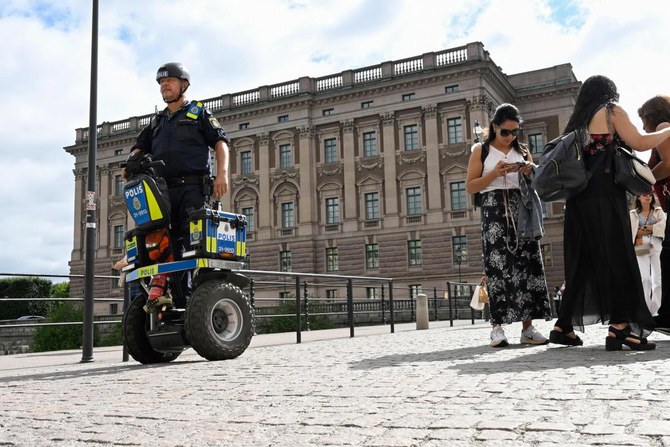
A police officer on a Segway patrols at Sweden’s parliament Riksdagen as the terror threat level in Sweden was raised to four on a five-point scale on Aug. 17, 2023. (AFP)
Short Url
Updated 17 August 2023
Follow

Sweden heightens terror alert after Qur’an burnings

  • Level was increased from ‘elevated threat,’ where it had been since 2016, to ‘high threat’

STOCKHOLM: Sweden’s intelligence agency heightened its terror alert level Thursday to four on a scale of five after angry reactions in the Muslim world to Qur'an burnings in Sweden made the country a “prioritized target.”
The level was increased from “elevated,” where it had been since 2016, to “high,” the head of the Swedish Security Police Charlotte von Essen told reporters.
“The reason for this decision is the deteriorated situation with regard to attack threats to Sweden, and the assessment that the threat will remain for a long time,” she said.
Von Essen stressed that the decision to raise the threat level was not based on a “single incident,” but rather a “collective assessment.”
Sweden has, like neighboring Denmark, has in recent months seen a spate of public desecrations of the Qur'an, including burnings, which have sparked widespread outrage and condemnation in Muslim countries.
Iraqi protesters stormed the Swedish embassy in Baghdad twice in July, starting fires within the compound on the second occasion.
The Jeddah-based Organization of Islamic Cooperation has also voiced “disappointment” with Sweden and Denmark for not taking action following the spate of burnings.
Last week, a Molotov cocktail was thrown at the Swedish embassy in Beirut though it did not explode, and at the weekend Al-Qaeda called for attacks against the Scandinavian country.
The protests led Sweden to beef up border controls since August 1.
Several Western countries have recently updated their travel adviseries for Sweden.
The United States on July 26 urged its nationals to “exercise increased caution in Sweden due to terrorism.”
And on Sunday, Britain’s Foreign Office said “terrorists are very likely to try and carry out attacks in Sweden,” and added “authorities in Sweden have successfully disrupted a number of planned attacks and made a number of arrests.”
Swedish authorities have however refused to comment on whether any attacks had been foiled or arrests made.
The country has condemned the desecrations of the Qur'an but upheld its laws regarding freedom of speech and assembly.
The government has vowed to explore legal means of stopping protests involving the burning of holy texts in certain circumstances, though a majority appear to be opposed to a such a change.


Ethiopia’s prime minister accuses Eritrea of mass killings during Tigray war

Updated 6 sec ago
Follow

Ethiopia’s prime minister accuses Eritrea of mass killings during Tigray war

  • Landlocked Ethiopia says that Eritrea is arming rebel groups, while Eritrea says Ethiopia’s aspiration is to gain access to a seaport
  • Ethiopia lost sovereign access to the Red Sea when Eritrea seceded in 1993 after decades of guerrilla warfare

ADDIS ABABA: Ethiopia’s government Tuesday for the first time acknowledged the involvement of troops from neighboring Eritrea in the war in the Tigray region that ended in 2022, accusing them of mass killings, amid reports of renewed fighting in the region.
Ethiopian Prime Minister Abiy Ahmed, while addressing parliament Tuesday, accused Eritrean troops fighting alongside Ethiopian forces of mass killings in the war, during which more than 400,000 people are estimated to have died.
Eritrean and Ethiopian troops fought against regional forces in the northern Tigray region in a war that ended in 2022 with the signing of a peace agreement.
Eritrea’s Information Minister Yemane Gebremeskel told The Associated Press that Ahmed’s comments were “cheap and despicable lies” and did not merit a response.
Both nations have been accusing each other of provoking a potential civil war, with landlocked Ethiopia saying that Eritrea is arming and funding rebel groups, while Eritrea says Ethiopia’s aspiration is to gain access to a seaport.
“The rift did not begin with the Red Sea issue, as many people think,” Ahmed told parliamentarians. “It started in the first round of the war in Tigray, when the Eritrean army followed us into Shire and began demolishing houses, massacred our youth in Axum, looted factories in Adwa, and uprooted our factories.”
“The Red Sea and Ethiopia cannot remain separated forever,” he added.
Ethiopia lost sovereign access to the Red Sea when Eritrea seceded in 1993 after decades of guerrilla warfare.
Gebremeskel said the prime minister has only recently changed his tune in his push for access to the Red Sea.
Ahmed “and his top military brass were profusely showering praises and State Medals on the Eritrea army and its senior officers. … But when he later developed the delusional malaise of ‘sovereignty access to the sea’ and an agenda of war against Eritrea, he began to sing to a different chorus,” he said.
Eritrea and Ethiopia initially made peace after Abiy came to power in 2018, with Abiy winning a Nobel Peace Prize for his efforts toward reconciliation.
In June, Eritrea accused Ethiopia of having a “long-brewing war agenda” aimed at seizing its Red Sea ports. Ethiopia recently said that Eritrea was “actively preparing to wage war against it.”
Analysts say an alliance between Eritrea and regional forces in the troubled Tigray region may be forming, as fighting has been reported in recent weeks. Flights by the national carrier to the region were canceled last week over the renewed clashes.