

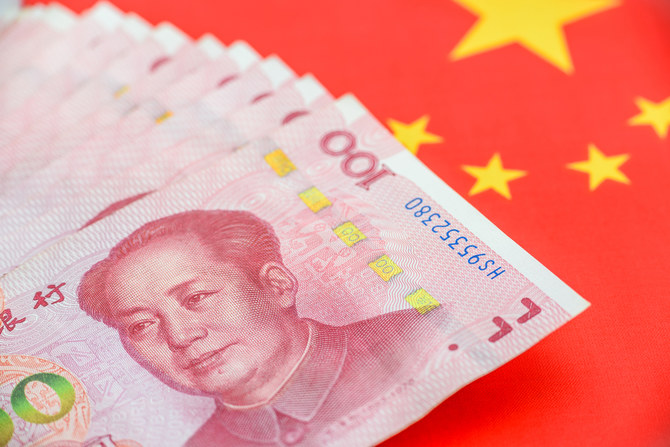

SHANGHAI: China’s yuan fell to over nine-month lows against the dollar on Thursday, as widening yield differentials with the US and expectations of more policy easing by Beijing eclipsed a firmer-than-expected guidance fix and state bank support.
The dollar rose broadly against a basket of currencies thanks to a resilient US economy which firmed bets for US interest rates to stay higher for longer. That contrasted with expectations for further monetary easing in China to prop up a faltering economic recovery, driving yield differentials between the world’s two largest economies to the widest level in 16 years and pressuring the yuan.
Prior to market opening, the People’s Bank of China set the midpoint rate, around which the yuan is allowed to trade in a 2 percent band, at 7.2076 per dollar prior to market opening, 90 pips weaker than the previous fix of 7.1986 and the weakest since July 6.
However, the fixing was still much stronger than market projections — about 971 pips firmer than Reuters' estimate of 7.3047.
Maybank analysts said the stronger-than-expected fixing showed the central bank’s continued efforts to ensure the yuan doesn’t fall too low versus the dollar. “That said, CFETS yuan index has started to soften and that could help to support exports and this is much needed given the fact that domestic demand could probably take a while to recover,” they said in a note.
The CFETS yuan basket index, a gauge that measures yuan’s value against its major trading partners, fell to 97.33 on Thursday, according to Reuters calculations based on official data. The index, the lowest since Aug. 8, and has lost 1.36 percent year-to-date.
In the spot market, the onshore yuan opened at 7.3101 per dollar and weakened to a low of 7.3174, the softest level since Nov. 3, 2022. By midday, it was changing hands at 7.3149, 159 pips weaker than the previous late session close.
Its offshore counterpart followed the weakening trend to an over nine-month low of 7.3490. It lasted at 7.3381 per dollar around midday. To prevent the yuan from sinking too fast, sources told Reuters that China’s major state-owned banks were seen busy selling dollars to buy yuan in both onshore and offshore spot foreign exchange markets.
State banks often act on behalf of China’s central bank in the country’s foreign exchange market, but they could also trade on their own behalf or execute their clients’ orders. Offshore branches of the state banks were seen selling dollars during London and New York trading hours this week, sources said.


