

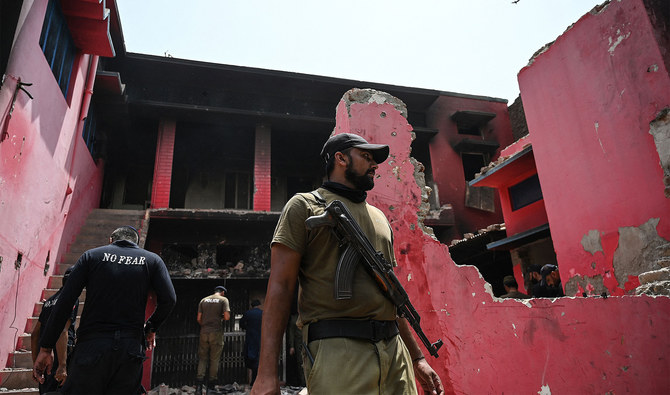
Troops deployed to guard Pakistani Christians after churches torched over Qur’an desecration accusation

Police officials inspect a burnt Salvation Army church in Jaranwala on the outskirts of Faisalabad, Pakistan, on August 17, 2023, a day after an attack by Muslim men following spread allegations that Christians had desecrated the Qur'an (Photo courtesy: AFP)
Short Url
Updated 17 August 2023
Follow

Troops deployed to guard Pakistani Christians after churches torched over Qur’an desecration accusation

  • Attack took place in Jaranwala city and continued for more than 10 hours without any intervention by police
  • Over 100 people suspected of being involved in rioting have been arrested, a government statement said

LAHORE: Paramilitary troops have cordoned off a Christian settlement in eastern Pakistan where a Muslim mob vandalized and torched several churches and scores of houses after accusing two of its residents of desecrating the Qur’an, police and witnesses said on Thursday.

The attack took place in Jaranwala in the industrial district of Faisalabad on Wednesday, and continued for more than 10 hours without any intervention by police who were at the scene, residents and community leaders said. Police denied the accusation, saying security forces had prevented an even worse situation.

The rioters were demanding that the two accused, who had fled their homes, be handed over to them.

The residents said thousands of Muslims led by local clerics were carrying iron rods, sticks, knives and daggers during the rioting.

A provincial government statement said paramilitary troops were deployed to aid the police to control the situation.


A Christian woman and a boy weep after seeing their homes vandalized by an angry Muslim mob in Jaranwala near Faisalabad, Pakistan, on August 17, 2023. (Photo courtesy: AP)

The troops have cordoned off the Christian colony, blocking all entry and exit points with barbed wire, according to a Reuters TV cameraman.

Over 100 people suspected of being involved in the rioting have been arrested, the government statement said, adding that an inquiry has also been ordered into the incident.

Blasphemy is punishable by death in Pakistan and although no one has ever been executed for it, many accused people have been lynched by outraged crowds. A former provincial governor and a minister for minorities have also been shot dead because of blasphemy accusations.

Rights groups say accusations of blasphemy are sometimes used to settle scores. Hundreds of people are languishing in prison after being accused of the crime because judges often put off trials, fearing retribution if they are seen as being too lenient, they say.

The United States was “deeply concerned that churches and homes were targeted,” State Department Deputy Spokesperson Vedant Patel said on Wednesday.


Pakistan PM orders accelerated privatization of power sector to tackle losses

Updated 15 December 2025
Follow

Pakistan PM orders accelerated privatization of power sector to tackle losses

  • Tenders to be issued for privatization of three major electricity distribution firms, PMO says
  • Sharif says Pakistan to develop battery energy storage through public-private partnerships

ISLAMABAD: Pakistan’s prime minister on Monday directed the government to speed up privatization of state-owned power companies and improve electricity infrastructure nationwide, as authorities try to address deep-rooted losses and inefficiencies in the energy sector that have weighed on the economy and public finances.

Pakistan’s electricity system has long struggled with financial distress caused by a combination of factors including theft of power, inefficient collection of bills, high costs of generating electricity and a large burden of unpaid obligations known as “circular debt.” In the first quarter of the current financial year, government-owned distribution companies recorded losses of about Rs171 billion ($611 million) due to poor bill recovery and operational inefficiencies, official documents show. Circular debt in the broader power sector stood at around Rs1.66 trillion ($5.9 billion) in mid-2025, a sharp decline from past peaks but still a major fiscal drain. 

Efforts to contain these losses have been a focus of Pakistan’s economic reform program with the International Monetary Fund, which has urged structural changes in the energy sector as part of financing conditions. Previous government initiatives have included signing a $4.5 billion financing facility with local banks to ease power sector debt and reducing retail electricity tariffs to support economic recovery. 

“Electricity sector privatization and market-based competition is the sustainable solution to the country’s energy problems,” Prime Minister Shehbaz Sharif said at a meeting reviewing the roadmap for power sector reforms, according to a statement from the prime minister’s office.

The meeting reviewed progress on privatization and infrastructure projects. Officials said tenders for modernizing one of Pakistan’s oldest operational hubs, Rohri Railway Station, will be issued soon and that the Ghazi Barotha to Faisalabad transmission line, designed to improve long-distance transmission of electricity, is in the initial approval stages. While not all power-sector decisions were detailed publicly, the government emphasized expanding private sector participation and completing priority projects to strengthen the electricity grid.

In another key development, the prime minister endorsed plans to begin work on a battery energy storage system with participation from private investors to help manage fluctuations in supply and demand, particularly as renewable energy sources such as solar and wind take a growing role in generation. Officials said the concept clearance for the storage system has been approved and feasibility studies are underway.

Government briefing documents also outlined steps toward shifting some electricity plants from imported coal to locally mined Thar coal, where a railway line expansion is underway to support transport of fuel, potentially lowering costs and import dependence in the long term.

State authorities also pledged to address safety by converting unmanned railway crossings to staffed ones and to strengthen food safety inspections at stations, underscoring broader infrastructure and service improvements connected to energy and transport priorities.